


Contents:
What is a black swan in economics?
In economics, a black swan is a rare event that falls outside familiar expectations and changes the landscape: prices, demand, access to resources, the rules of the game, or people's behavior. What matters is not how dramatic the headline sounds. The event lies outside the range that people included in their calculations.
In management terms, familiar probabilities stop being useful. You may keep a careful budget, manage deadlines, measure margins, and compare plans with actual results, yet still face a scenario that your model did not anticipate.
Which book popularized the term “black swan”?
Nassim Nicholas Taleb, a researcher of risk and probability, former derivatives trader, and author on uncertainty, popularized “black swan” in its modern economic sense. He also worked for many years at NYU Tandon School of Engineering as a professor of risk engineering.
The key book is The Black Swan: The Impact of the Highly Improbable. Its first edition appeared on April 17, 2007; an expanded second edition followed in 2010.

In Russian, the book is often published under a title that translates as “The Black Swan: Under the Sign of Unpredictability.”
Taleb's three characteristics of a black swan
For Taleb, a black swan is more than a rare occurrence. All three characteristics matter:
- Outlier: it lies outside the normal range of expectations, and past experience offers no reliable sign that it will happen.
- Major impact: its consequences reach beyond a local disruption. Markets, supply chains, customer behavior, resource costs, and access to financing may change.
- Explanation after the fact: once it happens, people often construct a neat story about why it had to happen. That story creates an illusion of control, even though there was no clear forecast beforehand.
The third characteristic is especially misleading for managers. Once an explanation makes everything seem obvious, it is tempting to rewrite the past instead of strengthening the system for the future.
Why black swans defeat forecasts and models
Economics relies on numbers, charts, probability distributions, and tidy averages. In practice, rare events can cause the biggest changes: they occur infrequently but alter many conditions at once. A model trained on quiet periods may fail just when accuracy matters most.
Taleb argues that we overestimate our ability to predict the future because our minds prefer coherent stories. In business, analysis can become a persuasive narrative that the team treats as a reliable plan, until reality follows different rules.
The practical lesson is to build defenses against scenarios that could cause large losses, instead of trying to guess the date of the next crisis.
How can a business prepare for black swans?
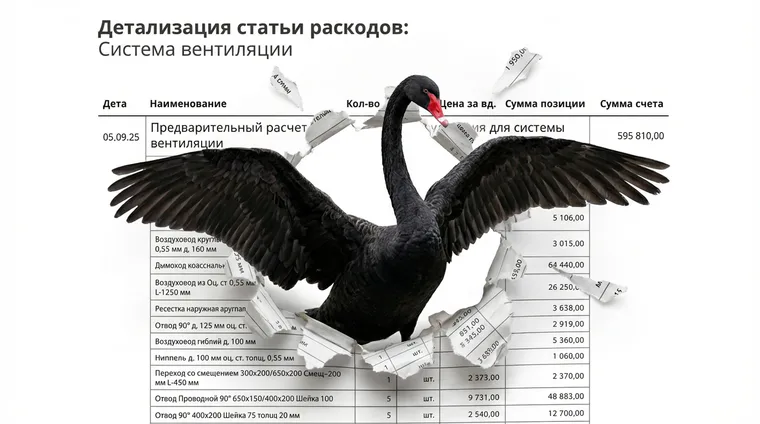
You cannot put an unpredictable black swan on a calendar. You can, however, prepare a system that handles a shock without immediate chaos in finances and management.
The following approach suits project businesses such as construction, renovation, design, and custom manufacturing, where money and deadlines depend on many outside factors:
- Step 1. Track money by project. If one project quietly finances another, an external shock becomes an internal cash problem: the account is empty even though revenue exists somewhere on paper.
- Step 2. Turn business events into measurable indicators: budget versus actual spending by category, receivables, a payment schedule, mandatory expenses, and a liquidity buffer. An indicator that you cannot review regularly is difficult to manage.
- Step 3. Build reserve funds. They can cover emergencies as well as planned options for development, such as training, equipment purchases, and specialized software.
- Step 4. Revisit the project plan and priorities whenever new constraints emerge. Short review cycles help you notice deviations sooner and agree on changes.
A black swan rarely destroys a company with a single blow. More often, records become unreliable, decisions are delayed, agreements drift, and a cash shortfall follows.