Negative feedback reaches every service business: in a review, in messages to a manager, or when completed work is inspected. A common mistake is to respond according to your mood. The same conflict then keeps recurring, the team burns out, and your reputation suffers.
Handling negative feedback involves more than a well-worded reply. It is a process: acknowledge the issue promptly, break it down into facts, propose a solution, record the agreement, and update your procedures.
Below are 7 tips to keep conversations on track and learn something useful even from strongly worded complaints. Some examples involve construction and renovation, where the cost of mistakes becomes apparent sooner.
Contents:
- Tip 1. Map your feedback channels and assign responsibility
- Tip 2. Respond promptly and set clear deadlines
- Tip 3. Separate emotions from the substance of the complaint
- Tip 4. Turn negative feedback into facts: documents, photos, and a timeline
- Tip 5. Offer 2–3 solutions and agree on the next step
- Tip 6. Close the case publicly if the complaint was public
- Tip 7. Analyze negative feedback and update your procedures
Tip 1. Map your feedback channels and assign responsibility
Negative feedback rarely stays in one place. A customer messages the site supervisor, leaves a 1-star review on a review platform, and sends a couple more messages directly to the business owner. If the team responds without coordination, the result is a chorus of excuses.
Map your channels and establish one simple rule: every channel has a person responsible for it and a response timeframe. Internally, this works as a single point of contact, much like handling sales leads: when inquiries go unrecorded, the business loses money and control.
It helps to decide at the outset who handles which situations. A manager answers questions about schedules and what is included. The project manager gets involved in quality complaints. The owner steps in when there is a risk of contract termination or a public scandal.
Tip 2. Respond promptly and set clear deadlines
People need to see that they have been heard. Even when a solution takes time, you can respond promptly: acknowledge receipt, explain your plan, and say when you will next be in touch.
The response formula is simple: “I have received your message → I am checking the details → I will get back to you with a solution at …”. Set a short, realistic timeframe. If you miss your promise, you create a second reason for frustration.
Response speed matters especially in long projects such as renovation, construction, or custom manufacturing: without facts, customers start filling in the gaps themselves. Transparency helps here: reports, regular photos, and project checkpoints.
Tip 3. Separate emotions from the substance of the complaint
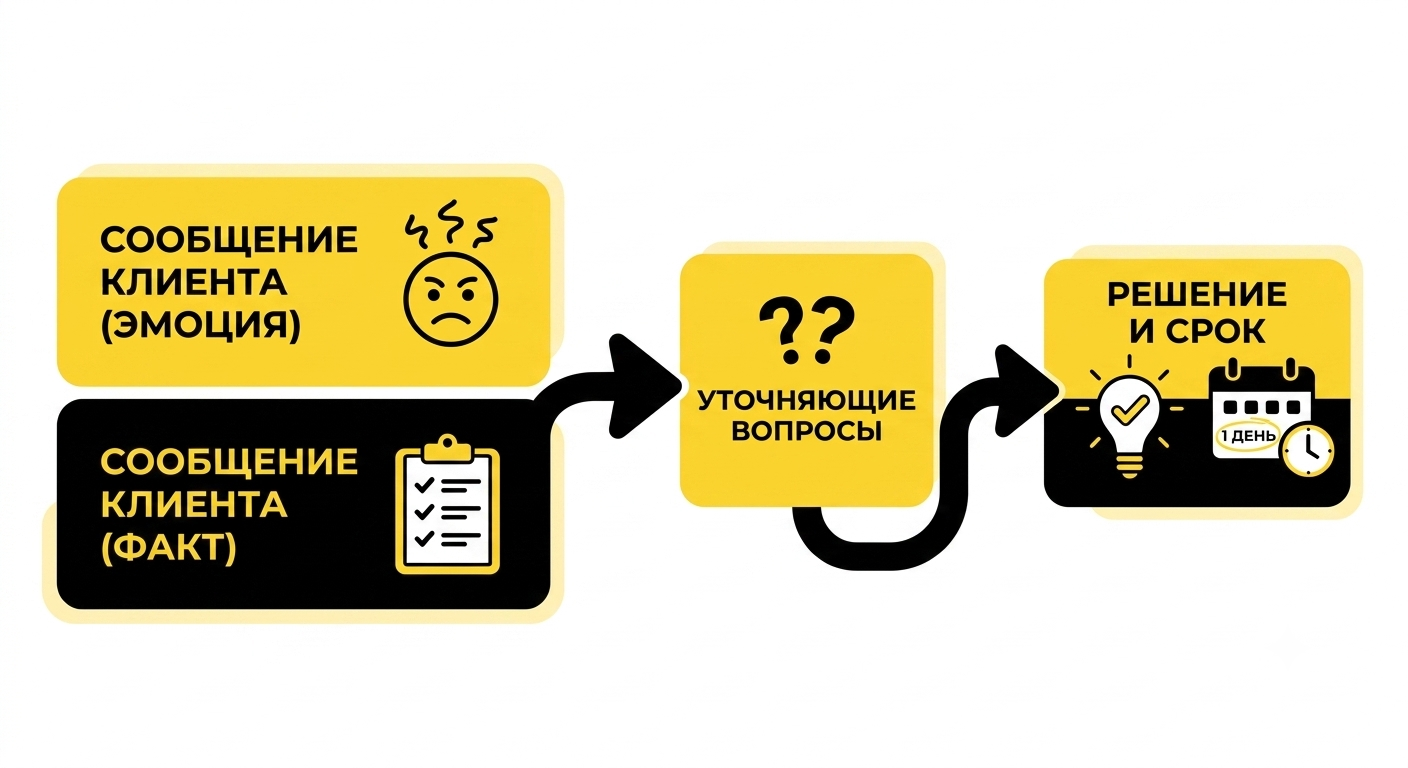
There are always two layers to negative feedback. The first is emotion: feeling hurt, worried, or angry. The second is the issue itself: a missed deadline, a budget increase, or a defect. If you immediately respond to the issue, the emotion remains unacknowledged and continues to put pressure on the conversation.
A useful approach is to briefly restate what you have heard and clarify what matters most. Wording like this keeps the conversation calm: “I can see this is upsetting. Let me clarify: is the main concern that the schedule has slipped by two days, or that the delivery date was missed?”
Once the issue is clearly defined, the conflict becomes solvable. This is especially apparent in construction: most disputes arise from expectations that nobody recorded or said out loud again.
Tip 4. Turn negative feedback into facts: documents, photos, and a timeline
The next goal is to move from judgments to things you can verify. What was promised? Where was it recorded? What has been done? What evidence supports it? This shift lowers the tension without relying on psychological techniques.
To keep the conversation grounded in facts, gather evidence for the case. A useful minimum includes:
- agreements on scope, deadlines, and payment: the contract, addenda, and correspondence;
- a dated timeline showing what happened and when;
- before-and-after photos, acceptance records, and inspection checklists;
- payments and materials documentation if the dispute concerns money.
When negotiations reveal disputed wording, a protocol of disagreements can help: it records what you ultimately agree on. The 101 blog has an example of a protocol of disagreements (in Russian). Apply any legal recommendations in that article in light of the law governing your contract; they do not establish universal rules for every country.
In drawn-out disputes, a systematic approach helps: when photos, project stages, estimates, and payments are in one place, the disagreement is less likely to descend into chaos. The 101 app helps with this: it was designed to record agreements and project progress.
Tip 5. Offer 2–3 solutions and agree on the next step
Once you have gathered the facts, it is time to work toward a solution. Options help the customer feel in control. A single option can sound like an ultimatum, even when it is reasonable.
The options should differ in speed, price, and their effect on the outcome. A short template: “I can do this in X days”, “There is a faster option with these conditions”, and “There is a cheaper option with a later completion date”.
After choosing an option, record the next step and its date: who will do what, by when, and where the agreement is documented. In construction, this reduces the risk of another conflict over money: the customer sees the structure, and the contractor sees the limits of their responsibility. Transparent project finances and markup support this kind of conversation, so the dispute does not turn into emotional haggling (in Russian).
Tip 6. Close the case publicly if the complaint was public
If a complaint was posted publicly, quietly resolving it in private only addresses half the problem. People see the original review, read it without context, and draw conclusions. The conclusion to the case therefore needs to be visible too.
The approach is simple: post a brief public reply, avoid an argument, confirm that you are looking into the issue, and give a timeframe. Once it is resolved, return and add the outcome. Sometimes the customer updates the review. Sometimes they do not, and that is a normal outcome: your job is to show that you have a process.
Tip 7. Analyze negative feedback and update your procedures
One conflict is an isolated case. Three similar conflicts form a pattern. If negative feedback keeps recurring, the problem lies in the product or the process: advertising promises, estimates, quality control, communication, acceptance of work, or payment arrangements.
It helps to review negative feedback once a week as incoming tasks. Keep a short procedure in a single document:
- Classify the complaint: deadlines, money, quality, or communication.
- Identify where the process broke down: where expectations stopped matching reality.
- Update a procedure: a message template, inspection checklist, report form, or contract clause.
- Check that the team has adopted the procedure and uses it.
If negative feedback involves a risk of nonpayment or broken agreements, it helps to have a plan prepared in advance: what to do in the first few hours, which documents matter, and when a formal demand is needed. 101 has an article on what to do when a customer fails to pay (in Russian). Check the procedures for formal demands and debt recovery against the law applicable to your contract.
The effects of this work become apparent quickly: fewer emergencies, fewer disputes to sort out manually, and greater predictability. Negative feedback remains, but it now helps improve quality and reputation.