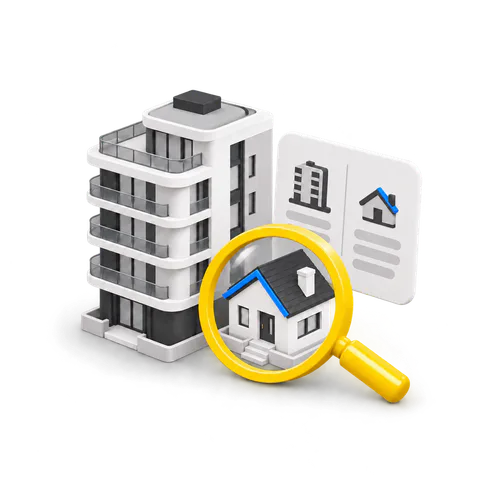

Real estate market analysis is useful when a decision costs money and time: buying an apartment, selling a house, investing in rental property or choosing a construction site. Without figures to work from, it is easy to rely on impressions and make an emotional decision.
The market is only a single entity in name. Each combination of city, neighbourhood, property type, budget and payment method has its own dynamics. Transactions may be happening in one segment while listings in another remain online for months.
Start with this principle: market analysis does not provide an exact prediction. It gives you a framework for assessing price ranges, buyer behaviour, time available for negotiations and the main risks.
Contents:
Why analyse the real estate market?
Imagine you have found an apartment, the price looks suitable, the agent is urging you to decide and your family is already discussing furniture. A preliminary comparison can reveal the asking price range of similar properties, the history of listing changes and financing terms. An asking price does not establish a transaction price; any potential discount must be discussed and checked separately.
The same approach applies when selling. Setting your price from a single neighbouring listing can lead to a mistaken assessment of demand. Compare several similar properties and track responses and changes in supply. A long listing period alone proves neither overpricing nor a lack of buyers.
Construction and renovation provide another scenario. Total costs include the purchase, bringing the property to a condition suitable for living or renting, and subsequent ownership costs. Prepare a works budget alongside your price analysis. The review of renovation costs in 2025 (in Russian) is historical material: its figures and trends do not replace current contractor quotations in your region.
What data should you collect?
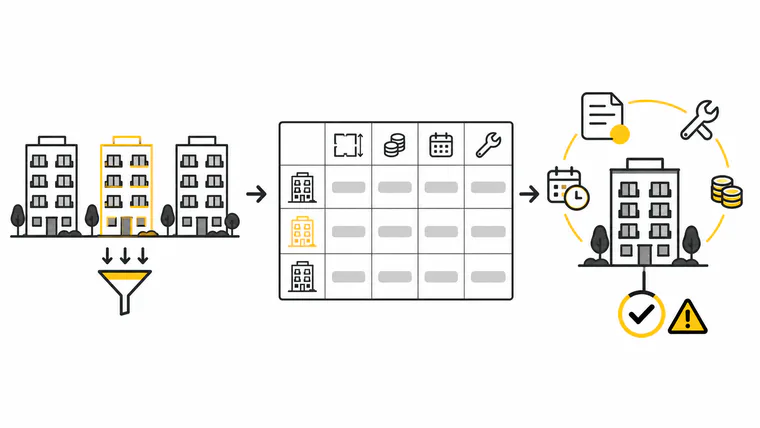
First define the segment: property type (new development, existing home or house), floor area, budget and payment method (your own funds, mortgage or instalments). Otherwise, the comparison becomes noise: studios alongside three-room apartments, panel buildings alongside monolithic buildings, finished homes alongside unfinished spaces.
Next collect verifiable sources. For a preliminary review, you can start with 20–40 listings matching your filters, record prices and features, separately look for transaction information and market reports, and estimate the work needed to make the property suitable for your goal. A sample of 20–40 is a practical starting point, not a guarantee of representativeness: a narrow or heterogeneous segment may require more data.
If you monitor the market regularly, keep a simple table with the address or property identifier, features, observation date, price and source. Mark duplicates and changes to the same listing so that you do not count one property several times.
- Sale and rental listings: show supply and sellers’ expectations.
- Reports from major market participants and banks: help you understand demand and mortgage conditions.
- Official housing completion and income statistics: provide context and long-term trends.
- Local neighbourhood factors: transport, schools, nearby construction and development plans.
- Renovation and finishing costs: affect the overall cost of ownership.
Construction and renovation add another layer of data: the cost estimate and changes during the works. When a client assesses a property’s finances, small recurring costs are often missed: delivery, lifting materials, rework and additional work. There is a 101 article on preparing an estimate quickly (in Russian).
What do the figures mean?
Listing prices show sellers’ expectations. The price of a completed transaction is a separate observation that requires a reliable source. For example, Eurostat’s House Price Index methodology, section 3.1, uses prices of homes actually purchased. This illustrates the distinction between data types; it is not statistics for every city. If you lack transaction information, explicitly state that you are comparing offers. Listing duration and price reductions remain indirect indicators.
You can preliminarily assess changes in demand through changes in comparable listings and verified transaction information. A listing disappearing does not establish a sale: the owner may have withdrawn it, moved it to another platform or listed it again. Time online cannot automatically be treated as time to sell, and repeated price changes do not prove a particular discount.
Assess supply from the number of comparable properties and incoming listings, excluding duplicates. More offers may increase competition among sellers, but do not guarantee falling prices. Compare property condition and sale terms as well.
Mortgages may affect your segment even if you are buying without a loan: some buyers focus on monthly payments, the down payment and available programmes. Their share varies by market and property type. The 2024 review of market expectations and mortgages (in Russian) concerns the Russian market at that time. Its forecasts and programme terms should not be treated as current for another date or country.
Account for differences between segments: economy and comfort classes, business-class housing, country homes and resort cities. Mortgage transaction shares, buyer profiles and seasonality may differ. A conclusion for one segment does not automatically apply to another.
An evening analysis checklist
Sometimes you need to prepare a decision quickly: a seller requests a deposit in two days, while bank approval is valid for a limited period. Deadline pressure does not remove the need to check documents, rights to the property and its technical condition.
Below is a preliminary checklist for one evening. It helps you organise data, but does not replace legal and technical due diligence, an individual assessment of loan terms or a full market study.
- Step 1. Write down your goal and time horizon: living in the property, renting it out or reselling it; for example, three years, ten years or until a move in one year.
- Step 2. Collect 20–40 comparable listings as an initial sample. Record floor area, floor level, condition, building features, asking price, publication and observation dates, and source. Check for duplicates.
- Step 3. Separate non-comparable properties and data you cannot verify. Record the reason for each exclusion. Do not remove a listing solely because its price seems too high or too low. Flag properties with legal complications separately and check them with a specialist.
- Step 4. For comparable offers, calculate the median asking price per square metre and the interval between the 25th and 75th percentiles (Q1–Q3). This is the middle of the distribution of your selected asking prices, not a discount, transaction price or forecast.
- Step 5. Assess listing history and price changes. Mark withdrawn listings separately without treating them as confirmed sales.
- Step 6. If you need a loan, check current offers in your country: the down payment, full monthly payment, fees, required additional expenses and terms of available programmes.
- Step 7. Add costs of making the property fit your goal and owning it: renovation, furniture, appliances, utility connections, maintenance, applicable taxes and insurance. Check the components and amounts under local conditions, without counting any cost twice.
When comparing loans, consider the full payment and closing expenses. The CFPB guide to comparing offers describes US practice. Use the general principle, but check specific forms, taxes and required payments against your contract and the rules in your country.
For construction or renovation, it is useful to keep the budget, receipts and expenses in one place. The 101 App helps organise project financial records. Those records support calculations but do not establish the property’s market value, legal soundness of the transaction or loan approval.
Common analysis mistakes
The first mistake is comparing properties that are not comparable. Two homes with the same floor area may differ in price because of the view, layout, entrance condition, courtyard, nearby construction or noise. Prefer comparables in the same small neighbourhood with similar building features.
The second mistake is considering only the purchase price. A renovated apartment can make sense if you want to move in or rent it out quickly without months of building work. An unfinished apartment can also make sense if you want to fit it out to your needs and avoid rework. Your analysis should include the scenario and its cost.
The third mistake is collecting data once and assuming the picture is fixed. Loan conditions, developer offers, seasonality and local neighbourhood news change the market. If your search lasts for months, consider updating the sample at least every two weeks.
The fourth mistake is relying solely on general headlines. “Prices are rising” and “prices are falling” may describe averages for a particular period. You need your own segment: a specific neighbourhood, property format and budget, with a clear statement of whether the data concerns offers or transactions.
Turning analysis into an action plan
After comparing the data, write down your decision rules. Define acceptable costs including purchase and ownership, arguments for discussing the price and issues that require stopping to investigate: documents, noise, windows facing a main road or complex alterations.
When buying, set a target range, prepare arguments based on comparables, discuss the transaction date and request supporting documents. If the terms do not suit you, assess whether you can continue searching. Suitable alternatives depend on the segment and your budget and are not guaranteed.
When selling, set the price with reference to comparable offers and available transaction information. Decide in advance when you will reconsider the price and terms if there are no responses. Before drawing conclusions, check listing quality, viewing arrangements and the suitability of your comparables.
If the analysis relates to renovation or construction, separately check your budget calculations and expense recording process. The article on project financial management in the 101 App covers budget planning and tracking receipts and expenses. This is project accounting, rather than an independent property assessment.
Finally, connect market analysis with operational control. Even a good purchase can lose its value if renovation runs off schedule and over budget. Alongside price analysis, keep tools for recording costs and agreements.
Further reading from 101: the historical review of the Russian market and mortgages in 2024 (in Russian), the historical review of renovation costs in 2025 (in Russian) and preparing an estimate (in Russian). Check each article’s date and relevance to your situation.