Risk management is needed wherever there is uncertainty: deadlines, money, supplies, people, requirements, weather and regulation. When a project is going to plan, risks are easy to forget. When the plan breaks down, there is no time left to make decisions calmly.
Managing risks is a way to agree in advance how to deal with reality: what could go wrong, how serious it would be, who would notice first, what to do and what to give up if no other options remain.
In practice, risk management is useful in large companies and small businesses alike. It is particularly visible in renovation and construction projects: a single missed delivery deadline can disrupt the entire sequence of work.
Contents:
What is risk management?
Risk management is a system of actions that helps you identify risks, assess their impact, choose responses and regularly check that the plan remains relevant.
A risk is an event or condition that could affect an objective. That objective might be profit, a project's handover date, safety, quality, reputation or compliance with a contract. Risks are often described in terms of likelihood and consequences, but in real life it is enough to answer two questions: what could happen, and what would follow.
A situation from project work: a contractor has completed a phase, the estimate has been approved and the client expects work to begin in the next area. Suddenly, the supplier postpones dispatch by a week. Formally, this is someone else's problem. In practice, it puts deadlines, money and relationships at risk. Risk management helps prevent situations like this from becoming a surprise.
What does risk management involve?
Risk management works in a cycle. It is easy to remember as a repeating loop: identify — assess — decide — review. On construction and renovation projects, this loop repeats every week, sometimes every day.
When the cycle is not formalized, risks are discussed in messages, resurface during conflicts and get lost when a manager is replaced. Once the cycle is defined, the team can decide more quickly what to do: tighten control, change the plan, set aside a reserve or renegotiate terms.
- Define the objective and boundaries: what you consider success, the timeframe, the budget and any quality constraints.
- Compile a list of risks by work phase, contractor, supplies, documents and people.
- Assess the risk: consequences, likelihood and early warning signs (the signals that will tell you the risk is starting to materialize).
- Choose a response: avoid, reduce, transfer (insurance, contract terms) or accept with a reserve.
- Assign a risk owner and a review date: one person is responsible for monitoring and action.
- Monitor risks: update statuses, record decisions and close risks that are no longer relevant.
The key point in the cycle is to set the “pain threshold” in advance: at what level of loss a risk must be discussed, what reserve is acceptable and which compromises on quality are prohibited.
Types of risk: a classification
Classification serves a practical purpose. It helps you avoid overlooking important issues and assign responsibility. When the risk list follows a clear logic, the team can spot gaps more quickly.
The following groups are most common in business:
- Strategic: market changes, losing a key client or choosing the wrong product or region to focus on.
- Operational: process failures, staff shortages, planning errors and failures to follow technical procedures.
- Financial: cash flow gaps, rising costs, exchange rates, penalties and non-payment.
- Legal: contractual risks, licenses, regulatory requirements and personal data.
- Project: missed deadlines, changes in the scope of work and dependence on external supplies.
- Reputational: public conflicts, negative reviews and distrust from partners.
- Occupational health and safety: injuries, incidents and downtime caused by violations.
In renovation projects, it is useful to track a separate layer of risks at the points where one phase depends on another. Plastering depends on electrical work, electrical work depends on the delivery of materials and delivery depends on payment. Tracking these interfaces often helps more than a long list of “everything under the sun”.
Types of risk management by approach and level
Risk management approaches differ in depth and method of assessment. Small companies rarely need complex calculations. Discipline is often enough: regular risk reviews and a clear basis for decisions.
| Approach | When it fits | What happens in practice |
|---|---|---|
| Qualitative | Risks need to be ranked quickly and little data is available | Low/medium/high scales, a risk matrix and discussion at a team briefing |
| Quantitative | Potential losses are high, statistics are available and precision is needed | Assessment in terms of money and time, scenario modeling and reserve calculations |
| Project | There is a project with a deadline and a defined result | A project risk register, monitoring critical chains and a response plan |
| Enterprise (ERM) | There are many risks linked across departments | Common rules, reporting and a culture of risk ownership |
Another important distinction concerns the response. Proactive risk management identifies risks in advance and plans measures. Reactive management comes into play after an incident. A reactive approach is also useful if the team records lessons learned and changes the process to prevent the situation from recurring.
Who handles risk management in a company?
Who manages risk is determined by how responsibility is assigned, regardless of job title. The business owner sets the rules: which risks are unacceptable, what reserve is acceptable and what takes priority when choices are difficult — deadlines, money, quality or safety.
The next step is to allocate roles. A large organization may have a dedicated function (CRO, risk manager or risk committee). In a small company, the project manager or operations director often takes on the role. The principle remains the same: every material risk needs an owner.
- Risk owner: responsible for monitoring, early warning signals and action.
- Project manager: brings risks together into an overall picture, coordinates decisions and manages reserves.
- Finance: reviews financial risks, limits and payment terms.
- Legal: handles contractual and regulatory risks.
- Internal control or audit (if present): checks that the rules work and incidents have been reviewed.
A useful test of the system's maturity is this: if the project manager left tomorrow, would risks remain under control, or would everything fall apart because it depends on personal agreements and message threads?
Tools and documents
A basic risk management toolkit consists of a few documents and records. You can maintain them in a spreadsheet, an enterprise system or a task tracker. Consistency and clarity matter more than format.
1) Risk register. One row represents one risk: description, consequences, likelihood, owner, measures, status and the next review date. A register helps avoid arguments over what people remember and the search for someone to blame at the end.
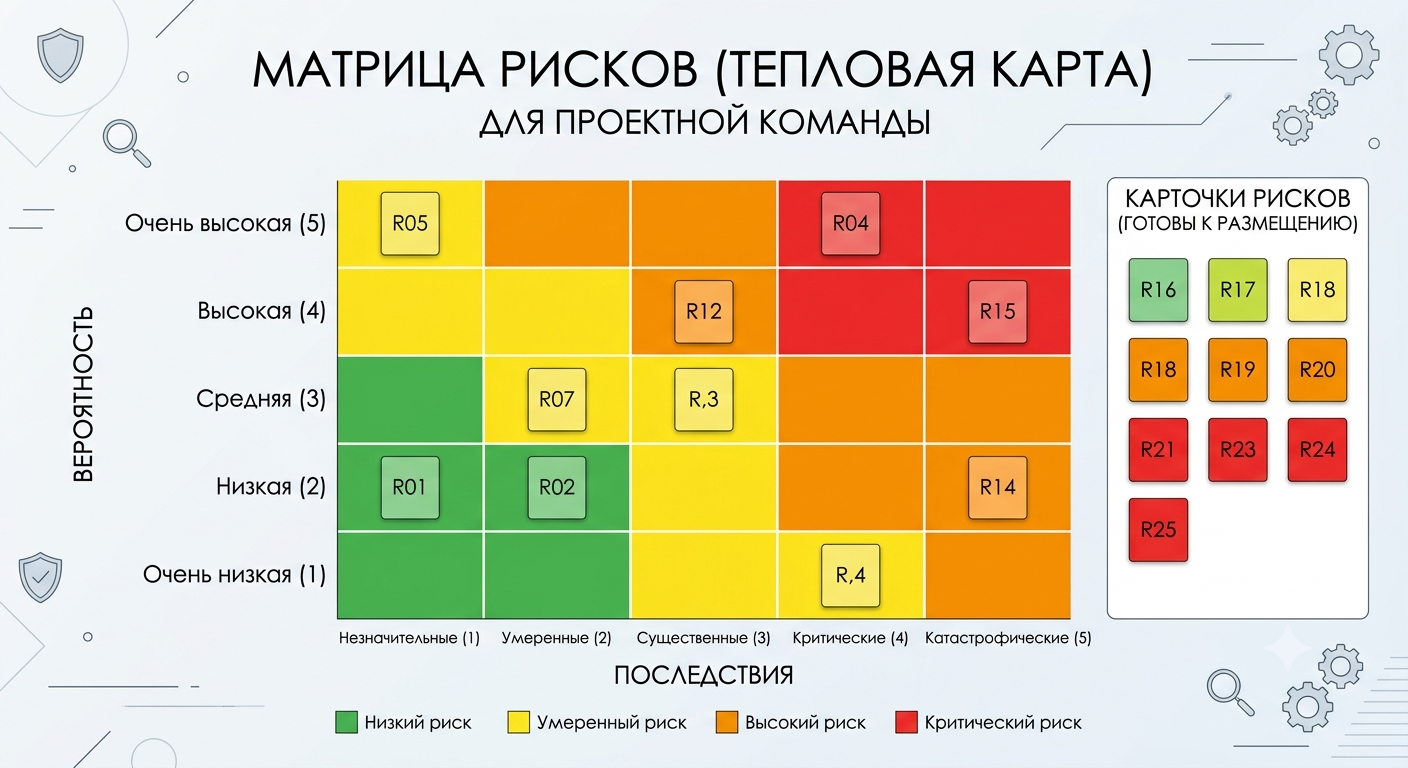
2) Risk matrix. A visual grid of “likelihood × consequences” helps set priorities. Risks in the red zone need an action plan and a reserve. Risks in the green zone often need only monitoring, provided this complies with established requirements and rules. Mandatory measures must be carried out regardless of the cell's color.
3) Response plan. A short description: what we do if a risk materializes, who makes the decision, what resources we deploy and how we inform the client or management.
4) Incident and lessons learned log. If a risk becomes a problem, record the causes and actions taken. A month later, that record saves time in a similar situation.
Digital tools are another consideration. When a project is managed in one place, it is easier to see deadlines, dependencies, statuses and early warning signs. This reduces operational risks: forgotten tasks, lost agreements and conflicting plan versions. The 101 App helps in these situations: the team keeps project tasks, assignees, deadlines and statuses together, without extra manual consolidation.
Common mistakes
Risk management rarely breaks down because of complex methods. Habits are more often to blame: agreeing verbally, failing to update the list, leaving risks without owners or putting off a difficult conversation.
- Creating the risk list once and then forgetting it until the end of the project.
- Confusing risks with problems: a risk is something that may happen; a problem is something that has already happened.
- No owner: “everyone is responsible” turns into “no one is responsible”.
- Assessing only likelihood and overlooking consequences and early warning signs.
- A response plan disconnected from real resources: no reserve of time, money or people.
- Concealing risks to avoid damaging reports or relationships. The cost of silence arrives later as a bill.
To get started without unnecessary effort, do one thing: list the project's 10–15 key risks, assign owners and schedule a review for a week from now. In a month, you will have a working risk management framework based on discipline. Presentations alone are not enough.