
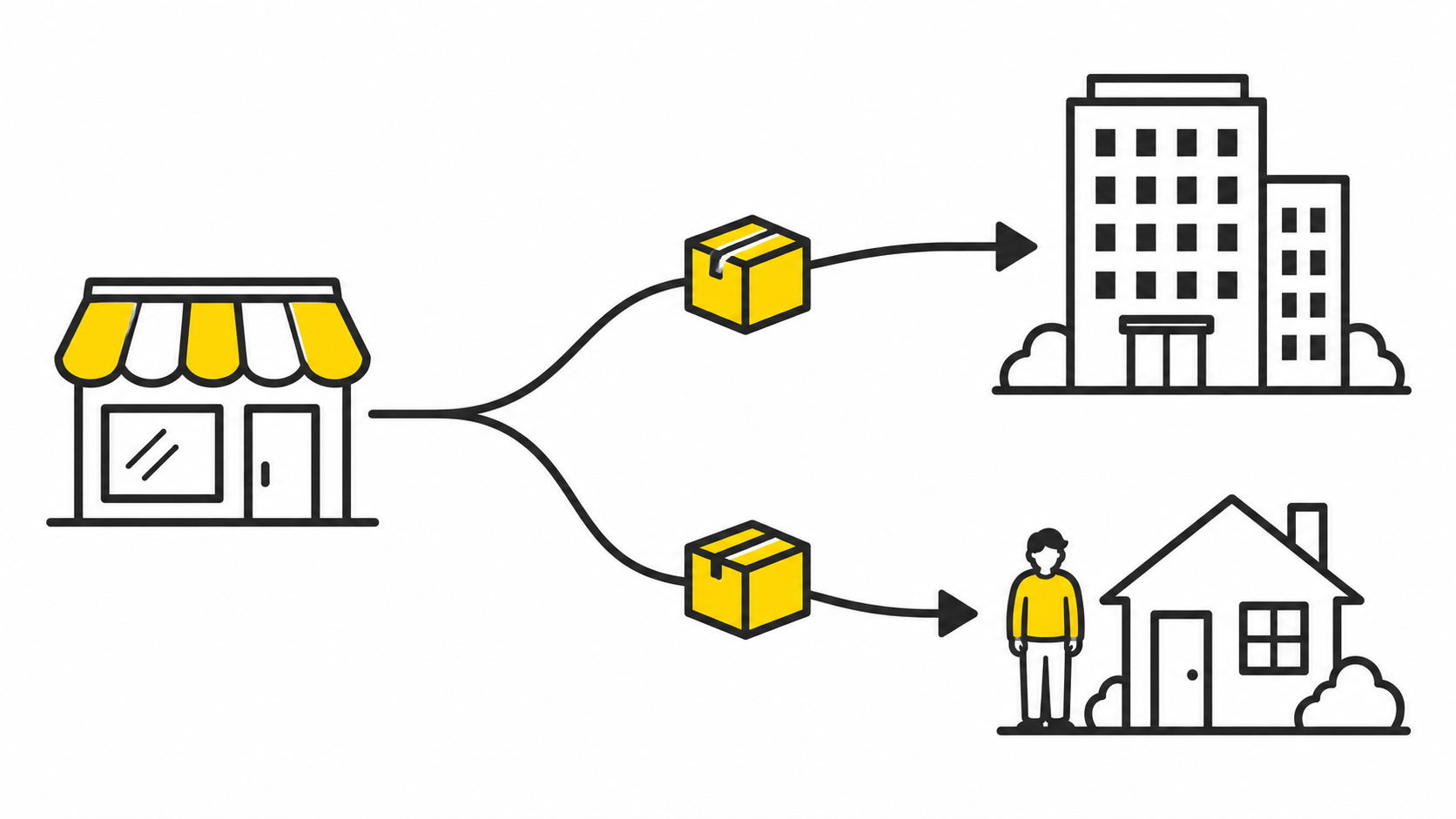
B2B and B2C are two terms for sales models: selling to business customers and selling to people for their personal or family needs. These short terms are often used as synonyms for “corporate” and “private customer” sales, which can lead to mistaken expectations: the same website, the same ads and the same sales scripts, yet conversion rates may differ.
The difference between B2B and B2C starts with who is buying and for what purpose. The decision-making process, risks and handling of money help you choose an approach to the sale. In some situations, speed and emotion matter more; in others, approvals, documents and oversight take priority.
Below, we explain B2B and B2C in simple terms, compare their key characteristics and connect them to practice: how to organize sales, calculate the economics of your work and keep track of the right metrics.
Contents:
- What Do B2B and B2C Mean in Simple Terms?
- How Do B2B and B2C Compare on the Main Criteria?
- How Do Marketing and Sales Differ in B2B and B2C?
- Price, Cost and Margin: Where Do B2B and B2C Businesses Go Wrong?
- Which Metrics Matter in B2B and B2C?
- How Can You Tell Whether Your Model Is B2B, B2C or a Mix?
- How Can the 101 App Help in B2B and B2C?
What Do B2B and B2C Mean in Simple Terms?
B2B (business-to-business) means selling to a business customer for its business needs: carrying out work, providing services, manufacturing or reselling products. The buyer may be a company or an entrepreneur. Neither the size of the deal nor the payer’s details determine the model on their own. A complex B2B deal may involve several roles, with specific requirements for the budget, contract, completion documents, deadlines and quality.
B2C (business-to-consumer) means selling to a person for personal or family needs. The decision may be made by one person or a family. For a simple purchase, the sales cycle is often shorter and the paperwork simpler than for a complex corporate purchase. A major home renovation for a family may also require lengthy approvals and a detailed contract.
Consider a construction example: a turnkey apartment renovation for the owner to live in is B2C. A contract to finish communal entrance areas for a property management company, or work awarded through a developer’s tender, is B2B. In both cases, you may be doing essentially the same work—building, renovating or supplying materials—while taking a different approach to sales.
How Do B2B and B2C Compare on the Main Criteria?
A common mistake is to look only at the word “company” in the contract. First, identify the purpose of the purchase. Then examine the process: who decides, how approval works, where the risks lie and what you need to demonstrate to get paid.
The compact table below outlines typical scenarios. It is a guide to preparing your sales approach, including for a mixed model. The length of the cycle, number of participants, documents and channels depend on the specific order; no single characteristic determines the model.
| Criterion | B2B | B2C |
|---|---|---|
| Who makes the decision | In a complex purchase, often a group: the initiator, a finance specialist, a lawyer and a manager | One person or a family; several people may be involved in approval |
| Sales cycle | May be longer because of approvals, contractor checks and the contract | Often shorter for a simple purchase; a large order may also involve lengthy approval |
| What the customer is really buying | Risk reduction and manageability often matter: deadlines, responsibility and oversight | The result and experience often matter: convenience, clarity and peace of mind |
| Documents | A contract, appendices, completion documents and procedures may be required | Paperwork may be simpler, but the documents required depend on the order and applicable rules |
| Sales channels | Often negotiations, partnerships, tenders and personal recommendations | Often advertising, social media, reviews and a product showcase |
How Do Marketing and Sales Differ in B2B and B2C?
In B2C, marketing often acts as a filter: attract relevant traffic, explain the value quickly and address basic concerns. In a complex B2B deal, marketing and sales are closely connected: a lead does not yet mean readiness to buy, and preparation for a purchase may take months. A long cycle is also possible in B2C, for example when renovating an apartment.
In B2B, it helps to think in terms of roles. In a complex purchase, the initiator, payer, signatory and person accepting the completed work may all be different people. You can map this process by identifying the decision-maker and those who influence the choice. The 101 blog has a separate guide to finding the decision-maker and avoiding weeks of negotiations with “the wrong person”: Who Is the Decision-Maker, and Why Do Deals Stall Without Them?.
How the presentation of your offer changes:
- B2B: the language of risk, oversight and predictability often matters. The customer wants to understand what will happen with the money, deadlines, quality and responsibility.
- B2C: a clear package and outcome often matter. The person is buying a work plan they can understand and peace of mind that the job will be finished.
- Trust matters in both. Reporting, procedures and transparent figures can support it in either model; the level of detail needed depends on the deal.
Price, Cost and Margin: Where Do B2B and B2C Businesses Go Wrong?
In B2C, you may run into a problem: setting your price “in line with the market” and forgetting your own costs. The result is plenty of orders but little money. Another scenario is possible in B2B: you manage to defend your price, but the project then runs over its cost budget because of rework, additional work, logistics or team downtime. Both risks occur in both models.
To keep the basic terms clear, it helps to distinguish the price from the cost of delivering the work or product. The price is the amount the customer pays. The cost is what you spend to carry out the work or provide the product. The word “cost” is used in different senses, so it is better to specify the exact measure in your calculations. The 101 blog uses construction examples to explain why confusion hurts profit: Price vs Cost: What Is the Difference for a Construction Business?.
Next come margin and markup. Markup in monetary terms is the amount added to cost when setting the price. Gross margin in monetary terms is the difference between revenue and the cost of the product sold or work performed. The bases differ when calculating percentages: markup is calculated on cost, while margin is calculated on revenue. The relevant base must be greater than zero for a percentage calculation. Gross margin does not yet account for all other expenses and taxes, so it is not the same as net profit. If you mix up these terms in your calculations, managing prices becomes guesswork. This article can help you check the terminology: Margin vs Markup: The Difference and How to Calculate Them.
The practical takeaway for B2B is to define the scope of work and the boundaries of responsibility. The fewer grey areas there are in the contract and correspondence, the less “additional work included by default” you face. The practical takeaway for B2C is to structure your offer into clear stages and explain in advance what the price includes and what costs extra. Both approaches are useful in both models.
Which Metrics Matter in B2B and B2C?
Both models need metrics for the same reason: it is easy to confuse turnover with results if you rely on appearances. This happens in construction too: money is coming in, yet profit is not growing.
B2C businesses often focus on the marketing funnel and repeat sales. In B2B, attention often goes to lead quality, approval speed, accounts receivable and fulfillment of contract terms. Choose indicators that fit your process: the funnel and outstanding amounts may matter in both models.
If you want a foundation for understanding “money in reports,” start with the difference between revenue and profit. The 101 blog covers this separately: Revenue vs Profit: The Difference and How to Calculate Them.
How Can You Tell Whether Your Model Is B2B, B2C or a Mix?
Many companies operate a mixed model: some customers order work for personal needs, while others need it for business purposes. This is normal. Problems begin when you try to sell everything the same way: one sales script, one commercial proposal, one timeline calculation and one set of documents.
The short check below helps you organize your sales approach. You can apply it to each product or type of order.
Step 1. Identify who is buying and for what purpose: for business or for personal and family needs. The payer’s details do not determine the model on their own.
Step 2. Record how many roles are involved in the decision: is there a finance specialist, lawyer, manager or technical expert?
Step 3. Identify the customer’s risks. In B2B, these often involve deadlines, penalties, downtime and responsibility. In B2C, they may involve comfort, quality, predictability and keeping the estimate under control. The risks depend on the order; deadlines and quality matter in both models.
Step 4. Decide what you need to show before payment. In B2B, this often includes procedures, reporting, case studies and a clear acceptance process. In B2C, it may be a work package, examples of results, reviews and a transparent estimate. The materials needed depend on the specific deal.
Step 5. Separate your materials by audience: prepare a separate commercial proposal for B2B and B2C if needed. Even when the work is the same, the arguments and structure of the offer may differ.
Step 6. Separate B2B and B2C projects in your management analysis so you can compare profitability and cost variances. Use consistent rules for calculating the indicators in both groups.
How Can the 101 App Help in B2B and B2C?
If your business is project-based, money and oversight become important selling points in both B2B and B2C. The customer needs to understand what is happening: incoming funds, expenses, participants’ responsibilities and how stages are recorded.
This is where management accounting is useful. It helps you link incoming funds and expenses to projects and assess results by order. To draw conclusions, you need to record all income and costs related to the order; company-wide overheads also matter when assessing the business as a whole. The 101 blog has a detailed guide to organizing management accounting in a project-based business: How to Set Up Management Accounting in a Project-Based Business.
The 101 App lets you record incoming funds and expenses by project and work with participants’ reports. If your work involves B2B manufacturing orders, supplies or logistics, check separately whether the tool meets your industry-specific needs. Financial results depend on how complete the data is and which expenses have been included.
Another opportunity relates to B2B sales: the decision-maker may care about how you organize oversight. Showing clear figures and working procedures may help you discuss the terms and risks of the deal. It is best to ask the customer what level of detail they need.
Sometimes the question is which to implement first: CRM or management accounting. It depends on the problem. If leads are getting lost, you need a sales system. If cash seems to “have a life of its own,” you need to put your accounting in order. The 101 blog explains the difference between CRM and management accounting and why it helps to distinguish them: Management Accounting or a CRM System? (in Russian).
If you would like to see how the 101 App fits your B2B or B2C process, you can attend a presentation and discuss a workflow from projects to reporting.