

Marketing for apartment renovation rarely fails because of the ad creatives. More often, the problem lies elsewhere: the company attracts traffic but handles sales however it can, explains the project only verbally, and loses trust at the first question about deadlines, scope of work, warranties, or money.
The market is competitive, contract values are high, and the sales cycle is long. Customers compare more than before-and-after photos: they assess how well the work is managed. Is there a process? How are agreements recorded? Who is responsible? What happens when things change, and who bears the risks?
The following 10 tips help you build renovation marketing as a system: presenting your services → leads → sales → service → repeat business and referrals.
Contents:
- Tip 1. Niche and segment
- Tip 2. Presenting your services: what should customers see in 3 minutes?
- Tip 3. Build trust through processes, reporting, and transparency
- Tip 4. The funnel and response speed: how can you avoid losing inquiries?
- Tip 5. Sales scripts
- Tip 6. Platforms with active demand
- Tip 7. Do search and targeted ads still work?
- Tip 8. Content and messaging apps
- Tip 9. Partnerships: designers, agents, and suppliers
- Tip 10. Analytics and internet advertising rules in Russia
Tip 1. Niche and segment
Marketing for a renovation company begins with the question: “Which customers do we take on, and which do we decline?” Renovation “for everyone” leads to vague ads, estimates with no clear logic, sales staff without a solid basis for their work, and constant pressure to offer discounts.
Think about your segment: economy, business, or premium. This affects how you present your services, how quickly customers decide, service expectations, and lead sources. If helpful, start with renovation classes and customer expectations: the blog has an article on apartment renovation classes (in Russian).
Consider a hypothetical scenario: a company takes on “anything and everything.” Its ad promises “turnkey renovation,” but the correspondence reveals that a design project is “preferable,” purchasing is handled “as needed,” and deadlines are set “after the site survey.” The customer chooses a company that made its scope and process clear from the outset.
Tip 2. Presenting your services: what should customers see in 3 minutes?
Before speaking to a sales manager, customers are convincing themselves that “this team can handle the job.” At this stage, simple things matter: clear services, examples of work, transparent terms, a quick way to get a cost estimate, and a sense that questions receive relevant answers.
A renovation company needs these basic materials to present its services:
- A page describing your services clearly: cosmetic renovation, full renovation, building services, materials procurement, design, and designer supervision of the work—whichever services you actually provide.
- A portfolio with details: floor area, timelines, scope of work, and the challenges involved.
- A couple of case studies covering “the starting point / what we did / the outcome.”
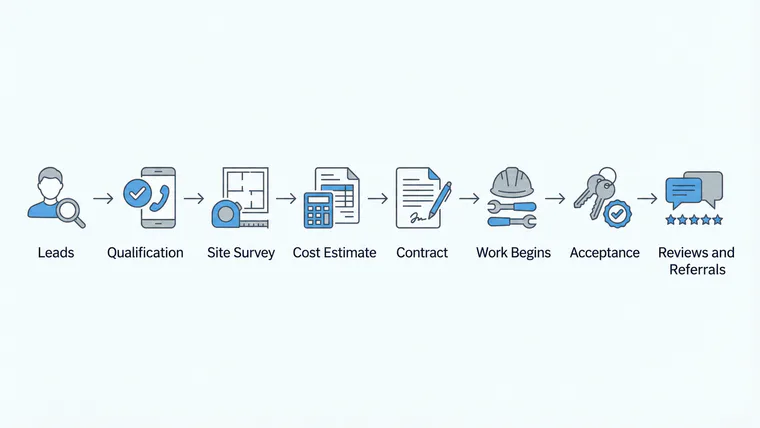
- A short description of the process: site survey → cost estimate → contract → schedule → work → acceptance.
- Answers to common questions about the contract, warranties, changes, and payment.
- Contact details and a convenient communication channel where someone actually responds.
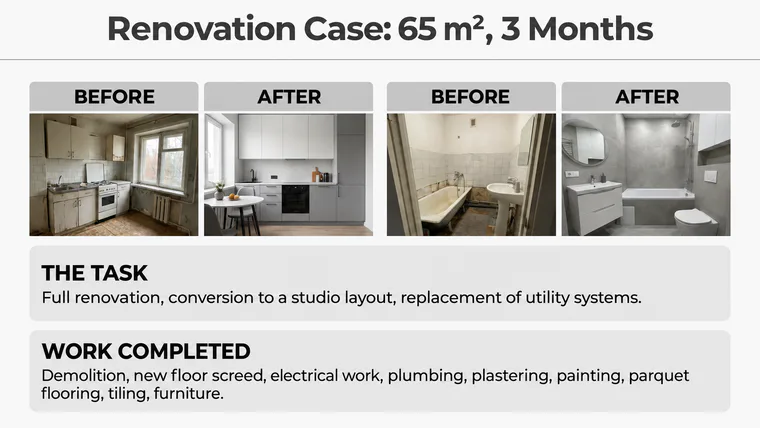
The illustration shows a hypothetical example of a case-study card for a 65 m² apartment renovation taking 3 months. It is a mockup demonstrating the structure of a case study; the details are illustrative and do not establish that any company completed a real project.
Another often underestimated item is a list of work with prices and clear units of measurement. If the price list is muddled, the sales manager resorts to improvised explanations, and the customer hears confusion. For help, see the article on why builders need a well-structured price list.
Tip 3. Build trust through processes, reporting, and transparency
In renovation, people buy a sense of control. After photos matter, and the key question is: “How will I know the work is on schedule and the money is not disappearing into extra charges?”
Strong marketing demonstrates the process. Show how changes are recorded, who approves additional work, how materials are reported, and how completed stages are accepted. You can do this in your content, in a commercial proposal, and at a meeting.
If your company keeps digital records, that is also part of sales. Showing customers the project structure, reports, and the reasoning behind materials use reduces their concern that “you might deceive us.” For reporting and work organization, explore the “About the app” section and the article on simplifying report creation (in Russian).
Sometimes it is easier to show this on screen once and explain it in a short presentation than to repeat the explanation in chats. After such a meeting, agreeing on terms and protecting your margin is usually easier.
Tip 4. The funnel and response speed: how can you avoid losing inquiries?
An important part of renovation marketing is keeping an incoming lead and moving it to the next step. Consider a hypothetical scenario: a customer sends 3–7 inquiries in succession. In that scenario, a faster, more accurate response helps your company make the shortlist for a site survey.
You need a simple funnel with clear stages and rules: when to call, what to clarify, when to arrange a site survey, what to send afterward, who prepares the estimate, and how to follow up toward a signed contract. The blog has a separate guide to the sales funnel in construction and renovation, which you can compare with your own process.
A useful rule for a small sales team is to use one qualification standard in the first minutes of a conversation. Ask about the property and the task: where the apartment is, its floor area and condition, the desired timeline, whether there is a design project, who makes the decisions, and how materials will be purchased. The sales manager then proposes a next step that can realistically be taken today.
Tip 5. Sales scripts
Scripts do not make sales conversations rigid. They reduce chaos: the sales manager remembers important questions, answers common objections consistently, avoids making excessive promises, and does not argue with the customer from an “I am right” position.
Three topics almost always come up in renovation: price, deadlines, and warranties. The sales manager needs to break the price into understandable components, show quality criteria and the risks of cheap solutions, and explain how the company controls deadlines. Qualification is part of this too: when a project is unsuitable, it is better to state your limits honestly than to take on a project likely to cause conflict.
If you want to develop scripts from scratch, see the article on sales scripts for renovation and construction. For discussions about price, the guide to handling price objections offers plenty of reasoning you can adapt to your segment.
Tip 6. Platforms with active demand
When you need a flow of inquiries here and now, classified-ad sites and service marketplaces give you quick access to people already looking for renovation. The downside is also clear: competition is high, lead quality varies, and you need to maintain your listings consistently and respond quickly.
A common mistake is using one “turnkey renovation” ad for every situation. A set of ads for different needs works much better: “bathroom renovation,” “electrical work,” “plastering,” “full renovation in a new-build apartment,” and “renovation with materials procurement.” Customers arrive with a specific task in mind.
For a broader view of lead sources, see the articles on where to find renovation customers (in Russian) and where to find apartment renovation leads.
Tip 7. Do search and targeted ads still work?
Search advertising and targeted ads work when your internal operation is ready: clear service presentation, a clear funnel, quick responses, a sales manager who can qualify leads, a surveyor with a defined procedure, and a logically structured estimate. Otherwise, advertising pays to bring people into chaos.
For renovation, a sequence such as “search → quiz or short form → call → site survey” often works. Retargeting also plays a role: people return to renovation after a week, a month, or sometimes a season, when property transactions are completed and funds become available for the renovation.
For an overview of channels and how they fit together, start with the article on attracting apartment renovation inquiries (in Russian). It explains why one tool rarely handles everything and how to combine channels.
Tip 8. Content and messaging apps
In renovation, content acts as “proof that the work is well managed.” Subscribers do not need an endless stream of entertainment. They need to see your practical experience: how the company solves problems, what an orderly site looks like, how changes are agreed, and how quality is controlled.
Telegram suits this format: posts explaining construction details, short videos from the site, answers to questions, and curated materials. Keep the channel from turning into a stream of “special offers” and discounts. Focus on service, processes, and technical aspects of the work. See the detailed article on using Telegram for business (in Russian).
A short scenario: a customer is choosing between two contractors. One sends a commercial proposal as a PDF and disappears. The other sends a case-study link, a couple of photos from stage-by-stage reports, and explains when the estimate will arrive and what information is needed for accuracy. The choice often becomes obvious.
Tip 9. Partnerships: designers, agents, and suppliers
Partnerships bring leads with an existing foundation of trust, but they require carefully defined rules. In renovation, useful partnerships include designers, architects, real estate agents, new-build sales managers, materials showrooms, air-conditioning installers, and kitchen specialists. The principle is simple: the partner brings an inquiry, you deliver quality and transparency, and the partner can recommend you without embarrassment to their own customer.
To make a partnership work, define the offer: lead handover terms, who manages the customer and how, when the partner receives compensation, what counts as a “referred customer,” and how disputes are resolved. Discipline matters here: partnerships quickly end when agreements are not recorded.
One more point: partners find it easier to recommend a company that looks well organized. That brings us back to service presentation, the funnel, and reporting in the earlier tips.
Tip 10. Analytics and internet advertising rules in Russia
Measure a renovation company’s marketing in money and stages. Without this, it is easy to keep funding a channel that generates many inquiries but few contracts. At a minimum, review these figures every week: how many leads came in, how many reached a site survey, how many received an estimate, how many signed a contract, the average contract value, and project margins.
This gives you meaningful control: you can strengthen what generates contracts and address bottlenecks. When looking for a bottleneck, examine advertising, site surveys, estimates, estimate presentations, and correspondence: difficulties can arise at any of these stages. You may also find it useful to read how companies lose sales through communication (in Russian) and the article on increasing sales conversion (in Russian).
A separate issue is the legal and technical discipline of internet advertising. For example, in Russia, internet advertising falling under Article 18.1 of the Law “On Advertising” (in Russian) is subject to requirements for the “Реклама” (“Advertisement”) label, advertiser information, an advertising identifier (ERID), and data submission through advertising data operators (ORD) to Russia’s Unified Register of Internet Advertising (ERIR). The data-submission obligation applies to placements aimed at consumers in Russia and meeting the established criteria; the applicability of requirements and exemptions must be checked for each placement. If you run advertising through a contractor, you should still keep these matters under control. This is a Russian example: for placements in other countries, check the local rules.
To explore further, start with the “Marketing and sales” section. It provides materials for your situation: leads, funnels, scripts, communication, and tools.