

Contents:
Why can a low-quality price list harm a company?
Unclear items in the price list can reduce profits and create disputes with customers. 101 GROUP admits that their team also went through this stage - they overpaid the craftsmen, compensated losses at their own expense in controversial situations and did not understand how much profit they were getting.
How is your price list for finishing work leading you to lose money?
Let's try to group various cases from practice that lead you to financial losses:
1. When you cannot explain something from your price list
Why did you calculate this item this way rather than another way? Why does wall preparation appear separately from wallpapering? Who is responsible for the fact that excess funds were spent on extra materials? These questions are not just unpleasant - they can even take you to court, and without a clear price list and documentation you are unlikely to prove anything there.
In one of our communities, we asked craftsmen, foremen and managers a question to consider: “How would you calculate the cost of installing porcelain tile on the strip under the shelf and above the shelf?”
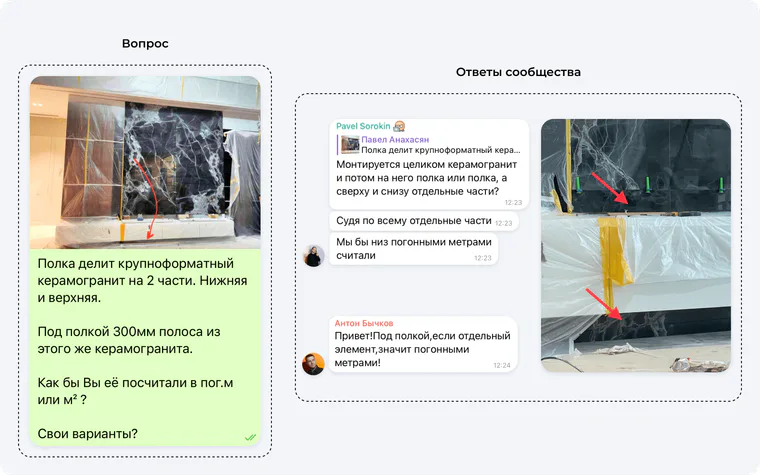
And 130 professionals in their field (said without irony!) were unable to answer it correctly. Almost all chat participants said that the strip above the shelf should be counted in square meters, and below it in linear meters.
How would you handle this situation or answer this question?
Why did almost everyone suggest different ways of estimating the equally labor-intensive strips of tile above and below the shelf? Because the price list of various builders and superintendents has the same problems!

 I wanted to prove that many price lists require more accurate calculation rules, no one has an ideal price list, not even us, although we refine the price list every day and discuss such problems.
And the solution to the problem was simple, and this is what we included in our price list - anything fixed to a surface without a turn must be counted in m²:
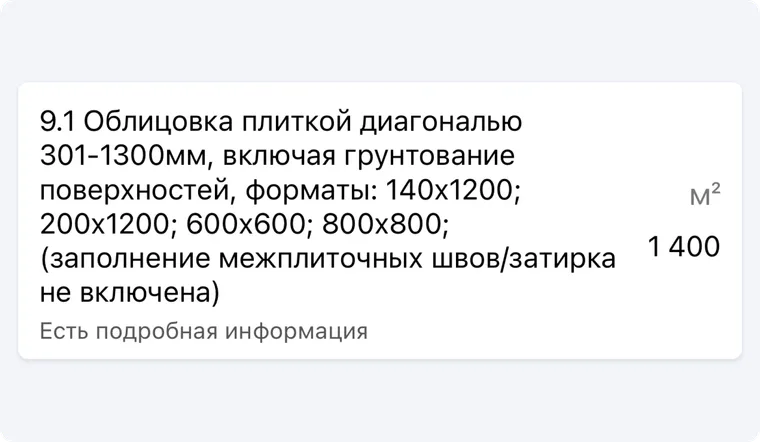
If the installation involves turns, charge a separate surcharge for them:

2. When you overpay for misunderstandings
Each price list has the following item: “Wallpapering.” This vague item can become a real disaster. If you still just write “wallpapering - 200 RUB (substitute any amount here)”, then you lose money.
There are many questions you can ask about this point:
- What type of wallpaper?
- How is the surface prepared?
- Who buys supplies for craftsmen?
Regarding any of the listed issues, you could have a dispute with the customer or the worker!
Imagine: you signed an agreement with wallpapering at an unfortunate rate of 200 RUB. And the customer bought fabric wallpaper, which you usually install for 700 RUB. The papers have been signed, the customer is waiting for the work, the workers are ready to start, but they don’t agree to work for 200 RUB. Therefore, you have to cover the remaining 500 RUB from your own pocket.
If it seems that you can overpay 500 RUB once and forget about it, then these 500 RUB will quickly turn into a much more significant amount that you lose every day. There are plenty of such vague positions in the price lists of different foremen!
3. When you unknowingly deceive customers
If you are still purchasing supplies yourself, then you may be losing a significant amount per year and unknowingly deceive customers.
Therefore, we have included the cost of consumables in the price list.
Consumables are materials that are consumed during the repair process: gloves are torn, fabric is damaged, discs are worn out. The main feature of this type of materials is that it is very difficult to check how rationally they are spent.
We found out that we were losing 200,000 RUB a year on buying gloves alone! Why did this happen? When a worker is given gloves or other consumables for free, he, as a rule, treats them quite irresponsibly - he changes them more often, does not take care of them and does not wash them, uses them as a rag, etc. We had a case where 40 pairs of gloves were used to plaster a 10-meter fence.
This is not only wasteful, but also dishonest towards the customer. A person who is far from the construction industry may believe that this is exactly how many gloves are needed (although it’s hard to believe) and overpay a significant amount. However, most likely, the customer will ask a question, and the foreman will have to come up with some excuses or pay from his own pocket for the craftsmen’s love for gloves!
To avoid such situations, it was decided to selectively include the cost of consumables as part of the items for work, where this was necessary.
4. When workers deceive you
In addition to being wasteful with consumables, craftsmen may deceive you and use lower quality materials to replace those you purchased.
One day we found out that the worker did not use the expensive tile cutting disc for 10,000 RUB that he had asked for. We spent the customer’s money, and the worker simply set aside the high-quality consumables, took out the simplest and cheapest one, and with its help he completed the work on expensive tiles! And he simply took a high-quality disc with him to side jobs, where he set high prices, arguing that he was purchasing expensive consumables.
This is a double deception - such a worker not only deceived us, but also put us in a situation where we deceived the customer.
We realized this when we encountered another unpleasant situation at the site. One of the craftsmen primed the wall in the evening, went home and “unexpectedly” found out in the morning that the primer was covered with dust (wow, is it dusty at a construction site?), which means it needs to be primed again. Thanks to this ingenious solution, the priming bill was not 100 m², but 200 m².
The situation has certainly caused controversy. The customer refused to pay for 200 m², the foreman discussed it at length with the worker - and he just wanted to cheat, seeing that the price list stated: “Priming of walls - 50 RUB/m².” Why not prime twice if they pay more for it?
Of course, we had to bear the overpayment and add only half of the cost of priming to the client’s bill.
→ How to avoid such situations and limit opportunities for workers to charge for unauthorized extra work?
Include priming (that is, wall preparation) in wallpapering or other price-list items! The master will not want to spend your materials and his time on double work if he does not receive additional money for it.
Therefore, if in your price list there is still an item like “Priming of walls 50 RUB/m²”, then quickly replace it with clearer items that have priming included as part of other work.
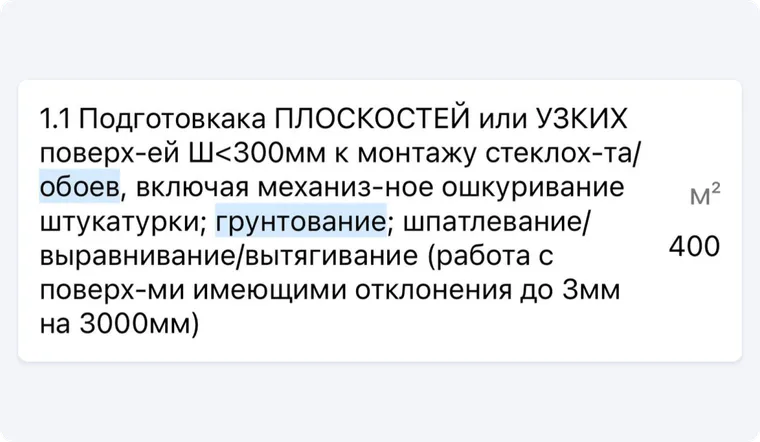
What exactly should not be in your price list for finishing work?
Check yourself for the presence of “red flags” that can lead you to large losses or even to the court:
1. Artificially inflated prices
Customers can compare your prices with your competitors and choose a better option. Many companies raise prices unknowingly, especially when they hire new workers or foremen:
- a newcomer calls his friend for the position of electrician, who gives him a price higher than the market;
- The item is added in the price list;
- it turns out that the price is too high and should be returned to market values, but the craftsmen are already accustomed to such figures and do not agree to anything less;
- the worker leaves the company.
What does this lead to? The cost of one item increases not only for one master, but for all electricians → the estimate increases → customers are dissatisfied → the flow of orders decreases → the business suffers. We are exaggerating, but the “butterfly effect” in the construction business may well work.
In order to increase a worker's rate, you need to conduct a quality audit and find out how much craftsmen with the same qualifications get in other companies:
- call at least 7 specialists;
- ask them for a price list for the work (in no case should you say that you are doing a survey, just say that you are looking for a specialist);
- compare prices and analyze whether a price increase is justified.
If the audit shows that your worker charges less than comparable workers, then the price needs to be increased. And if you see that other workers receive even less, then you will have to explain to the worker that their pay is already above the market average and that no increase is planned yet.
2. Unclear positions
If the client feels deceived in at least one of the positions, this can easily lead to misunderstandings and even lawsuits.
It was in this situation that one of the site supervisors found himself, who could not explain how exactly he calculated a certain type of work. His client assumed fraud and realized that she might have been overcharged on every invoice, not just one. The consequences were sad:

The outcome of a legal dispute depends on the agreement, documents and circumstances of the case. A clear price list helps explain the calculation, but does not in itself guarantee the result. Plus, we remind you that court is expensive, time-consuming and labor-intensive (and there is simply no guarantee that everything will work out!). Therefore, it is better to prepare in advance and purchase 101’s ready-made finishing-work price list (in Russian).
What are the required items, and what is better not to include in the price list for finishing work?
Mandatory items in the price list are the main types of services:
- general construction work;
- welding work;
- roofing works;
- landscaping;
- installation of final plumbing fixtures;
- adjustment factors and surcharges;
- concrete works;
- pile foundation work;
- tiling works;
- door installation;
- plastering work and many, many others (we will not give the entire list!).
All this is probably in your price list and is unlikely to cause problems. It is only important that all these works present a complex but logically understandable structure. For example, so that priming does not turn into a separate service hanging in the air that craftsmen can use to increase their earnings, but is included in other types of work:
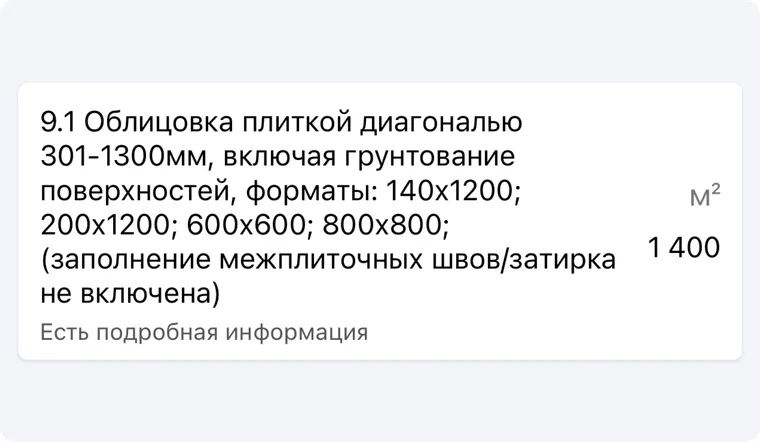
Please note how detailed this point is:
- clear dimensions;
- indicated about priming;
- Options that are not included are marked.
If we talk about work that should be removed from the price list for finishing work, then this is not only priming the walls, but also:
- insignificant details that may confuse customers or make it difficult to find the right product or service;
- positions that are not related to the company's core business and may distract customers.
For example, rough tile cuts. If you are still counting it separately, then you may be leaving an extra maneuver for the masters to deceive. When mitering tile edges, they can make a rough cut even if it is not needed. This often happens when a rough cut is included as a separate item in the price list.

Therefore, we decided to include the rough cut in the mitering item itself, so that it is executed only when necessary:
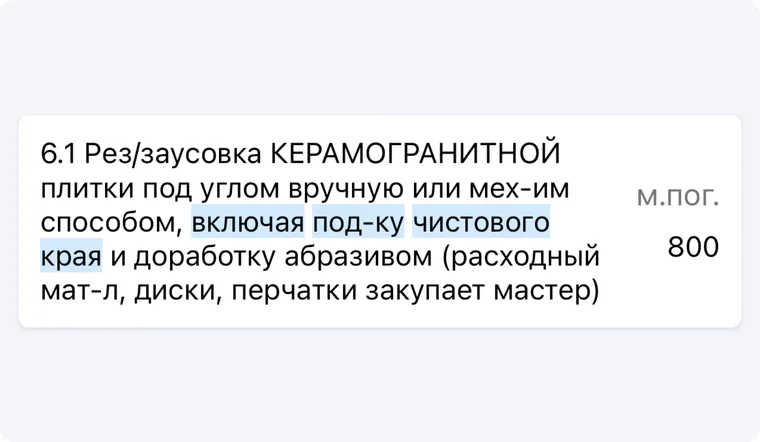
We accounted for all these details in our ready-made price list, which you can purchase through this link (in Russian) and use our years of experience when checking your own price list.
What to check before using 101’s ready-made price list?
A ready-made price list can serve as the basis for your own list of works. Before use, check the item names, units of measurement, what each job includes, exclusions and rules for calculating additional operations. Then compare prices to your costs, the market, and the conditions of your specific project.
If you need 101’s ready-made price list, open the “Products and Solutions” section in the application and check the availability, description and conditions of the required material. The purchase and download procedure is described in the 101 guide (in Russian). After receiving the price list, check its items and prices before using it.
Quick test: check yourself and your price list ⭐️
If you cannot solve the proposed problems and answer the questions, then there is clearly something wrong with your price list:
- After completing drywall work on a metal frame you will have to prepare the seams and joints of the material so that the painters can apply the joint tape. Should seam preparation be included - in the drywall crew's work or the painters' work?
- When you have to work with drywall on stepped, arched structures or structures with turns, can you charge for this work without using items like “10×10 box”, “20×20 box”, “arc-shaped turn”, etc?
- We have removed these structures from the price list and use one item with a clear calculation rule.
-
Can you calculate the cost of an electrical distribution board with circuit breakers using just one item from the price list? Or will you need to separately count a distribution board recessed into concrete, brick or drywall + take into account its size?
We have removed all these confusing calculations from our price list, leaving only one item, which allows you to easily and quickly calculate the cost of the distribution board! - Can you calculate the installation of a plumbing manifold using simple multiplication? Or will you count according to the principle of “1 outlet – 100 RUB”, “2 outlets – 200 RUB”, etc.?
Do you want to know the solutions to all problems? Go and purchase 101 finishing-work price list (in Russian). These are examples of situations that require clear calculation rules in the price list.