
Contents:
What is revenue?
Revenue is the value of goods or services transferred to customers in the ordinary course of business. Under accrual accounting, it is recognized when, or as, a performance obligation is fulfilled according to the contract. The payment date may be different. This distinction matters when you set up management accounts for your company.
Some owners treat every deposit in the company account as revenue. Imagine receiving five advances of one million rubles each. The account now holds five million rubles, but the company may not yet have performed any of the work. Under accrual accounting, revenue follows the transfer of the promised result to the customer, not the arrival of cash. Record customer advances separately from recognized revenue.
What counts as revenue?
Under the accrual approach, the following can be revenue:
- Work you have performed for a customer. For example, you have built a house and the customer has accepted the completed work under the contract.
- Materials a supplier has transferred to a buyer with a ten-day payment deferral. The supplier may recognize sales revenue before receiving cash if the contract's conditions for transfer have been met.
What does not count as revenue?
Several cash movements require a different classification:
- Money borrowed and deposited in the company account is a liability, not revenue from selling goods or services.
- When a company sells its own item of equipment and dealing in equipment is not its ordinary business, the disposal is generally treated as income from selling an asset rather than revenue from core operations. If equipment sales are its ordinary business, those sales can be revenue.
- A customer advance received before the related performance obligation is satisfied is not revenue under accrual accounting. Whether the advance can be refunded depends on the contract and applicable law.
- A receipt of money or a transfer between accounts describes cash movement. Neither event by itself establishes that revenue has been earned. An income statement reports recognized revenue.
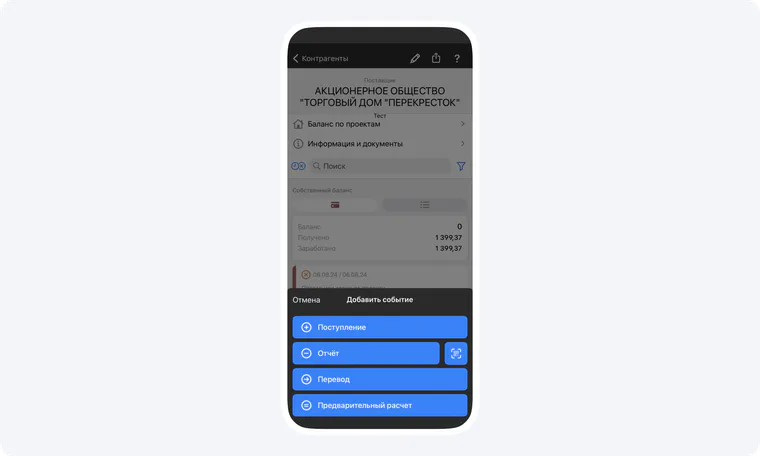
The archived 101 app screen below shows separate event options for Receipt, Report, and Transfer. The interface may have changed; the distinction between a cash event and recognized revenue remains useful.
Main sources of revenue
A company can earn revenue from different ordinary activities:
Sale of goods
Goods sold are a principal source for manufacturers and trading businesses.
Provision of services
For service businesses, including construction and renovation contractors, revenue arises from services delivered to customers under the agreed terms.
Rent and licences
Renting out property or granting licences may generate revenue if it is part of the company's ordinary activities. Otherwise, classify the income separately according to the circumstances.
How to calculate revenue
Identify which goods or services were transferred to customers and the amount attributable to the fulfilled obligation. A signed contract for a renovation job worth 500,000 rubles does not itself create revenue. If a customer accepts work worth 5,000,000 rubles during the month, that amount relates to performed work. Another 1,000,000 rubles for a project stage can be recognized only if the contractual and accounting conditions for that stage have been met; merely saying that the stage is finished is not enough. Track advance payments and actual cash receipts separately.
Revenue and cash gaps
When you recognize revenue on an accrual basis, you must still monitor how much cash enters and leaves the business. A cash-flow statement records payments by date. Comparing it with recognized revenue helps you see why a profitable project may lack cash when supplier invoices or wages fall due.
A cash gap is a serious business risk. A payment calendar and reserve can reduce its likelihood. Accrual revenue tells you what value has been earned; it does not tell you how much money is available to spend. Review advances, payment dates, and upcoming costs separately. A reserve can cover work before the customer pays for an accepted stage, and later receipts can replenish it.
Forecasting revenue
Alongside actual revenue, a business needs a forecast. It helps plan sales volumes, seasonal changes, shifts in demand, and project capacity. A useful forecast can combine:
- analysis of past data;
- an assessment of competitors and the market;
- surveys or conversations with customers.
Compare planned sales with recognized revenue, expenses, and expected payment dates. The gap between these measures shows when working capital may be needed.
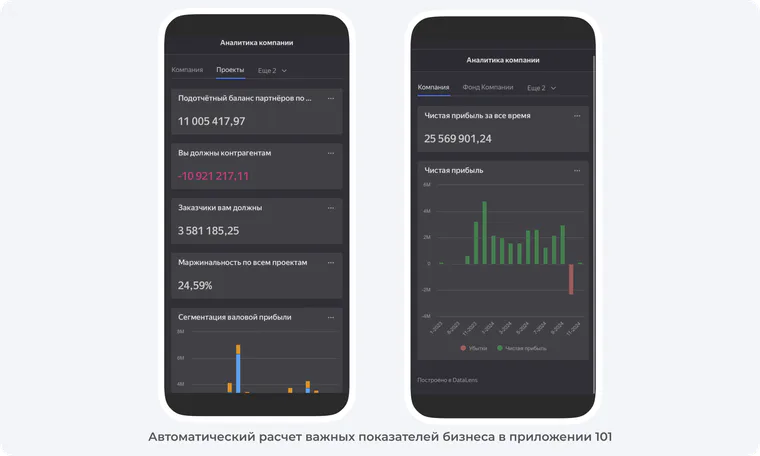
The archived analytics screen below illustrates that profit, debt, and margin are evaluated separately from revenue. It does not establish the current interface or any subscription features.
Why revenue matters to a business
Revenue is a useful measure of business activity, but it needs context from profit and cash flow.
Financial stability
High revenue shows the volume of recognized sales. By itself, it does not prove that the company is profitable, has cash on hand, or can cover its expenses. If revenue is 20 million rubles in one month and 5 million in the next, investigate the cause and plan for the variation.
Investment appeal
Investors consider revenue alongside profit, cash flow, debt, and growth. An increase in revenue alone does not guarantee funding or successful expansion.
Performance analysis
Revenue by project or business unit helps you compare activity. If it fluctuates, check delivery dates, the mix of orders, and team workload before drawing conclusions about the cause.