
Contents:
Why does a project-based business need management accounting?
Several projects can be at different stages at the same time. A customer has paid an advance for one contract, materials have been purchased for another, and some completed work is still unpaid. The total bank balance does not show which project is profitable or which obligations remain.
Management accounting brings together revenue, costs, payments and settlements for each project and for the company as a whole. It helps owners and managers make decisions about pricing, purchasing, payment timing and team workload. The metrics you need depend on your contracts and on which transactions your company actually records.
What should a project company's management accounts include?
Start with a consistent list of projects and income and expense categories. For each job, record the contracted amount, work completed, actual costs, customer receipts and amounts owed to contractors. Keep these figures distinct: a customer advance is not automatically earned profit, and a purchase paid for now may relate to a later stage of work.
At a minimum, four views help you assess a project:
- Planned versus actual work and costs by project.
- Receipts, payments and the current project balance.
- Settlements with customers, contractors and employees, including funds issued on account.
- Profit by project and company overhead allocated using a defined method.
Cost of work, contribution profit and margin answer different questions. For example, contribution profit can be calculated as revenue minus the selected variable costs; contribution margin expresses that profit as a percentage of revenue. Document which costs you treat as variable, or project comparisons may mislead. See our articles on contribution profit and margin versus markup.
How can you organize management accounting in 101?
1. Create projects and expense categories
Use a separate project for each job or contract if you need to compare their results. Configure expense categories so similar types of work and purchases are recorded consistently. The steps are in the 101 guide to expense categories (in Russian). Before the team starts recording events, decide who enters and who confirms the data.
2. Link plans to actual events
An estimate records the plan. To use a consistent calculation structure, connect a price list to the project (guide in Russian) or use a work template (guide in Russian); check line items, quantities and totals before sending the estimate. Record work completed, purchases and payments as separate events as they occur. When comparing plan and actual figures, use the same period and scope; missing or unconfirmed events can distort the result.
3. Record receipts and funds issued on account
Record advances and other receipts against the relevant project. Keep money issued to an employee for purchasing separate from confirmed expenses; after the purchase, reconcile the report, receipt and remaining accountable balance. See the 101 guides to project receipts (in Russian) and material purchases with or without a receipt (in Russian).
4. Check the project balance
In 101, the project balance is the difference between recorded receipts and expenses; it is not the amount of cash held by an individual participant. Compare the Receipt, Expense and Balance figures, then check the related events and their confirmation. Details are in the project balance guide (in Russian).
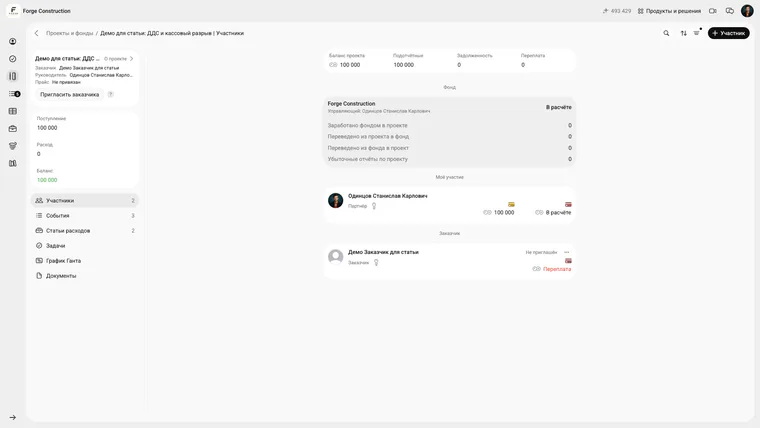
Project balance and accountable funds are shown separately. The interface is in Russian; this is a demo company.
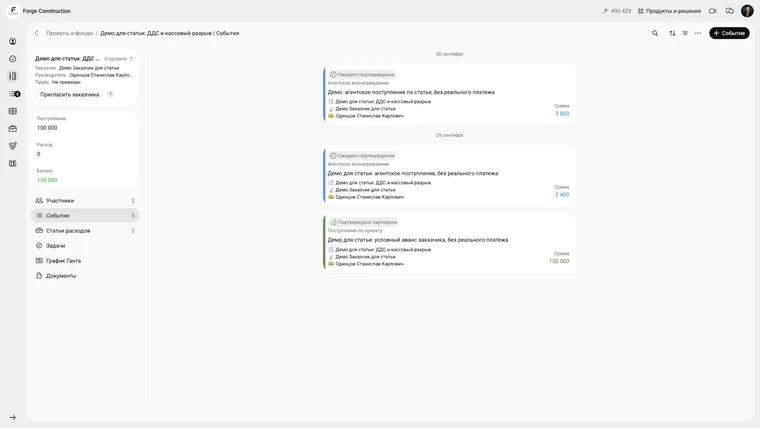
The event list shows receipts awaiting confirmation and a confirmed advance. The interface is in Russian.
5. Review company results separately
For company-wide expenses and profit, select one company and one period. In the web version of the Company Fund, the Analytics section shows expenses, while Profit and Loss shows profit from projects. When exporting events, check the dates in the download: the chart period does not automatically restrict the exported archive. Access to sections depends on permissions and the subscription plan; check what is available in your account. See the Company Fund analytics guide (in Russian).
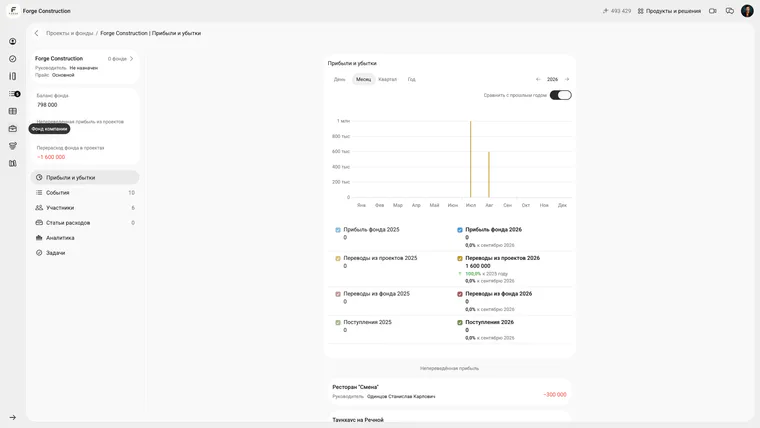
The Company Fund Profit and Loss section: monthly view and year 2026 selected. The interface is in Russian.
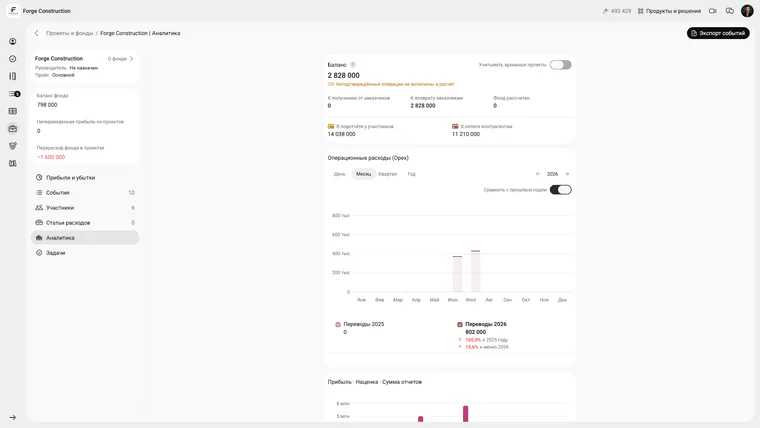
Company Fund Analytics shows expenses, chart period and the event export button. The interface is in Russian.
Which decisions can these figures support?
When transactions have been entered and checked completely, reports can help you compare jobs, types of work and periods. You may spot excess material spending, a late customer payment, rising overhead or a low-margin project. Investigate the volume of work, contract terms and cost allocation before drawing a conclusion: a metric alone does not prove that the team made a mistake.
The data can also inform decisions about which services to develop, where to change pricing or purchasing, and when to discuss payment dates. No report guarantees higher cash flow by a particular date; outcomes depend on data quality and the decisions taken.
What common mistakes undermine management accounting?
- Mixing transactions from different projects without a consistent allocation rule makes comparisons unreliable.
- Recording estimates but not actual work, purchases and payments leaves the plan impossible to test.
- Treating an advance as profit or a project balance as an individual participant's cash confuses different measures.
- Failing to identify and reconcile funds issued on account and personal payments obscures what money is available.
- Changing category definitions between periods and then comparing figures that are no longer comparable.
Start with a small set of essential measures and reconcile them regularly. Add further views once the underlying data is entered consistently.
Frequently asked questions
How can I tell whether a project is profitable?
Compare recognized revenue and the costs attributable to the project for the same period. Then check outstanding obligations and how company overhead is allocated. Examine cash receipts and payments separately: profit and the cash balance can differ.
How do contribution profit and contribution margin differ?
Contribution profit is the amount remaining after selected variable costs are deducted from revenue. Contribution margin expresses that amount as a percentage of revenue. Compare only figures built from the same definition of variable costs.
Can I compare types of work and project managers?
First check whether the relevant data and viewing permissions are available in your account. Use consistent cost-allocation rules, and remember that managers may be responsible for projects of different sizes and complexity.
How long does setup take?
It depends on the number of projects, the quality of your existing records and the category structure. Start with one project, check its plan, actual work and payments, then apply the same rules to other projects.
How much time does daily recordkeeping take?
The ongoing workload depends on the number of projects, how tasks are shared across the team and how regularly events are entered. When people record work, purchases and payments as they occur, the manager can focus on reviewing reports and exceptions. Estimate the time for your company after a trial period.