
Contents:
What are design and site investigation works?
Design and site investigation works comprise activities that study the conditions needed for design and construction. They take place at an early stage to investigate the site: ground conditions, human-made influences, and everything needed to develop a sound design and cost estimate.
Design and site investigations can be expensive, but the consequences of skipping this stage can cost even more. They help identify potential problems early, reducing the risk of substantial costs and delays later.
The scope of investigations and documentation requirements are determined by the site, the structure, the project, and the applicable rules in the country of construction. Before work begins, confirm these with the designer and relevant specialists.
Why are design and site investigation works needed?
Design and site investigations examine the characteristics of the site to help select suitable technologies and materials for constructing a building or structure.
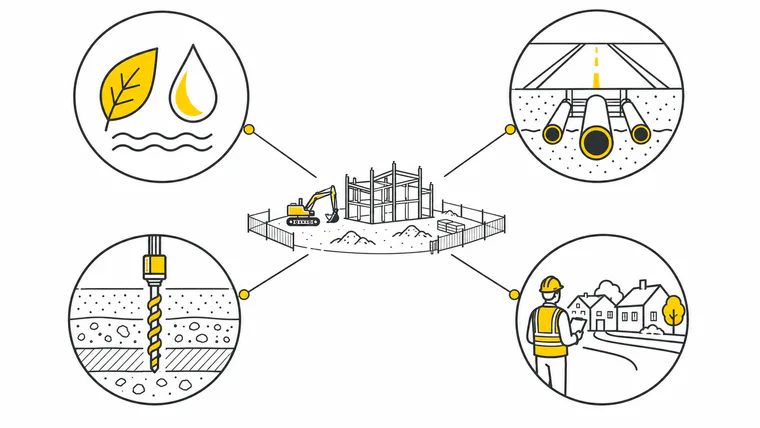
The main tasks addressed by design and site investigation works are:
- collect all the necessary information about the site;
- minimize potential errors during construction;
- prepare all the necessary documents;
- reduce the risk of unnecessary costs during construction and installation work;
- take measurements for specialists to review.
Design and site investigations help identify conditions that could lead to ground settlement and cracks in foundations and walls. The designer needs these data to choose solutions that reduce construction risks.
Carrying out design and site investigation works
The scope of design and site investigation works depends on the structure and site conditions. The work usually includes preparing a brief, conducting investigations, and using the resulting data in the design.
Design and site investigation works include:
- preparing the technical brief;
- preparing a schedule for design and site investigation works;
- conducting field investigations (visiting the site, carrying out on-site activities, and using the necessary equipment);
- preparing the site layout;
- preparing the documentation.
Types of design and site investigation works
Types of design and site investigation works include:
Environmental investigations
These investigations help assess whether the site is suitable for safe habitation, evaluate environmental conditions, and predict changes caused by construction or subsequent occupation of the building against acceptable limits.
Geophysical investigations
Geophysical methods help investigate the site's subsurface structure by measuring physical properties. They are used alongside other investigations to clarify the position of layers and variations that matter for construction decisions.
Land surveying
These surveys determine the positions of features, point coordinates and elevations, and site topography. Survey results are used to prepare a topographic plan and tie design solutions to the adopted coordinate system.
Engineering geological investigations
These investigations examine the structure and properties of soils and rocks, as well as geological processes that could affect construction. The results help select foundation solutions and assess risks associated with the ground supporting the structure.
Hydrometeorological investigations
These investigations examine surface water and the climatic conditions of the area. Specialists assess the characteristics of water bodies, precipitation, and other conditions that must be considered in design and construction.
Hydrogeological investigations
Hydrogeological investigations focus on groundwater: its occurrence, movement, and effects on the site. Depending on the investigation brief, methods may include monitoring, boreholes, and other techniques. The need for and scope of this work are determined for the specific structure.
Stages of design and site investigation works
The stages of design and site investigation works are:
Stage 1
Conducting environmental, geological, land surveying, and other investigations. This stage establishes whether a house or other structure can be built on the site, what needs to be considered, how utilities should be routed, and which climatic or human-made factors should be taken into account. For example, ground conditions may rule out certain foundation types.
Stage 2
During the office-based analysis stage, specialists process and analyze the investigation results and prepare reports and conclusions. The designer uses these materials to develop the design of the future house. The required documentation depends on the structure and project requirements.
Stage 3
During design, the investigation results are used to calculate building services and utility systems and refine design solutions. Additional investigations are commissioned where necessary, and the corresponding changes are made to the design.