

You are choosing an interior for the home where your family will live and welcome guests. You are considering the layout, looking at stone samples and discussing lighting. At some point, a question arises that matters more than the colour of the walls: who can you trust to bring this vision to life, along with looking after your money, your time and your family’s peace of mind?
Sergey Kodolov is building Kodolov Group in Dubai around exacting standards of interior finishing and careful handling of materials. The company offers a complete service, from design through construction to furnishing and turnkey handover. There is also a side to this work that interior photographs cannot show: organising people, procurement and finances. Sergey uses 101 to manage projects.
I have personally visited apartments where he organised the interior finishing work. The workmanship was of a very high standard. I wanted to explore how a company delivering interiors of this kind operates when its employees and its leader are based in different countries.
Contents:
- A reputation built on completed work
- From first commissions to interiors in landmark residences
- Your home should reflect the way you live
- Caring for materials means respecting the homeowner’s choices
- Clear finances strengthen trust
- Managing projects without relying on one person’s memory
- An international team with ongoing responsibility for your project
- Partnerships that last beyond a single renovation
- Modern renovation standards apply to both workmanship and management
A reputation built on completed work
Sergey arrived in Dubai in 2022, with experience in the construction business already behind him. The website for his Dubai operation presents him as the founder of Kodolov Design & Contracting; the company reports more than 450 projects under his leadership since 2013 across the UAE, the CIS and Eastern Europe.
Sergey describes his start in a new market in concrete terms: small commissions, learning how local renovation work was organised and assembling a team. In his account of those early projects (in Russian), he links subsequent growth to recommendations from clients after successful work.
The first job he recalls involved correcting electrical work. Over a weekend, the team earned three thousand dirhams and divided the amount between its three members. Later, Sergey arranged to work on someone else’s project and spent around a month and a half observing the renovation process every day in this unfamiliar market. He needed to understand local practices and develop his own way of organising the work.
What appeals to me in this part of the story is an experienced entrepreneur’s willingness to return to site and learn. A new country called for new relationships, a team and an understanding of its working processes. A reputation earned elsewhere did not, by itself, secure the trust of an apartment owner in Dubai.
His first projects of his own followed, along with recommendations. This is how Sergey describes the beginning of that growth: completed work opened the door to the next introduction. For a prospective client, the value of this story lies in its clear progression. The reputation can be traced back to the actual experiences of people who entrusted their renovations to the company.
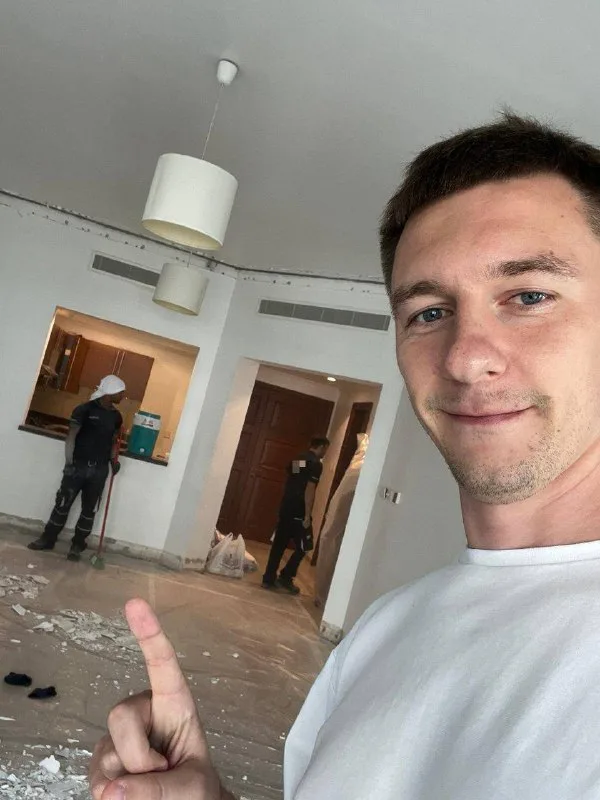
Starting work in Dubai. Photo from Sergey’s channel (in Russian).
From first commissions to interiors in landmark residences
The company’s published portfolio includes a project named “Royal Atlantis 2704”. The projects by Sergey that I knew about while preparing this article also include apartments in Burj Khalifa. For a property owner, these addresses raise a practical question: can the team meet the requirements of their particular home?
You can see one such property in Sergey’s video, “A complete turnkey fit-out of a new 380 m² apartment: Atlantis the Royal” (in Russian). Watch it to get a sense of the team’s work in this development and prepare questions about your own interior.
The tour description presents four bedrooms with different interior schemes and a shared area combining the living room and kitchen. For a family, the brief itself is interesting: one home must bring together private spaces for several people and a place where they spend time together. Floor area creates possibilities; comfort depends on how those possibilities are used.
The tour takes you through the rooms, from the entrance hall to the bedrooms, then the living room, laundry and kitchen. The primary bedroom chapter starts at 17:51, the living room and laundry at 25:37, and the kitchen at 35:52. These are useful points in the embedded video if you are currently planning those areas of your own home.
I think it matters that the conversation about interiors includes everyday spaces. When choosing a home, it is easy to be drawn to the view and a spacious living room. Yet a family uses the interior every day: welcoming guests, relaxing, storing belongings and doing household tasks. A project should address both reception spaces and practical daily routines from the outset, in keeping with your family’s habits.
I rate the finishing work I saw highly. When choosing a contractor, I would suggest taking the next step: visit their projects, discuss your requirements and meet the people who will be responsible for the result. The company offers site visits in Dubai, and that conversation can tell you far more than photographs alone.
Your home should reflect the way you live
Every family has its own routines. Some need a generous space for receiving guests; others want a clearer separation between shared and private areas. If your project includes a majlis, a space for gathering and welcoming guests, its comfort should be discussed alongside circulation through the home, lighting and the arrangement of neighbouring rooms.
These decisions deserve attention early in the project. Your contractor needs to understand how you intend to use your home, which rooms matter most to your family and which details you want to preserve. The homeowner’s personal taste sets the direction for everything that follows.
Kodolov Group’s comprehensive approach brings together design, interior finishing and furnishing. The company’s website describes a process that runs from assessing the space and developing the design to estimating costs, overseeing construction, decorating and handover. For the client, the purpose of this sequence is to keep the original vision connected to the finished interior.
The process itself also needs to respect family life. Agree in advance on access to rooms, working hours and permission to take photographs or film. These arrangements help the team accommodate your household from the first day.
A complete service is particularly valuable where different specialists’ decisions intersect. A chosen light fitting, for example, affects ceiling preparation; furniture placement affects electrical connection points; and floor finishes affect junctions with built-in elements. These are ordinary coordination questions that are best resolved before each participant completes their part.
For a homeowner, the benefit of that coordination is straightforward: you do not have to explain to each new specialist everything already discussed with the previous one. This is what people expect from a turnkey service. The company takes on the organisational work that turns individual decisions into a coherent interior.
Caring for materials means respecting the homeowner’s choices
Your chosen stone, wall finishes, furniture and lighting are all parts of one vision. Their value includes the time spent finding them, waiting for delivery and agreeing how they work together. Damaging a finished surface during the next stage undermines some of that effort.
Sergey’s demanding standards for interior finishing include careful handling of materials. For a homeowner, this is an important way to assess a team: care should continue throughout the work and as different specialists operate in the same room.
When getting to know a contractor, it is worth looking at how an active site is organised. How are completed areas protected? Where are materials kept? Who is responsible for the room when the next specialist starts work? The answers help you assess the team’s attitude towards your home long before final handover.
The quality I saw in Sergey’s apartments makes this subject especially relevant. A beautiful interior needs consistent care all the way to completion.
Clear finances strengthen trust
Sergey is developing a network of partners and bringing specialists from different countries together around his projects. This model relies on professional relationships and clear everyday agreements: who performs the work, who buys materials and who accounts for the money they receive.
Sergey was discussing the importance of record-keeping long before this article. In a post about tracking expenses (in Russian), he explains that even a strong team lost sight of small expenses until they started recording money in 101. His example is simple: a small receipt is easy to dismiss as insignificant, but an expense is still an expense. Regular record-keeping changes how people treat these details.
For a homeowner, the relevance is direct. A budget consists of specific purchases, work and payments. In 101, financial records are organised by project: money received, expenses, reports and supporting documents. With regular record-keeping, the team can explain what makes up the amount spent.
Consider an everyday situation: you want to know how much has already been spent on finishing materials. When transactions have been entered in the project, the answer rests on records and supporting evidence. It is easier for the manager to check the figures and for you to have a specific discussion about the budget.
This is how 101 supports relationships between participants: conversations about money gain a shared basis. That is especially valuable where a high-quality result depends on the work of an entire network of partners.
Managing projects without relying on one person’s memory
In the same account of record-keeping, Sergey points to an important detail: losses occurred even in a team he considered strong. Good relationships alone do not preserve every receipt or explain every payment. When money passes through several people, information needs to be recorded consistently.
For a growing company, this is a move from personally knowing every event to maintaining a shared record of the work. A manager who took part in a purchase remembers why it was needed. If an employee bought something on another site, the manager needs a report. If a partner manages the project, financial clarity becomes part of the relationship between the companies.
This is where the role of 101 becomes clear. Recording a project expense with supporting evidence preserves information for later review. With systematic record-keeping, a manager can revisit a transaction, compare it with other expenses and ask the person responsible a precise question.
For an apartment owner, this means more substantive conversations with the team. An answer about the budget should not depend on whether the only person who remembers every purchase happens to be available. Management discipline helps keep work moving consistently, particularly when a renovation takes a long time and involves many people.
An international team with ongoing responsibility for your project
The company employs people from different countries. Financial management is handled from Kazakhstan and marketing from Russia. Sergey spends considerable time in Argentina and continues to manage projects in Dubai, using 101 to maintain oversight.
For you as a client, the central questions are who is responsible for the work today and how well the manager understands the situation on site. Access to project information helps Sergey stay informed even at a distance. The team on site carries out the work and shares information, while the manager remains able to address issues in substance.
This arrangement requires discipline. Reports must reflect actual work and expenses, and quality issues must be checked on site. 101 helps connect this information with management. As the number of projects grows, that connection becomes increasingly important: a manager’s personal attention has to extend to both people and decisions.
If a contractor runs many projects, you need to understand how they will keep giving your home the attention it needs. Sergey explores this organisation in the video “How do we handle 60 renovations at once?” (in Russian), discussing 101 and other systems that help him run the company. It is an opportunity to look behind the management of the business and understand how oversight works when the leader cannot physically be on every site.
In the management video, Sergey presents several tools with different roles. In the chapter starting at 01:27, he discusses 101 as an app for recording income and expenses on each project. At 02:55, he turns to Asana and assigning tasks, including those related to the arrival of materials. From 06:42, he describes Telegram as a stream of photographs through which a client can follow the work. The section on record-keeping in Excel starts at 11:54.
This division addresses a need any homeowner can recognise: seeing what is happening with the renovation, understanding which actions are planned and knowing where the money is going. A photograph shows progress, a task helps organise the next step and a financial entry preserves the details of an expense. In the system Sergey presents, 101 is the tool responsible for income and expenses by project.
It therefore makes sense to learn about the management system while choosing a contractor. Ask how the team will connect progress reports with budget discussions, and who will keep the information current. For a family entrusting a company with their home, this clarity is part of the service. Sergey’s experience illustrates the place 101 can occupy in the daily work of a large team.
Sergey explains his approach to the local team in a post about hiring in Dubai (in Russian): he prefers specialists who already live in the city. For him, this is a matter of operational stability. An international team is combined with the presence of people where your home is located.
Another part of his approach is developing managers within the team. In an account of site supervisors’ professional growth (in Russian), Sergey describes a gradual increase in responsibility: from one project to several, then to managing other people. He emphasises that responsibility for money and deadlines requires different skills from directly supervising one type of work.
These reflections help explain how Sergey views management: employees’ independence needs to be developed and their responsibilities made clear. For a homeowner, a mature team is one that answers questions at the appropriate level. The company’s leader retains the overall picture, while the people on site understand their responsibility for everyday work.

Sergey Kodolov. Photo supplied for this article.
Partnerships that last beyond a single renovation
Sergey runs the @kodolovss channel (in Russian), shares his experience of organising a construction business and develops a professional community. His name also appears among the speakers at previous Russian Design Forum events in Dubai. What matters to this story is his participation in the city’s professional community, where designers, contractors and suppliers meet.
In a post about partnerships (in Russian), Sergey specifically discusses a clear division of responsibilities. This principle complements working through 101: a personal connection helps people start collaborating, while clear responsibilities and finances help them continue.
He writes from his own experience: several partnerships began spontaneously, with insufficiently defined boundaries of responsibility. For a new project, Sergey decided to work through the structure of the collaboration more carefully. There is a useful lesson in this openness: strong business relationships need attention even after people have agreed to work together.
The same applies to the network around a renovation. A change in one room can affect the designer, supplier and contractor. The clearer participants are about their responsibilities and finances, the easier it is to discuss changes. Working through 101 therefore fits naturally with Sergey’s approach to partnerships: record-keeping helps maintain financial clarity within relationships built on personal trust.
His professional network also extends to business support. In a testimonial on the Global Tax Assistant website, Sergey discusses cooperation on accounting and tax reporting in the UAE. This is another example of involving a specialist team in its own area of responsibility.
For a homeowner, the value of a partnership model lies in coordinated work. Design, interior finishing, furnishing and management should come together in one result for which the team is prepared to take responsibility.
Modern renovation standards apply to both workmanship and management
When you entrust your home to a team, you are entitled to expect careful workmanship, respect for agreements and clear answers about the budget. Transparency becomes part of the quality of the service.
These expectations come together in the Kodolov Group story: Sergey sets the standard for interior finishing, develops partnerships and uses 101 to maintain oversight of work carried out across locations. The app has its place in the daily organisation of the business, alongside the professional skills of the people creating the interior.
When choosing a team, ask to see both completed work and how your future project will be managed. Where will expenses be recorded? How will you receive a report? Who will check the information and answer your questions? Those answers help you understand how confidently the company can guide your vision through to a finished home.
For me, this story began with the high standard of finishing I saw in person. Behind it, a broader effort emerged: Sergey brings a team together, develops a partner network and builds relationships in which everyone has a defined responsibility. 101 helps maintain financial clarity across this system, between people, projects and countries.
That is the central lesson of the Kodolov Group story: as a construction company grows, transparent management becomes as essential to its work as the skills of its tradespeople. For Sergey, 101 has become one of the tools supporting that daily work. For a homeowner, the value of this approach is being able to understand who has been entrusted with the project, how the money is being spent and who is accountable for the result. That clarity is the foundation for the trust with which you want to begin creating a home for your family.