
Renovation costs can be divided into four blocks: labor, rough materials, design and procurement as a service. The calculations below are teaching examples for a 50 m² apartment, in rubles. The figures explain the method: they are hypothetical examples rather than a survey of market prices in 2026. For your apartment, you need current quotes from contractors and suppliers.
For a closer look at rising prices and how estimates work, start with the article “Apartment renovation costs in 2025” (in Russian), which explains why prices vary and why a “price per m²” often misleads.
Contents:
- Why does the “price per m²” so often disappoint expectations?
- How should you compare contractors?
- What has the greatest impact on apartment renovation costs?
- How can you estimate a budget for your floor area?
- Teaching calculations for a 50 m² apartment
- Where does an estimate become hard to control, and how can you manage spending?
- How can you obtain contractor calculations faster and compare quotes?
Why does the “price per m²” so often disappoint expectations?
“Renovation from 13 000 ₽/m²” sounds like a clear price. In practice, the essential question is hidden: what exactly is included? Some count only hands-on finishing work; others add demolition, waste removal, consumables, elevator protection, rough materials, logistics and quality control. There is one headline figure, but different scopes of work.

Another reason for variation is straightforward: apartment renovation costs depend on location and the availability of qualified specialists. A city of more than a million residents has different labor costs and competition from a small town. A newly built apartment and an existing apartment also require different work, even at the same floor area.
For a fair comparison, first record the scope: the work, rough materials, design and what the contractor means by procurement services. The figures then become comparable.
How should you compare contractors?
Here is what to compare first:
Labor means everything the crew does: demolition, building or removing partitions, plastering, screed, tiling, painting, electrical and plumbing work, assembling systems and installation. Even within labor, there are choices: whether to include perfectly level surfaces, complex details and stricter requirements for geometry.
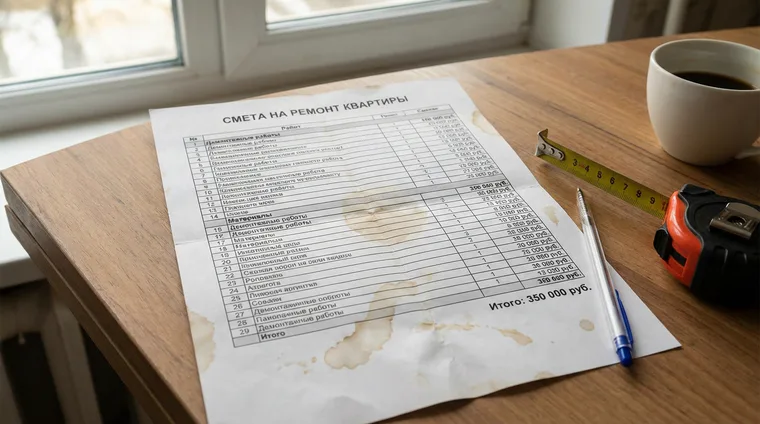
Rough materials include mixes, primers, plaster, filler, screed, waterproofing, cables, pipes, fittings, fasteners, consumables and sometimes soundproofing. Technical systems often create unexpected costs: the electrical panel, manifolds, leak protection, relocated systems and new circuits.
Design includes much more than images. An estimate usually covers a package: measurements, layout options, working drawings, schedules and specifications. With many nonstandard details, more drawings and precise positioning are required, and the price grows with the workload.
Procurement is the service of selecting, purchasing and handling the logistics of materials, sometimes including returns and replacements. Keep the distinction clear: the cost of the purchased materials is excluded from this block; it covers the work of the procurement specialist or studio.
To clarify estimate terminology and avoid confusing calculation formats, see the article “How to prepare an apartment renovation estimate?” (in Russian).
What has the greatest impact on apartment renovation costs?
Budgets usually go off course for reasons beyond tiles or wall colors. The main drivers are generally the project's basic decisions and how early you make them.
- City and neighborhood: specialists' rates, delivery costs, competition and workload.
- Apartment type: a new build, an existing apartment and a badly worn existing apartment after demolition involve different quantities of work.
- Layout and technical systems: relocating wet areas, manifold distribution, additional circuits and underfloor heating.
- Geometric requirements: a surface that is “level enough for painting” often needs more layers and labor.
- Complex details: concealed skirting, large-format finishes, shadow gaps and multilevel ceilings all cost more to execute.
- Schedule: speeding up the work almost always increases labor costs and the number of crews working simultaneously.
- Management quality: poor organization causes downtime, rework and last-minute purchases.
If a designer is involved and the project includes complex solutions, labor costs often move into a range that cannot be explained by a “price per m²” without examining the scope.
How can you estimate a budget for your floor area?
The following method helps you develop a reasonable initial figure in an evening, even without a final layout or schedules.
Step 1. Record the starting conditions: floor area, building type, condition (new build or existing apartment), whether the layout will change, the number of bathrooms and whether wet areas will be relocated.
Step 2. Choose the complexity level: a basic renovation without complex details, or one with complex technical systems and nonstandard solutions. At this stage, decide honestly whether you want to spend time checking these details and accepting work that will later be concealed.
Step 3. Establish a labor price range in ₽/m² for your city. A range is useful even within one city because crews define the scope differently.
Step 4. Add rough materials in ₽/m². For extensive technical systems, use the upper end of the range.
Step 5. Add design and procurement services. Design is often priced in ₽/m², while procurement may be priced in ₽/m² or as a percentage of purchases. For an initial calculation, ₽/m² is convenient because the final list of finishing materials may not yet be approved.
Step 6. Multiply the sum of the four blocks by the floor area and add a contingency. Keep the contingency on a separate line so it is visible. For teaching purposes, you can test scenarios with a 10% and a 15% contingency; the amount needed for your project depends on hidden defects and uncertainty in quantities.
To obtain an initial figure faster and rule out purely verbal calculations, read “Find out renovation costs quickly: how to get a figure you can trust” (in Russian).
Teaching calculations for a 50 m² apartment
Below are four hypothetical scenarios for a 50 m² apartment. City names label the examples; the figures do not establish current prices in those cities. The table includes only labor, rough materials, design and procurement as a service. Finishing materials, furniture, appliances, designer supervision, cleaning, waste removal and approvals are excluded.
| City | Labor, ₽/m² | Rough materials, ₽/m² | Design, ₽/m² | Procurement service, ₽/m² | Total for 50 m², ₽ |
|---|---|---|---|---|---|
| Moscow | 28 000–42 000 | 11 000–17 000 | 3 000–7 000 | 2 000–4 000 | 2 200 000–3 500 000 |
| Saint Petersburg | 25 000–38 000 | 10 000–16 000 | 3 000–7 000 | 2 000–4 000 | 2 000 000–3 250 000 |
| Kazan | 20 000–32 000 | 9 000–14 000 | 2 500–6 000 | 1 500–3 000 | 1 650 000–2 750 000 |
| Novosibirsk | 18 000–30 000 | 9 000–14 000 | 2 500–6 000 | 1 500–3 000 | 1 550 000–2 650 000 |
How should you use this table? Take the “Moscow” scenario and hypothetical rates: labor 32 000 ₽/m², rough materials 13 000 ₽/m², design 4 500 ₽/m² and procurement 3 000 ₽/m². The four blocks total 52 500 ₽/m². For 50 m², that is 2 625 000 ₽. Add a contingency on a separate line to obtain a teaching budget that you can use when asking contractors for a calculation by stage.
When comparing real quotes, clarify the rates for each block: labor, materials, design and logistics prices may differ between cities and contractors.
Where does an estimate become hard to control, and how can you manage spending?
A common sequence is that the renovation is priced, agreed and started. A month later, additional work appears. Some additions are normal, especially if the project began without a final plan or schedules. The problem starts when additions have no recorded reason or clear effect on the schedule and result.
Three areas where budgets most often go off course:
- Preparatory work: demolition, waste removal, repairing substrates and hidden defects. These are often underestimated at the start. Keep the preparation stages in mind from the article “What preparatory work is needed during apartment renovation?” (in Russian).
- Technical systems: additional circuits, a changed layout and more components in system assemblies.
- Procurement management: delivery, carrying materials upstairs, returns, incorrect deliveries and crew downtime caused by missing materials.
Simple discipline helps keep an estimate under control: record every change on a separate line with its reason, amount and approver. Digital records make this easier, with fewer lost receipts and fewer explanations that “it just happened.”
How can you obtain contractor calculations faster and compare quotes?
To compare contractors, request a calculation by stage and block, including a total. A preliminary calculation or estimate that identifies key work and responsibility boundaries is a convenient format. A separate article explains estimate types and preliminary calculations (in Russian).
Next comes control. Even a good estimate cannot help if nobody confirms actual spending and compiles it into a report. For projects managed in the 101 App, it is easier to consolidate payments and view the spending history, including cash flow reports (a useful starting point is the article on cash flow reports (in Russian)).
For the next step toward a manageable budget, gather the inputs (plan, floor area and technical system requirements) and request calculations from 2–3 contractors in the same format. The question “how much does apartment renovation cost?” then becomes a clear discussion of inclusions, exclusions, risks, contingency and how changes are controlled.