


Sharing profit with employees gives the team a clear connection between results and earnings. The site manager finishes a stage, the office secures payment, the client signs the report, and people can see why their effort matters on the next project.
The hard part is usually the calculation base and the rules: what counts as profit, when to calculate it, who participates, how to handle overspending, and how to separate company money from payments to individuals.
This guide covers practical profit-sharing models, the rules to write down, and a way to replace manual spreadsheet calculations and chat disputes with transparent figures and allocations.
Contents:
What counts as profit for sharing?
On a job, it is easy to confuse revenue with profit. The client's money arrives while purchases remain unsettled and some work is still in progress. The amount in the account is not yet the final result.
Agree on one calculation base. In a project business, it is often convenient to calculate profit by project or by work item: income minus direct costs for that part, using clear rules for overhead.
When work is priced with a markup, that markup generally supports the office and contributes to company profit. Explain this to the team in advance so the percentages do not become a dispute about individual shares. For more on open markups, see “Markup on work: pros and cons” (in Russian).
Practical profit-sharing models
| Model | Calculation | Suitable for | Risk |
|---|---|---|---|
| Percentage of project profit | A share of the project's result | Site managers, project managers, partners | Disputes over overspending and overhead |
| Percentage of profit by work item | A share of a specific item's result | Procurement, sales, individual roles | Harder to manage manually |
| Team profit pool | A fixed percentage in a shared fund | Office staff, support across several jobs | Individual contributions become less visible |
| Hybrid: fixed pay plus share | A minimum guarantee and a profit share | Key roles, specialists in short supply | Clear review terms are needed |
A contractor or agent may receive a percentage of the estimate. This can look attractive in cash terms, while the share of profit is unexpectedly large. If profit equals 30% of revenue, 10% of revenue equals 33.3% of profit (10 / 30). Recalculate this before agreeing on percentages.
Another useful practice is to include the company as a separate recipient. Its share creates a reserve for development, risks, cash gaps, and overhead that the team may not see in daily operations.
Rules that reduce disputes
Disputes often begin when people see a remaining balance and regard it as someone's personal payout. The team finishes the work, there is profit, and the owner takes a large share. That money may actually pay for tools, advertising, or accounting, but the team cannot see that from the balance alone.
Write the rules in one document, such as a bonus policy, incentive plan, or an appendix to a contractor agreement. Details that prevent later disputes include:
- what counts as profit: by project or item, and after which costs;
- the calculation period and allocation point: after report approval, after client payment, or weekly;
- who participates and under which conditions: role, tenure, completed tasks;
- what happens when costs exceed the plan or a loss occurs: a zero share, carryover to the next period, or a protection rule;
- how percentages change when roles or team membership change.
How to introduce profit sharing
If you introduce profit sharing with a single order, the team may welcome it and then raise questions the model did not answer. A short sequence lets you resolve difficult points early.
- Define the calculation base: project profit, item profit, markup, or agent remuneration.
- List the participants: who receives a share, fixed pay, or both.
- Add the company's share as a reserve for overhead and development, so business funds are clearly separate from anyone's bonus.
- Choose an allocation frequency and keep it: weekly, every two weeks, or after each stage closes.
- Set the rule for overspending: who bears the risk and where responsibility ends.
- Test the model against figures from a past project: compare everyone's payout and identify imbalances.
- Put the rules in writing and discuss one real case from your work with the team.
Profit sharing then becomes a management tool with stable rules that do not need monthly renegotiation.
How does the 101 App calculate and share profit?
In project work, the difficulty is often calculating the chosen model without manual routine. Manual allocations create delays and weaken the connection between action and reward.
In the 101 App, you can configure distribution manually for each project and each expense item. After the “Report” event is approved, profit is distributed among participants and appears in their balances.
The app supports three kinds of distributable result: profit, markup, and agent remuneration received by the company from a counterparty. Team members may work as contractors or partners; the company may also receive an agent reward and distribute it among participants.
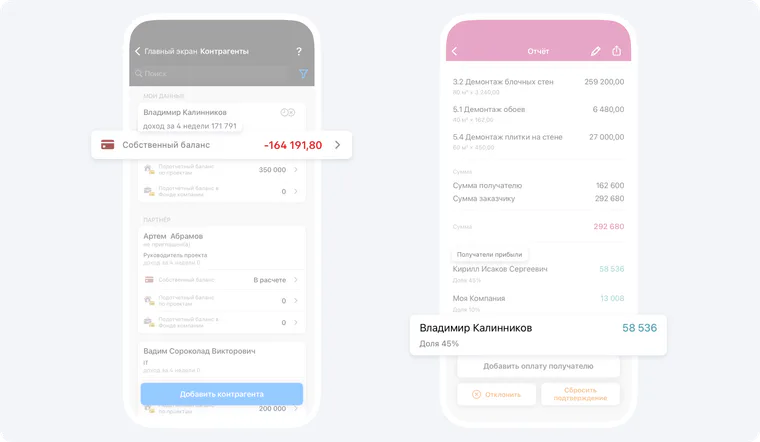
You can include different counterparties: the project manager, a partner, a designer who receives a profit or markup share for referring a client, and the company's reserve share. The shares add up to 100%, which is visible immediately.
One-off bonuses and awards
Some profit is shared by percentage, but one-off payments remain: a bonus for difficult negotiations, an award for meeting deadlines, or a gift for an occasion. Mixing these payments into project profit makes the figures less transparent.
In the 101 App, you can manage these payments through the Company Fund. Create an expense item for bonuses, create a “Report,” choose the recipient, enter the amount, and make the transfer. The Company Fund is available in PRO+.
Why do frequent allocations work more consistently?
When payouts are large and infrequent, the result can feel like a lottery: people work for a long time, receive it late, and lose sight of the connection to their actions. On a construction site this can show quickly: work is fast one month, then the team focuses on current tasks and no longer feels the result of the earlier push.
Frequent smaller allocations make motivation a steady habit. Finish a stage and see the allocation. Complete an approval and see the allocation. The regular rhythm supports quality.
Discipline matters: choose a frequency and keep it consistent. Changing the rules mid-season feels like breaking an agreement.
Common mistakes
Profit sharing breaks down when the model is unclear: the base is undefined, company money is mixed with personal payouts, or percentages change on impulse.
- Sharing revenue instead of profit, then discovering there is too little left for purchases and taxes.
- Ignoring overhead, which makes the owner's share appear too large.
- Changing percentages retroactively, even once.
- Making one large payment each quarter and losing the effect of regular reinforcement.
- Leaving the rules in chat messages, then disputing their wording.
- Mixing bonuses and gifts into the share model, so figures jump from month to month.
To share profit with employees calmly, start with the calculation base and rules, then automate allocations. The conversation about money can then rely on a clear calculation.