

Contents:
What is low margin in simple terms?
In a construction or renovation business, low margin means little money remains relative to revenue after completing an order. But margin, gross profit and net profit are different measures: margin subtracts direct costs from revenue, while net profit is calculated after all expenses and taxes. Below, we calculate the share of net profit in revenue.
Let us use specific numbers. Suppose you renovate a property for 1,200,000 Russian rubles, of which:
- 700,000 rubles go to materials;
- 300,000 rubles go to wages and logistics;
- 100,000 rubles go to rent, taxes and unforeseen expenses.
That leaves 100,000 rubles of net profit on 1,200,000 rubles of revenue. In this illustrative Russian-ruble example, net profit as a share of revenue is 100,000 / 1,200,000 × 100% = 8.33%. A large volume of materials purchases can raise revenue without a comparable increase in profit.
How does low margin lead to losing the patent tax regime?
This section discusses Russian tax rules for 2026. Conditions in other countries and periods must be checked separately.
To start further back: if you have a relatively small business, you probably already use available ways to reduce taxes. One popular option is the Russian patent tax regime or simplified taxation system (in Russian).
Tax burden must be calculated under the rules currently applicable. In 2026, revenue of 60 million Russian rubles already exceeds the 20 million ruble limit for the Russian patent tax regime (PSN). The patent cost depends on the region, activity and term; the simplified system (USN) depends on the tax base and rate; under the general system, VAT and either personal income tax for a sole proprietor or corporate profits tax are calculated separately. Comparing these systems as fixed percentages of the same amount without expenses and VAT is incorrect.
To assess eligibility for the Russian patent regime, check at least these conditions:
- PSN revenue in 2026 must be no more than 20 million Russian rubles in both 2025 and 2026; revenue is combined if PSN and USN are used together;
- the average number of hired workers over the tax period must not exceed 15 across all activities subject to PSN, including workers engaged under civil-law contracts;
- the actual work and delivery arrangement must match the issued patent. With subcontracting, PSN eligibility must be checked separately; a contractor’s sole-proprietor or self-employed status alone is insufficient.
At revenue of 5 million Russian rubles a month, the 2026 PSN limit can be exceeded within a few months. Money for materials included in the contract price also counts toward revenue and must be included in the forecast.

Russian-language meme: “You know, I’m something of an investor myself.”
What does “moving money through” mean in renovation and construction?
We are not talking about criminal schemes. This is a common arrangement: a client transfers money to a construction company so it can buy all the materials and pay for the work on the client’s behalf.
How is it arranged?
1. Construction contract
If the contractor buys materials at its own expense to perform the work, the parties may use a construction contract under Russian law (in Russian): as a general rule, the work uses the contractor’s materials unless the contract says otherwise. In that case, the price of work including materials affects the contractor’s revenue. The business faces two risks:
- you inflate company turnover without substantially increasing profit by receiving funds for materials purchases into your account;
- you may exceed the Russian PSN limit of 20 million rubles or the USN limit of 490.5 million rubles in 2026. The 20 million ruble VAT exemption threshold under USN is a separate condition and must not be confused with eligibility for USN.
2. Agency agreement
If purchases are genuinely made in the client’s interests as principal, consider an agency agreement with separate accounting for remuneration and pass-through funds:
This model requires genuine contract terms, supporting documents, separate accounting and compliance with the tax regimes. Agency remuneration is not yet net profit: the agent still pays its expenses and taxes from it.
Why do people run a low-margin business or take on purchasing materials?
There are several reasons:
3. Earn 10% of the amount
Materials purchases often cost more than the work itself. Ten percent of 5,000,000 Russian rubles is 500,000 rubles. Many find that tempting.
4. Earn a little more
A refrigerator sells for 100,000 Russian rubles. A foreman with a regular-customer discount buys it for 90,000 and sells it to the client for 100,000. The difference is 10,000 rubles before expenses and taxes. If purchasing remuneration is agreed separately, calculate and document it under the contract rather than automatically adding it to that difference.
Why is this benefit illusory?
Money for materials included in a construction contract price increases revenue and taxable income. Profit depends on expenses and may barely increase. Therefore, examine:
High taxes
Suppose a Russian entrepreneur’s USN income in 2026 is 200 million rubles and two new contracts add 40 million. The total of 240 million rubles alone does not exceed the USN limit of 490.5 million. However, the VAT exemption does not apply at that income: the applicable rate, deductions and tax burden must be calculated separately. There is no automatic switch to “20% on all turnover” here.
Low margin
A markup or agency fee is reduced by related expenses and taxes. Not every bank receipt is taxable income: for example, a repayable loan and documented pass-through funds under a genuine agency agreement follow special rules. First identify the legal basis for the receipt and the applicable Russian tax regime.
If little profit remains after materials, work, taxes and other expenses, high turnover does not mean high earnings.
Pavel Anakhasyan, co-founder of 101 GROUP: “For construction and finishing work, a normal margin is at least 20%. Below that, you are doing something wrong!”
The 20% in this quotation is the author’s rule of thumb, not a universal benchmark for every project. Compare like with like: margin with margin, and net profit with net profit; account for the work type, expenses and risks.
Moving between Russian tax regimes can change the burden, but it cannot be described as a switch from 6% to 20% of turnover. In 2026, the main Russian VAT rate is 22%; under the general system, a sole proprietor calculates personal income tax, while a company calculates profits tax at the main rate of 25%. Tax bases, deductions and expenses must be assessed separately.
How can a low-margin service lead to legal trouble?
A construction contract in which the contractor buys materials is lawful in itself under Russian law. Risk arises when the real relationship and documents do not match the declared model: for example, purchases in the client’s interests are recorded as the contractor’s own sales without accounting for the parties’ actual obligations.
How will you report to the Russian tax authorities when turnover grows?
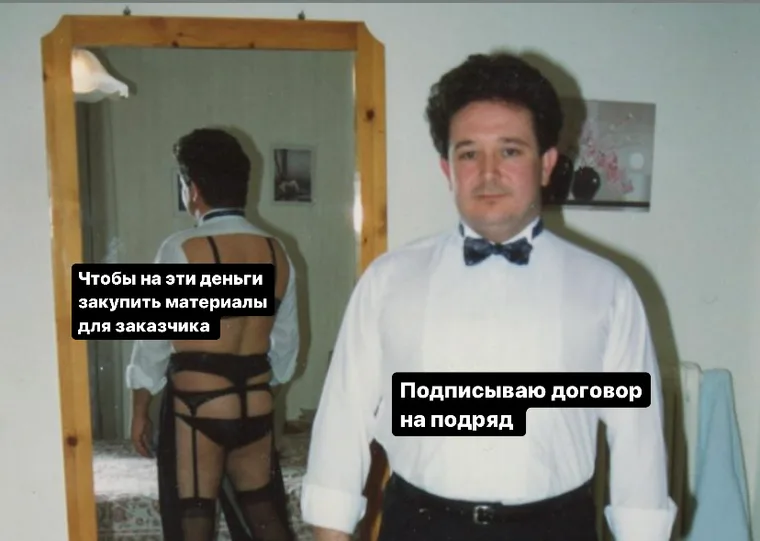
Russian-language meme: “Signing a construction contract” versus “Using that money to buy materials for the client.”
The situation can feel like a deadlock:
- builders want profit, but without expense tracking it is hard to assess a project’s result; this can be done, for example, in the 101 App;
- clients do not want to buy construction materials themselves. Nor should they have to.
Purchasing for a client requires an appropriate contract, documents and separate accounting. Neither a service nor a payment method alone guarantees that no tax obligations arise.
We provide:
- separate accounting for your own income and documented pass-through funds under an appropriate contract model;
- ready-made lists of materials to purchase;
- transparent tracking of every purchase.
Follow 101 news in our Telegram channel (Russian-language).