
The question of renting or buying an office usually arises when a team has outgrown a kitchen or coworking space. Client meetings, documents, equipment, a meeting area and storage all need room. They also bring recurring costs that can affect profit as much as payroll does.
Comparing renting and buying by intuition is risky. Regular rent and some upkeep costs create obligations regardless of workload. Buying premises, paying a refundable deposit and repaying loan principal are different cash flows: they cannot automatically be treated as current operating expenses. Management accounts should identify office expenses separately so they are not spread indiscriminately across projects and lead to misleading conclusions.
We will examine the advantages and disadvantages of both options, then build a simple comparison over 3–5 years so the decision rests on figures.
Contents:
- What should you decide before comparing renting and buying?
- Renting an office: advantages and disadvantages
- Buying an office: advantages and disadvantages
- How can you compare renting and buying in one model?
- Fit-out, relocation and furnishing: where money can be lost
- How to keep office expenses under control
- Key conclusions: when to rent and when to buy
What should you decide before comparing renting and buying?
A comparison of renting and buying falls apart if you have not first defined your requirements. An office is a tool for selling, working, storing things and bringing a team together. Its specifications affect the cost of using and owning it.
Start with duration and flexibility. If the business grows in bursts, its space requirements can change quickly. Buying may then tie up money in premises that no longer suit the way the team works.
The second issue is financial pressure. Office rent is a fixed expense, alongside some salaries, taxes and subscriptions. Unit economics, break-even analysis and profitability help you assess these costs together. Useful background includes our articles on business performance indicators and how analytics in 101 App works (article in Russian).
Renting an office: advantages and disadvantages
Renting offers speed and a manageable level of risk: sign the lease, make minor improvements and move in. For many companies it is a way to test a location, an office format and how much space they actually need.
Typical advantages include an easier move, more scope to adjust space as the team grows and less cash needed upfront than for a purchase. Renting also encourages discipline: the office is a cost that should be justified by sales and more efficient processes.
Typical disadvantages include dependence on the landlord's terms, index-linked increases, restrictions on alterations and the risk of termination. There is also a psychological concern: you may hesitate to invest heavily in premises the company does not own. Before undertaking work, check the lease term, approval requirements and compensation for improvements. An emotional argument alone does not establish which option is financially better.
Buying an office: advantages and disadvantages
Buying offers control and a longer planning horizon. The company acquires ownership of premises; whether it can sell, let or pledge them depends on applicable law, permitted use, encumbrances and financing terms. Owning an office may support an image of stability, but it does not by itself establish the company's ability to pay its debts.
Typical advantages include more scope for long-term fit-out and arranging the space around your processes, such as meeting rooms, a showroom or work areas. Alterations, changes to building services, storage and workshops must comply with permitted use, local requirements and necessary approvals.
Typical disadvantages include the purchase price and associated transaction, fit-out, furniture and equipment costs, the risk of choosing the wrong location and reduced flexibility. If the business changes its format through remote working, a new district or a different flow of clients, the office may hold it back: moving depends on selling or letting the property.
| Criterion | Renting | Buying |
|---|---|---|
| Flexibility in floor area | Higher: easier to expand or reduce space | Lower: changing offices requires a transaction |
| Upfront costs | Lower: deposit, first month's rent and basic preparation | Higher: purchase + fit-out + furnishing |
| Control over alterations | Restrictions under the lease | More scope, subject to permitted use and mandatory approvals |
| Risk of rising payments | Indexation and changes to lease terms | Depends on financing and property upkeep |
| Ownership of the premises | An ordinary lease does not automatically transfer ownership | Acquired under the transaction terms and applicable law; use may be restricted |
Ownership and an asset in the accounts are different questions. For example, a lessee applying IFRS generally recognizes a right-of-use asset and a lease liability under IFRS 16 (source in English); the standard provides exemptions for short-term leases and low-value assets. Check taxes and accounting classification against the standards and law applicable to your company.
How can you compare renting and buying in one model?
For the comparison, separate upfront outflows, monthly payments and the cash outcome at the end of your chosen period. The 3–5-year horizon is an example for scenario analysis, not a payback forecast. Buying leaves an asset, while a loan may leave outstanding debt. A comparison with renting is incomplete without these balances.
The following steps provide a preliminary comparison. Use the same floor area, period, currency and scope of included payments; assess tax effects separately under local rules. The calculation does not replace legal and technical due diligence on the premises.
- Step 1. Define your requirements and scenarios: floor area, district, parking, access, client space, expected period of use and anticipated changes in the team.
- Step 2. Compile rental cash flows: the deposit and preparation costs at the start, monthly rent with contractual indexation and upkeep, and potential move-out costs at the end. Show the expected deposit refund as a separate inflow under the lease terms. Keep any amount at risk of being withheld in the adverse scenario.
- Step 3. Calculate the purchase. Without a loan, include the full price, transaction costs, preparation and upkeep; separately show the assumed net proceeds from a sale at the end of the period. With a loan, include the down payment, transaction costs, preparation, monthly loan payments and upkeep. Deduct selling costs and the remaining debt from the assumed sale price. Do not add the property's full price again on top of the down payment and loan payments.
- Step 4. Compare payment timing and working-capital needs. For a deeper comparison, you can discount all options' cash flows using the same justified rate. If the rate already accounts for the cost of capital, do not add that cost again as a separate amount. Treat returns from investing in business growth as an uncertain alternative scenario.
- Step 5. Compare total cash outflows over the period, less final inflows, and the maximum cash requirement. Test scenarios for rising rent, fit-out costs and a lower selling price. Cash flow is not the same as an accounting expense: loan principal, the deposit and acquiring an asset should not be included in full in an operating break-even calculation.
For a deeper analysis, break office spending down into expense categories to see where profit is being absorbed. In 101, a useful starting point is clear expense categories with consistent names across the team. Our article on expense categories (in Russian) is relevant even outside construction: the approach to recording costs applies more broadly.
For the operating break-even point, identify fixed expenses and the contribution margin ratio based on variable costs separately. With a positive contribution margin ratio, required revenue equals fixed expenses divided by that ratio. Check the purchase of premises and repayment of loan principal in your cash plan; the expenses recognized for a period depend on the accounting rules used.
Fit-out, relocation and furnishing: where money can be lost
Discussions about renting or buying often overlook a third component: the cost of making the premises ready for work. Fit-out and furnishing can substantially increase the budget as electrical work, ventilation, equipment or furniture for a growing team are identified during preparation.
A useful rule is to keep versions of every office fit-out estimate. If an agreed amount increases during the work, record what was added and who approved it. Compare the original budget, agreed changes and actual spending, and retain the justification for each additional task.
Relocation itself is another potential source of losses: team downtime, misplaced documents and disorganized access arrangements and supplies. These costs are often overlooked until they arise.
How to keep office expenses under control
Office payments form part of fixed expenses. Tracking them separately at company level helps you see how much is spent on supporting the business: rent, communications, accounting, services and office payroll. A separate office-expense group makes it easier to compare these costs with revenue and contribution margin.
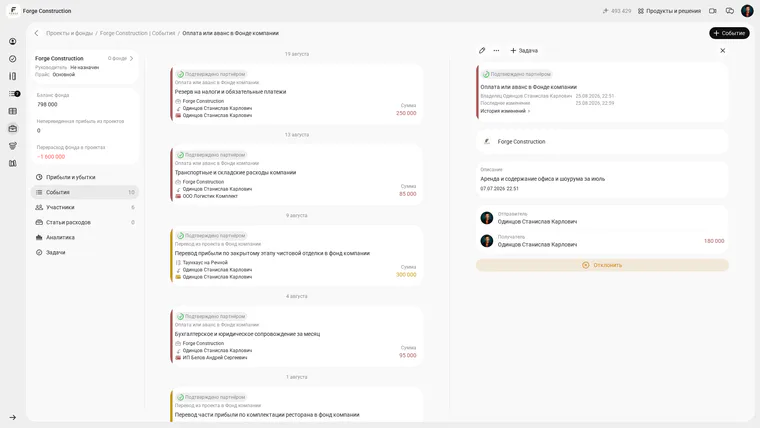
In 101 App, the company fund helps record general company transactions separately. The PRO+ offer terms, section 1.2 (in Russian) provide for recording the fund's financial transactions and reporting on them. An event records entered information about a payment or advance; its status in the app does not replace bank confirmation of a transfer. Reconcile the completeness of your records with contracts and payment documents.
The screenshot below shows an existing training record for office and showroom rent and upkeep for July in the Forge Construction company fund. The card displays a description, sender, recipient and an illustrative amount of 180 000. All data in this demonstration account are fictional; the amount is not a market rental rate or a recommended budget. The screenshot shows an accounting record, not proof that a bank payment was executed.
If you are choosing an office while the business grows, also calculate profitability and examine how fixed expenses affect it. Useful articles cover calculating profitability, the meaning of contribution margin and calculating revenue in management accounts.
Key conclusions: when to rent and when to buy
Renting is often suitable when you need premises quickly, team growth is uncertain, you want to test a location and office format, or flexibility in space matters.
Buying is often suitable when your planning horizon at that location is clear, cash flow is steady, significant fit-out tailored to your processes is planned and the office forms part of the company's image and credibility.
If the decision has stalled, start with your office requirements and an affordable cash commitment, then compare renting and buying over the same period. Assess fixed expenses and the break-even point separately. Once the figures are assembled, choosing an office becomes less a matter of personal taste.