

A crisis rarely affects every company in the same way. One loses enquiries, another faces rising costs, and a third has money tied up in work that has not been signed off. The result is the same: profit margins narrow, and mistakes become visible sooner.
At such times, managers have two levers: the margin on each deal and the speed at which cash moves through the business. In construction and renovation, this usually comes down to project accounting, agreements with clients, and discipline in handling materials.
Below are five approaches that may help increase profit even when demand contracts. This guide is aimed at project businesses: renovation, finishing, building services, and small general contracting teams.
Contents:
- Crisis: where is profit hiding in your business?
- 1. Recalculate margins for each type of work
- 2. Increase average order value with packages and change rules
- 3. Reduce losses from materials, rework, and downtime
- 4. Accelerate cash: advances, stages, and completion documents
- 5. Introduce daily management control
- A seven-day checklist
Crisis: where is profit hiding in your business?
The problem with a crisis is that it rarely creates entirely new losses. It exposes existing ones: unrecorded discounts, unnecessary site visits, material overruns, work without agreed quantities, and weak payment discipline.
Start with a simple task: stop measuring the business by total revenue and look at profitability by project and business line. If your records amount to “money came in, money went out”, begin with a short audit of management processes and cost categories. The 101 blog has a separate guide to auditing management accounting and common problems that erode profit.
Then the work becomes specific: what generates margin, what causes cash shortfalls, and where your team loses time and materials. You can implement the five approaches in parallel, but start with one so you can measure its effect.
1. Recalculate margins for each type of work
A company-wide margin can be misleading during a crisis. One project carries profit, a second consumes resources, and a third looks profitable until warranty visits begin. Break the figures down: how much margin does each type of work, project format, and customer acquisition channel generate?
An illustrative example: a team takes on turnkey renovations and individual bathrooms. Bathrooms seem more profitable because the jobs are shorter. Recalculation reveals more changes during delivery, more deliveries and small purchases, and more rework caused by coordination with other trades. The final margin is lower, cash turns over faster, and the pressure is greater.
To recalculate margins, you need three things: the planned estimate, actual expenditure, and actual labour input. Organise estimating as a system rather than a folder of files. If estimates live in spreadsheets, read Excel or the 101 App for projects (in Russian) and identify what prevents consistent calculations. You can also calculate margins by individual line item and view figures for entire cost categories.
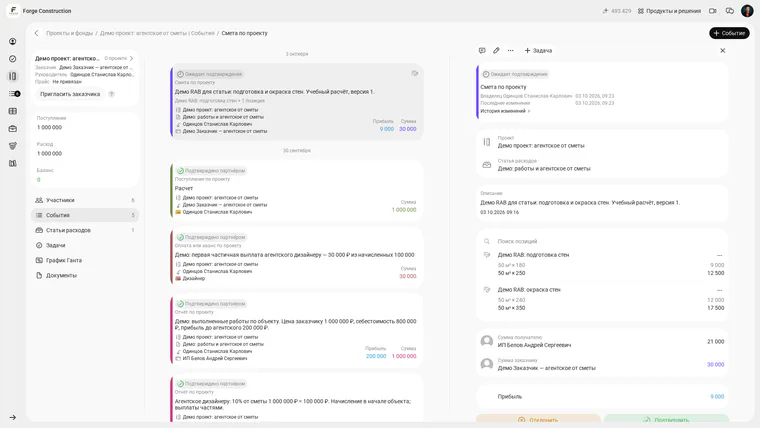
A training example in the Russian-language version of 101: a saved estimate with two line items. Costs are 21,000, the client total is 30,000, and planned profit is 9,000. The estimate is awaiting confirmation; this is a plan, not the project's actual profit.
Recalculation gives you a decision map: which work to pause temporarily, where to change the rules, where to increase prices, and where to strengthen controls. This is the foundation for the next four approaches.
2. Increase average order value with packages and change rules
In a crisis, it is tempting to lower prices simply to win a project. The problem is that a discount usually comes straight out of profit. A safer approach is to increase the average order value through clear work packages and rules for changes during delivery.
Two measures can produce results quickly. First, work packages with clear boundaries. When clients see “basic”, “standard”, and “extended”, the discussion becomes concrete: what is included, what is a separate task, and when extra charges apply. Second, a change procedure: every change is recorded, priced, approved, and added to the payment schedule.
To discuss pricing calmly, clarify the terminology: how price differs from cost, what an estimate means, and where to allow for a management contingency. The 101 article Price and cost: what is the difference? grounds the discussion in figures.
Another approach is to sell a clear end result with a predictable process, rather than simply “renovation”. In construction, a transparent estimate and an understandable work schedule often achieve this. Read What is a renovation estimate and how do you calculate it? to help structure your proposal.
3. Reduce losses from materials, rework, and downtime
Cost optimisation sounds dull until you add up the losses on one site: unnecessary deliveries, purchases “just in case”, leftovers that are never returned, downtime caused by poorly coordinated stages, and rework after acceptance. During a crisis, these losses can become a major opportunity to improve profit.
The practical logic of lean working is simple: record recurring waste, set limits, and measure the effect. Use the guide to lean working for builders (in Russian) as a starting point and adapt the ideas to your team.
A scenario: a foreman requests extra bags and fixings “to avoid missing the deadline”. The purchaser buys a buffer, leftovers move between sites, some disappear, and some stay in storage. The solution usually lies in rules: purchase against a materials list, document returns, prohibit unapproved off-book purchases, and maintain a shared materials catalogue.
If materials account for a significant share of spending, organise purchasing and expenditure records to control overruns. To check stock balances, record usage, returns, and transfers separately. The article How can you simplify construction materials accounting? (in Russian) shows where to start.
4. Accelerate cash: advances, stages, and completion documents
You can have a healthy margin and still be constantly short of cash. During a crisis, this can halt work at the worst possible moment. Set a separate goal: speed up cash turnover and make the payment schedule part of project management.
The first layer is advance payments and staged work. Working entirely on payment after completion raises the risk considerably. Change often begins with a simple rule: the contract specifies stages; each stage has a scope, deadline, and amount; and that amount includes an advance payment. Use the guide to moving to advance payments (in Russian) as a negotiation checklist.
The second layer is completion documentation and recording delivered work. The later quantities are agreed, the later you receive payment. If you manage many sites and tasks, consider automating preparation of completion documents and tracking approvals. The article on preparing work completion documents (in Russian) explains the process.
The third layer is a cash forecast for each project. It shows where a shortfall may arise and what to do: postpone a purchase, agree an earlier payment, or restructure stages. The combination of project budget, actual figures, and calendar helps. Read How to manage a project budget in the 101 App.
5. Introduce daily management control
The fifth approach sounds large-scale, but it is really about consistency. A crisis leaves little room for “reviewing finances on Fridays”. You need a daily rhythm: what is happening to margins, payments, and expenses, and where has the team deviated from the plan?
When records are scattered, control becomes a manual search for figures. A single system for projects and cost categories helps assemble management reports without heroic effort. Read How to organise management accounting in a project business and select reports suited to your needs.
A useful crisis practice is to agree three daily questions within the team. What are we doing today to finish a stage and request payment? Which expenses are essential today, and which can wait? Where does the project face a risk of overspending or rework?
If you want to bring controls together, look at how the 101 App handles projects, budgets, cost categories, actual expenditure, and reports. Initially, organising expense categories and separating personal spending from project spending may be enough. Read the article on allocating expenses to categories (in Russian).
A seven-day checklist
If time is short, use this one-week plan. It helps you test the selected measures even if your team does not yet have a fully configured system.
- Group projects and work types, then recalculate actual margins for the last 2–3 months.
- Identify three main sources of overspending: materials, rework, and downtime. Set one rule that reduces losses from tomorrow.
- Restructure your proposal: work packages, boundaries, change rules, and payment calendar.
- Introduce staged payments in all new contracts and check that existing projects have a clear completion plan.
- Select three daily measures: project margin, planned versus actual; payment receivables; and material overruns.
- Once a day, record deviations and one action that brings the project back to plan.
- After a week, recalculate the figures and decide what to roll out across all projects.
A crisis does not rule out growth. It makes growth more demanding: profit emerges where there are records, rules, and discipline.