
Contents:
Does your business need management accounting?
Financial accounting helps business owners see cash flows, profit, and the position of assets and liabilities. Without complete data, it is harder to spot a cash shortfall, assess project results, and plan growth.
Keep financial records, learn to plan, invest in your team, and build a reserve fund. Incomplete reporting and a lack of analysis increase the risk of poor decisions; these shortcomings alone do not mean that your business will inevitably close.
To reduce risks and manage business development, organise your accounting:
- Record all receipts and payments promptly. The 101 website lists income and expense tracking and accountable funds among the app’s capabilities.
- Save information and organise it systematically.
- Analyse your figures regularly to choose a well-founded course of action.
The cash flow statement
The cash flow statement shows receipts and payments over a period and the change in cash. It is also called Cash Flow or CF. To assess whether you will have enough money for future obligations, compare your current cash balance with a forecast of receipts and payments.
In a simple management version, the statement contains cash flows with transaction dates and categories of receipts and payments. You can start with an ordinary table; its data shows cash movements on a cash basis.
Consider a hypothetical example of cash movements in a single account, in Russian rubles. Specify dates, amounts, the type of movement, and the category. A transfer of 30 000 rubles from your own reserve fund is included in this account’s movements; transfers between your own accounts are excluded when consolidating the whole company’s cash flows. The net movement in the table is 530 000 − 420 000 = 110 000 rubles. The closing balance also depends on the opening balance.
| Date | Amount | Category |
|---|---|---|
| RECEIPTS | ||
| 10.05.2024 | 500 000 rubles | Customer advance |
| 15.05.2024 | 30 000 rubles | From the reserve fund |
| PAYMENTS | ||
| 14.05.2024 | 300 000 rubles | Salaries |
| 25.05.2024 | 50 000 rubles | Office rent |
| 26.05.2024 | 70 000 rubles | Taxes |
| NET ACCOUNT MOVEMENT | ||
| 110 000 rubles |
The cash flow statement helps identify patterns in receipts and payments and assess liquidity. For example, compare working on 3 and 4 projects: which option requires more working capital? To find out which option earns you more, also compare project profits using the profit and loss statement. Scaling requires an assessment of the business structure and project results.
The profit and loss statement
The profit and loss statement helps you assess your business’s profitability. It is also called P&L.
The statement shows revenue, expenses, and the financial result for a period. Under accrual accounting, revenue is recognised as the recognition conditions are met, such as the transfer of goods or provision of services to a customer. For management accounting, establish recognition rules and supporting documents in advance; recording an event in the app alone does not replace these conditions.
Revenue is the monetary value of goods delivered, work performed, or services provided to a customer, recognised under the applicable accounting rules. Receipt of an advance and receipt of the final payment are recorded separately in cash movements.
Revenue and the associated expenses help identify profitable areas and loss-making projects. Profit is not the same as available cash: before withdrawing funds, also assess balances, future payments, obligations, and applicable restrictions.
The 101 website presents income and expense tracking, profit and markup, and company analytics. Check the website for the availability of the functions you need and the pricing terms; these capabilities do not imply automatic generation of a full corporate P&L without configuring accounting rules.
The balance sheet
The balance sheet shows the company’s financial position on a particular date: assets, liabilities, and equity. The basic equation is assets = liabilities + equity.
The balance sheet lets you assess:
- what property and equipment the company owns;
- what liabilities exist at the reporting date;
- current accounts payable (what you owe) and accounts receivable (money owed to you).
The balance sheet helps assess property, debts, and the debt burden. For example, recognised accounts receivable show amounts owed to the company; expecting an advance does not by itself mean that a receivable has been recognised. The balance sheet helps analyse liquidity, while profitability is assessed together with the P&L and an appropriate calculation base. It does not guarantee timely payment of obligations.
Data on project balances and settlements from 101 can be one source for management accounting. The overall company balance sheet also requires other assets, liabilities, and equity that are absent from individual projects.
Where can you get the data for these reports?
The hardest part of preparing all these reports is gathering all the necessary data regularly and systematically.
Where can you find information to prepare the reports?
- bank account statements;
- cash records, documents and confirmations of funds issued to accountable persons and subsequent expenses; issuing such funds alone does not mean that the company has incurred an expense;
- chats;
- notes, including those on scraps of wallpaper, and other sources; verify significant records against supporting documents.
The main challenge is to collect and reconcile data from reports, invoices, and other sources. This can take considerable working time. If you are looking for an affordable way to digitise your accounting, explore 101’s capabilities and the current pricing terms.
A unified accounting system can reduce manual work if data is entered regularly and correctly. Analytics supports decision-making, but its usefulness depends on the completeness of records and the calculation rules adopted.
Which accounting capabilities are presented on the 101 website?
- income and expense tracking;
- balances and settlements;
- profit and markup;
- company analytics;
- the company fund.
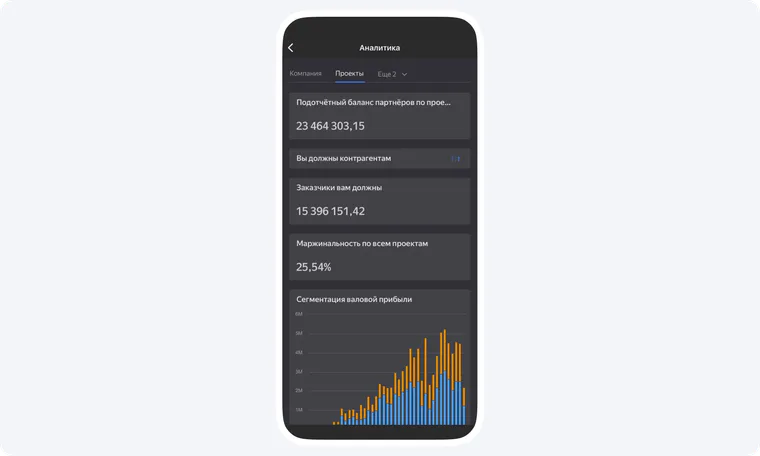
The website’s pricing table also lists advanced analytics and event history export. Check the access terms and the contents of the export for your task. The illustration below is retained from the original 2024 article: a Russian-language analytics screen showing debts, margin, and a gross profit chart. It is a historical interface example, not confirmation of the current feature set or instructions for the current screen.
Track the results of business decisions in 101 and compare the analytics with cash flow, P&L, and the balance sheet to plan your company’s development on a sound basis.