


Management reporting is a set of reports that helps managers make financial decisions: how much the business has earned, where performance has slipped, whom it owes, who owes it money, and whether there is enough cash for upcoming payments.
It is designed around the needs of each business. Its format and level of detail therefore depend on how sales, projects, purchasing, contractors, employee expense advances and payment schedules are organised.
Its main purpose is straightforward: management reporting helps you track the business over time and adjust your actions before the month has even closed. This is often explained through management accounting: a system that collects data and turns it into understandable figures for running the business.
Contents:
What is management reporting?
In practical terms, management reporting answers the questions business owners and project managers ask. How much cash came in and went out? How profitable is each project? What obligations does the company have? How much money is tied up in advance payments and receivables?
Management reporting usually builds on management accounting. Transactions are recorded first: receipts, expenses, accruals and debts. The data is then grouped according to consistent rules, by project, category, period and person responsible. The result is a set of reports that provides a basis for discussion: planned versus actual performance, profitability and liquidity.
In a project-based business, such as construction, renovation, events or made-to-order manufacturing, management reporting almost always centres on the project as a separate financial unit. Each project has its own balance, customer payments, expenses, profit and debts.
How does management reporting help managers?
The first benefit is clarity about money. Managers no longer have to guess why revenue is growing while available cash is not. The cash flow report and balance sheet explain this together: one shows cash movements, while the other helps explain why some funds are not available right now, because advances have been paid, receivables remain outstanding or obligations have accumulated.
The second benefit is control over profitability. The profit and loss statement helps you see profit for a period and compare business activities: which projects generate a margin and which drag performance down. This is critical in construction, where two sites with the same revenue often have different costs because of purchasing, logistics, rework or planning mistakes.
The third benefit is faster decisions. Management figures are useful when they are updated regularly. Management accounting rests on three principles in particular: a regular reporting cycle, timely updates and complete data.
A useful practical test is whether you can open a report and work out what to do next within 10 minutes. Recheck an estimate? Raise prices? Follow up on payment under a particular contract? Set a purchasing limit for the materials category? Management reporting should prompt action; otherwise, it becomes an archive.
The essential management reports
The minimum set of management reports needed to keep a business under control is usually reduced to three: a profit and loss statement, a cash flow report and a balance sheet. This combination appears across industries because it addresses three different needs: profit, cash and financial stability.
| Report | Main question | What makes it useful? |
|---|---|---|
| Profit and loss statement (P&L) | How much did we earn during the period, and from what? | Income and expenses are allocated to categories and projects, and the period is closed using consistent rules |
| Cash flow report | Which receipts and payments have already occurred, and how has the cash balance changed? | Actual transactions are recorded; future payments are tracked separately in a cash flow forecast or payment schedule with expected dates and amounts |
| Balance sheet | What does the company own and owe on a particular date? | Assets, liabilities and equity are recorded, including cash, accounts receivable, accounts payable and advances paid |
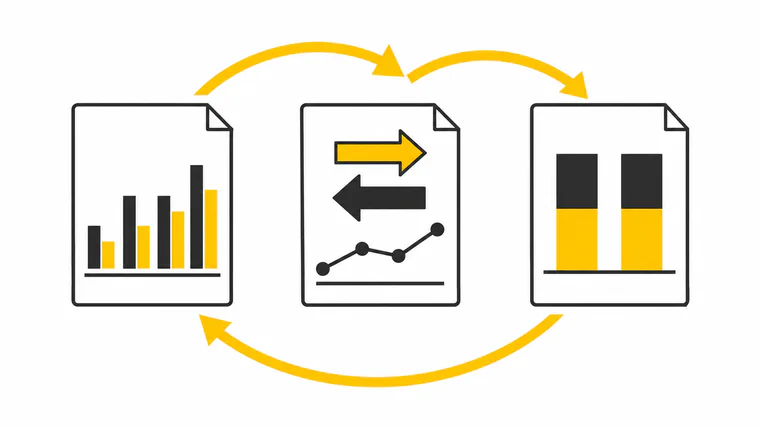
Project-based businesses add a further layer to these three reports: the project balance, planned versus actual figures against the estimate, expense breakdowns by category, contractor reports and employee expense advance reports. In 101, this is described as a project with a financial balance: customer payments, actual expenses, profit and debts within one project.
For a broader explanation of the terminology and the relationship between financial accounting and reporting, see our article on accounting for income and expenses (in Russian). Its legal references concern Russia.
How to set up management reporting without an analytics department
The hardest part of management reporting is collecting data. When expenses are buried in chats, receipts are in pockets and payments are in bank statements, reports become inconsistent. The article about the three essential reports also highlights this problem: data has to be collected systematically from different sources.
The good news is that management reporting can be built on discipline and simple rules. The steps below provide a sequence to follow. Implementation time depends on the state of the data, the complexity of the processes and the team's readiness.
Step 1. Define the management questions. These can be straightforward: profit by project, potential cash shortfalls over the next 2–4 weeks, debts and outstanding advances.
Step 2. Define the accounting units. In a project-based business, these are the project, whether a site, contract or event, plus income and expense categories.
Step 3. Agree on a single source of truth for the data: where payments are recorded, where expenses are entered and where supporting documents, such as receipts, invoices and work acceptance certificates, are attached.
Step 4. Set a regular cycle: enter transactions daily, reconcile cash flow weekly and close the P&L monthly. Regular reporting and timely updates are fundamental to management accounting.
Step 5. Set up planned versus actual comparisons. The plan comes from the estimate or project budget; actual figures come from recorded transactions. Compare the same periods, projects, scope of work and categories. Compare cash plans with receipts and payments, and cost budgets with recognised costs. An advance payment is not, by itself, a P&L expense. In construction, this often helps explain where money has gone in each category.
Step 6. Link decisions to the figures. If a category is overspending, introduce limits and approvals; if receivables are overdue, follow up on payments under the relevant contracts.
Common management reporting mistakes
Mistake 1: preparing reports only once a quarter. Management reporting is meant to reveal deviations quickly. Timely updates may sound dull until a cash shortfall arrives.
Mistake 2: mixing funds from different projects. When one site finances another, it can create an illusion of stability. 101's materials describe this risk as funds from a profitable project covering another project's shortfalls. Uncoordinated reallocations can leave insufficient cash when payments fall due.
Mistake 3: missing evidence for expenses. A receipt is lost, a contractor sends a total without a breakdown, or an employee advance is settled verbally. In management reporting, this leads to repeated disputes and distorted project costs.
Mistake 4: producing reports without drawing conclusions. A simple approach helps: every report should have an owner who reviews it and a decision rule that determines what changes when a figure deviates from the plan.
How the 101 App simplifies management reporting
If management reporting depends on collecting data, automation usually comes down to recording events as work happens: a customer payment, a materials purchase, an employee expense advance or a contractor's work acceptance certificate. This is a common reason for automating management accounting.
In the 101 App, a project is managed as a financial unit, with income, expenses and a project balance. Planned and completed work are compared in the project schedule: the estimate forms the plan, and the work report records completion. This simplifies day-to-day control and the subsequent review of results because the figures are already organised.
If construction reporting is relevant to your work, start with our practical article on how to simplify report creation (in Russian). It shows how reports support both internal record-keeping and reporting to customers.
Book a demonstration of the 101 App to see how to manage project accounting and reporting in your daily work.