“Shall we all chip in for the company event?” sounds harmless. In practice, it often turns into an argument: how much each person should pay, what is included, who approves it, why one person is paying for two, and where the receipts are.
A company event has a straightforward management aspect: it is either a company expense or voluntary spending by the team. When that distinction is unclear, money can damage relationships faster than any ill-judged toast.
Below are several practical payment arrangements and a set of tools for recording the budget, payments and supporting accounting documents. This keeps the event focused on the team and stops money becoming a source of arguments.
Contents:
What Exactly Is a Company Event?
The term “company event” covers several different formats. The format affects both who pays and how you document the expenses.
Three scenarios are common. The first is an event for employees: a New Year celebration, the company anniversary or a summer outing. The second is a meeting with partners or clients that involves negotiations and has a business purpose. The third is an informal team gathering after work, where the company may contribute money but the event remains an employee initiative.
Who Should Pay for a Company Event?
A practical approach is to agree on payment with the person initiating the event in advance. This is an arrangement between the parties; it does not, in itself, create a legal obligation to pay for the event. If the company organises the event as part of its company culture, it pays from company funds. If the team initiates a social gathering for its own enjoyment, the participants can share the costs.
Businesses often use a mixed model. The company pays for the basics: the venue, food and host. Employees pay extra for personal options: a plus-one, a separate table, an afterparty or an individual alcohol order. The key is that contributions are voluntary. If they become compulsory, resentment can quickly build.
The tax treatment of event expenses depends on the jurisdiction, the purpose of the event, its participants and the payment method. Check with your accountant in advance whether the costs can be recognised and which taxes and mandatory contributions apply to personal expenses in your company’s circumstances.
Payment Arrangements for Company Events
The arrangements below often work without conflict. Choose one that suits the size of your team and the level of formality.
| Arrangement | Who Pays? | How Do You Record It? | What Could Go Wrong? |
|---|---|---|---|
| 1) The Company Pays in Full | The company | One estimate, one person responsible, payment by company card and supporting accounting documents | “Personal” expenses appear on the shared bill |
| 2) A Budget per Person | The company | A limit per participant + a list of what the limit covers | Arguments over “who only came for an hour” and “who brought a plus-one” |
| 3) The Company Pays for the Basics; Participants Pay for Extras | A mix of company and participant payments | Two budgets: “shared” and “personal”, with separate payments | Shared and personal payments end up on one receipt without a breakdown |
| 4) A Department Fund | The company | Monthly allocations to a department fund, then spending as authorised by the manager | No rules on what the fund can pay for or who approves spending |
| 5) Voluntary Participant Contributions | Employees | Transparent collection + a spending report + a refund of the remaining funds or a carry-over to the next event | “We collected money for one thing and spent it on another” |
How Can You Record Expenses and Keep Track of Receipts?
A typical problem with company events is that the money has been spent, and then the hunt for receipts begins, along with attempts to reconstruct in a chat who paid for what. You can avoid this by assigning one clear role and recording payments routinely.
You need someone responsible for the budget and a clear sequence of actions:
- Approve the format and status of the event: a company event or a team initiative.
- Prepare an estimate by expense category: venue, food, drinks, entertainment, transport, photography/video, gifts and other costs.
- Set rules for personal options: plus-ones, separate orders, an afterparty and additional activities.
- Choose the payment method: a company card, an invoice from a contractor or an expense advance to the person responsible.
- Record each payment on the day it is made and attach supporting evidence: a receipt, invoice or acceptance certificate.
- Compare planned and actual spending: the outcome for each expense category and the reasons for any differences.
- Prepare a final report for the manager or the team: the total amount, remaining funds and who paid for personal options.
If personal expenses for specific individuals arise during the process, such as a named ticket, a voucher with a stated value or an individual purchase, mark them separately in your records and ask your accountant in advance how the company documents such expenses.
Where Should You Track Expenses?
Your choice of tool depends on the purpose. If you need a transparent report for the team, a spreadsheet is enough. If you need to monitor payments, expense advances and documents, a system that keeps expenses together with supporting evidence and the people responsible is more convenient.
These options are often suitable for a company event:
| Tool | When Is It Suitable? | What Should You Look For? |
|---|---|---|
| Spreadsheet (Excel / Google Sheets) | A small team with few contractors | Consistent data entry and storage of scanned receipts and invoices |
| Bank + company cards | Numerous small payments and a need to control spending limits | Categories, transaction comments, receipt uploads and user roles |
| Accounting system | You need to enter expenses in the accounts and collect source documents | Complete supporting accounting documents and expense advance reports |
| Project-based management accounting service | Company events are part of regular company spending, and you need planned-versus-actual comparisons and transparency | Expense categories, expense advances, transaction attachments and reporting |
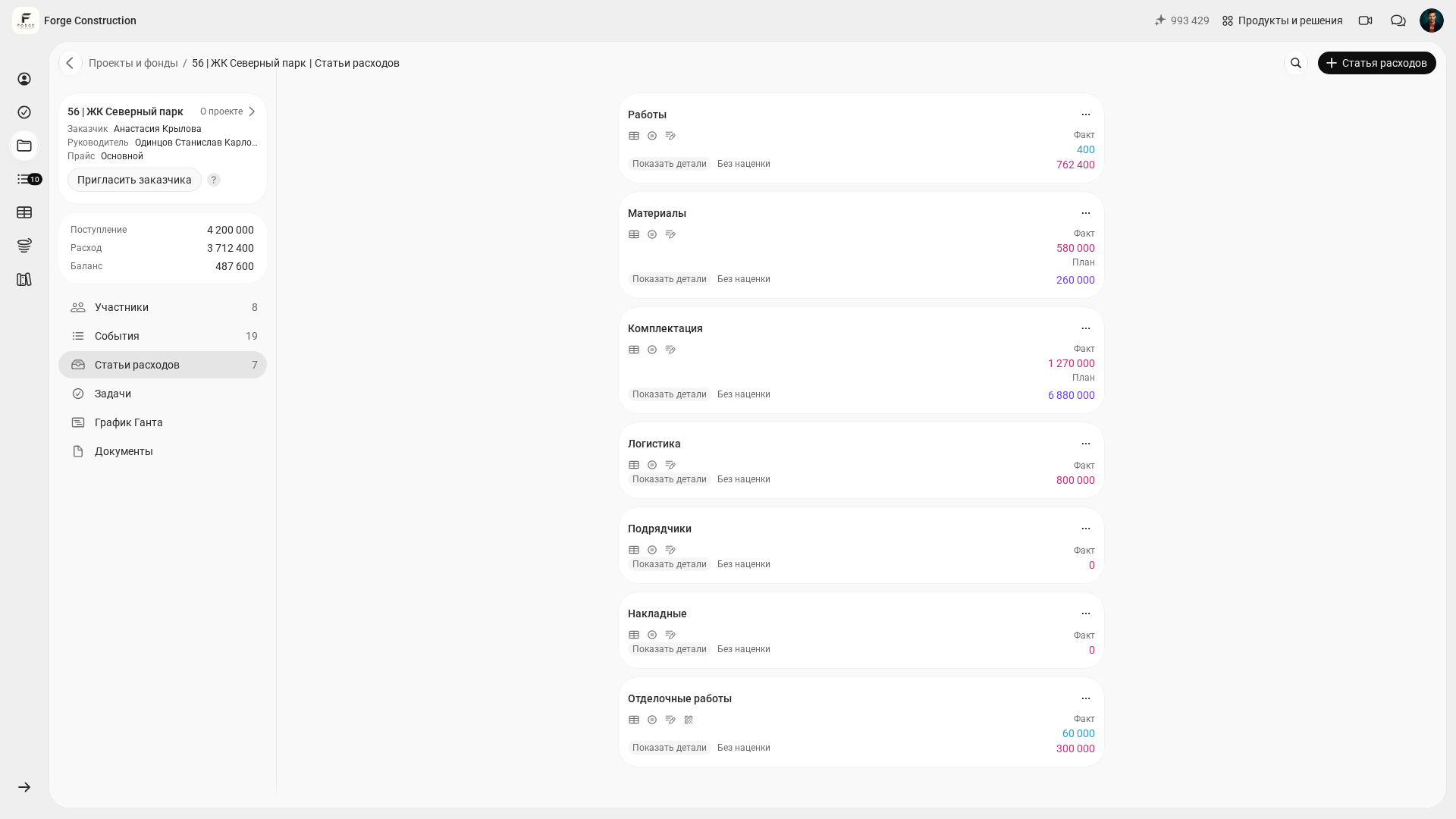
If you want to manage the event as a clearly defined “internal project”, one convenient approach is to create a separate “Company Event 2026” project in the 101 App and manage it like any other budget: an Estimate for the plan, Reports for actual expenses and separate records of money transfers. You can attach supporting evidence to events. The differences between an Estimate, a Report, an Incoming payment and a Transfer are explained in the Help article on event types (in Russian). The “plan + actuals + commitments” approach is explained in detail in the article on the project budget (in Russian).
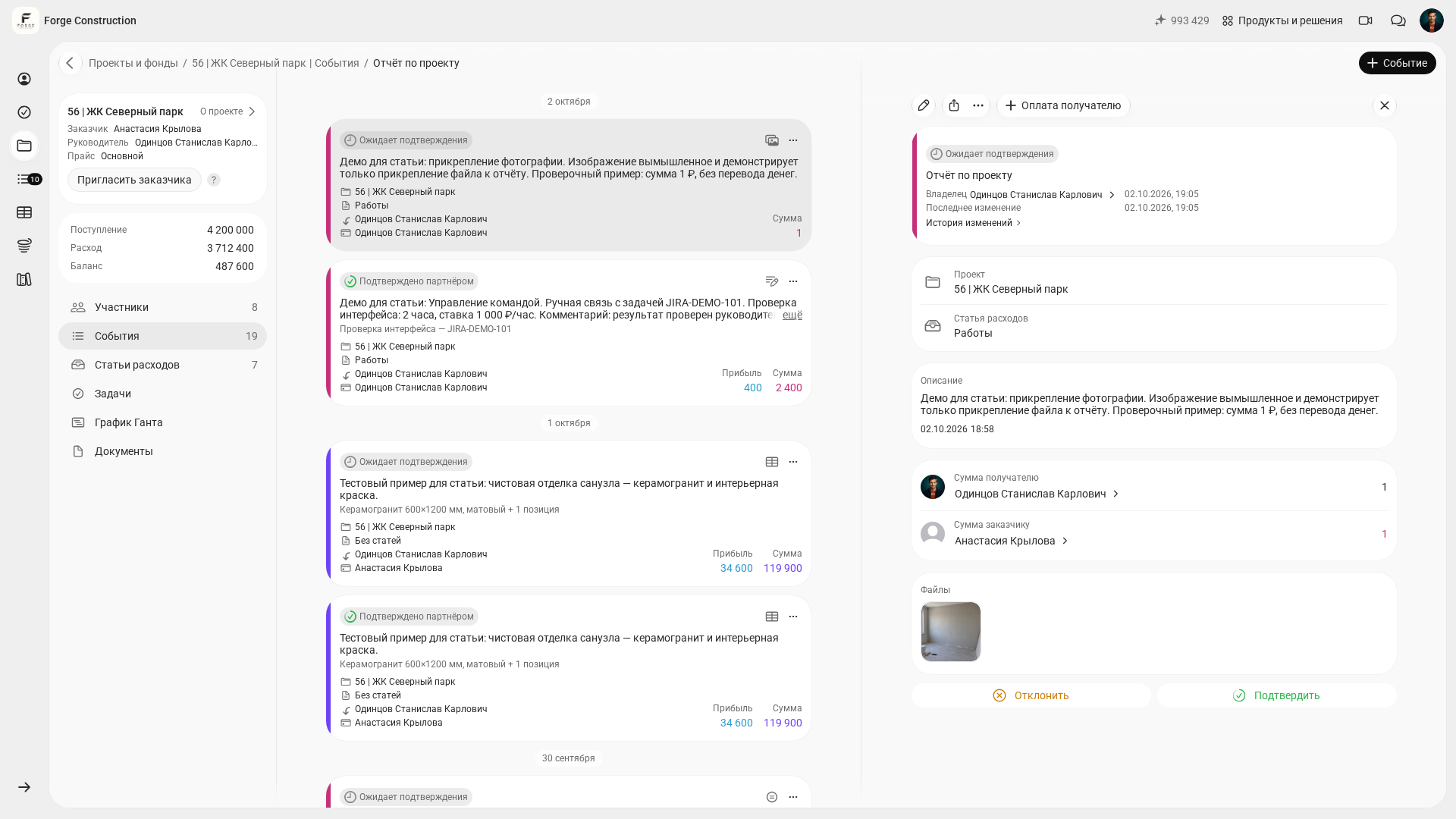
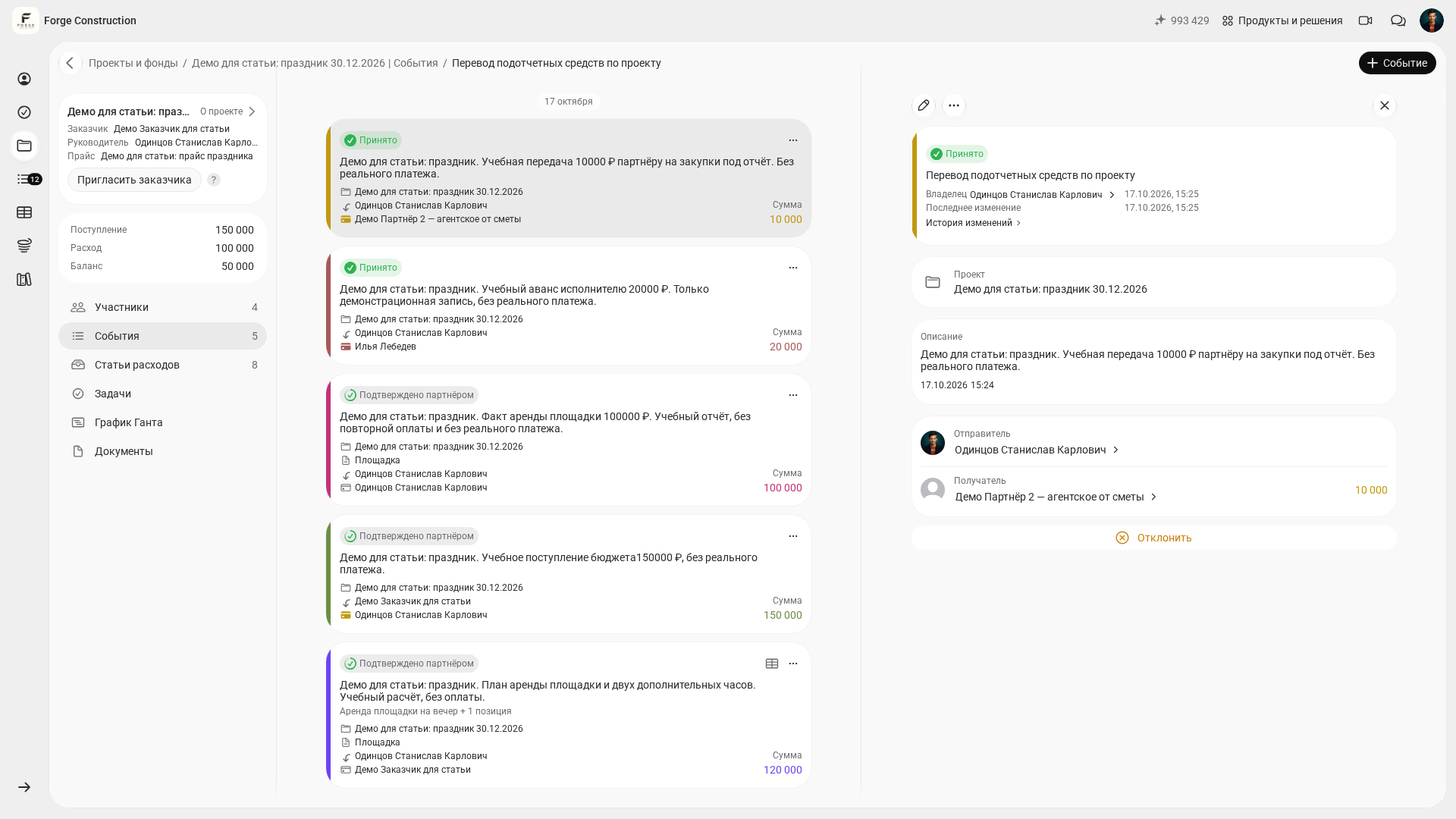
For purchases made with money already advanced, use the separate “Project expense advance transfer” event type in 101. It shows who received the money and how much was transferred. Record the actual purchase in a separate Report under the same project; you do not need another transfer if the money has already been advanced. After recording the events, check their statuses and the recipient’s balances for the relevant project: a saved Report alone does not confirm that the expense advance has been settled. Read more about advancing funds and recording a purchase (in Russian).
If the event is paid for from general company funds, you can record it alongside other overhead costs and keep it separate from project budgets. For an explanation of overheads and the distinction between “project expenses” and “company expenses”, see the article on overhead costs.
Another advantage of a project-based system is that the report is built from facts: who paid, what was purchased and which document was attached. The same principle helps keep the company’s management data in order, rather than piecing it together from a dozen chats and files. If this is relevant to you, see the article on management data (in Russian).
If you would like to explore how to track team expenses using your own example, join a demonstration of the 101 App.
Checklist Before You Pay:
- It is clear whether this is a company event or a team initiative.
- There is a budget and a person responsible who has authority to approve spending.
- What is included in the shared bill and what counts as a personal option have been recorded.
- The payment method is clear: card, invoice or expense advance.
- Every expense has supporting evidence: a receipt, invoice or acceptance certificate.
- Any personal expenses are marked separately, such as named tickets or vouchers.
- After the event, planned and actual spending have been compared, a final report has been prepared and the remaining funds have been accounted for.