

An advance payment from a customer in renovation and construction often sounds like a simple arrangement: “Send the money so we can buy materials and get started.” In practice, the advance affects the parties’ rights, project documents, and taxes. A mistake in the wording or accounting can turn an ordinary payment into a dispute about “whose money it is.”
The key point is this: an advance is money you still have to earn through the work and its documentation. Until there is a result, it represents an obligation under the contract and a liability to the customer in accounting; tax rules treat it separately, especially for VAT and the simplified tax regime.
This article describes contractor practice in Russia as of March 2026: what to put in the contract, how to account for the payment, and which paper and digital evidence to collect so the advance supports the project without creating avoidable risks. The Russian rules below should not be applied to contracts or taxes in other countries.
Contents:
- What is an advance under a works contract?
- Advance, earnest money, and security deposit: what is the difference?
- Which advance-payment terms should the contract contain?
- How should advances be accounted for?
- Which documents show that an advance has been earned?
- How can you keep advances under control on a project?
What is an advance under a works contract?
Under a Russian works contract, the basic rule is that the customer pays after the work result is handed over. An advance is due when the law or the contract provides for it. The parties should specify when it is paid, how much is paid, what it covers, and how performance is documented.
Consider a finishing project: in the first week, the contractor must pay for material delivery and advance wages to the crew. The customer is willing to transfer money but wants to know how it will be used. An advance helps start the project, while transparent records help maintain clear communication.

Another point is that an advance under a works contract can be viewed as commercial credit to the contractor: the customer pays before receiving the result. The contract should therefore explain how the advance is credited against work that is accepted in stages.
Advance, earnest money, and security deposit: what is the difference?
These terms are often mixed up in everyday speech. Under Russian law, they have different consequences, especially when a contract ends.
Advance payment is part of the price paid before the future work is performed. If the contract ends and no work was done, or less work was done than expected, the amount that the contractor may keep and the amount to refund depend on evidence of performance and the final calculation.
Earnest money secures an obligation. It must be recorded in writing. If the documents leave doubt as to whether a payment was earnest money, Russian law generally treats it as an advance. Earnest money can then have a penalty-like effect, depending on which party is responsible for the contract not being performed.
Security deposit may be used in a contract to cover future breaches, such as debts, penalties, or losses. In renovation work, a party may try to use it as a safeguard for the customer or contractor. It must not be confused with an advance: the payments serve different purposes and need different contract clauses and set-off documents.
Which advance-payment terms should the contract contain?
An advance works best with three foundations: a contract, clearly defined stages, and acceptance of the result through certificates or the contract’s procedure. Then the customer sees what the payment covers, and the contractor knows when work may continue or be suspended if a reciprocal payment is not made.
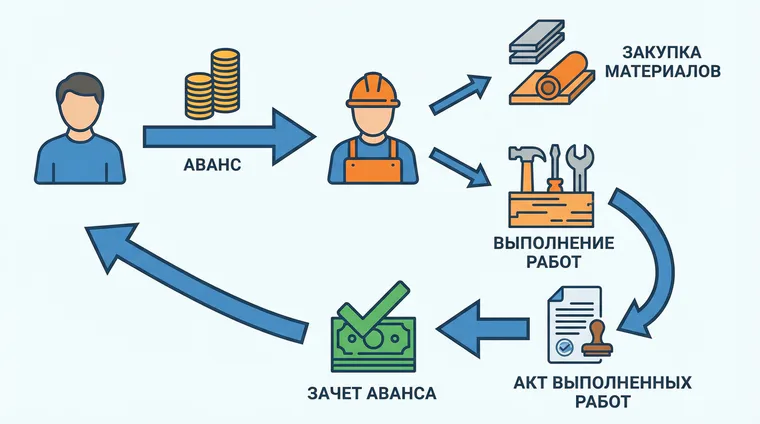
The simplest approach is to link advances to stages: payment → performance → report or acceptance certificate → next payment. We discuss the move to an advance-payment arrangement in “What to do if a customer refuses to pay an advance” (in Russian).
If you are setting up a workable contract, check that it covers the following points:
- Amount and schedule of the advance. A fixed amount or percentage, payment dates, and conditions for the next payment.
- Purpose of the advance. The costs it covers: work, materials, delivery, mobilizing the crew, or equipment.
- Set-off rules. How the advance becomes payment for completed work: against acceptance certificates, reports, or stages.
- Acceptance procedure. What counts as acceptance, the time allowed for objections, and what happens if the customer does not respond. For acceptance in Russian construction practice, see our article on the KS-2 work acceptance certificate (in Russian).
- Right to suspend work if payment is not made. This reduces the risk of financing the project with the contractor’s own funds.
- Refund of the unearned balance. The deadline, calculation method, and evidence of costs and completed work.
If you need a ready-made document covering construction stages and digital paperwork, see the 101 renovation works contract (in Russian) and the packages in the contracts for builders section (in Russian). It is also useful to read our discussion of works-contract risks (in Russian), so small but costly clauses do not get overlooked.
How should advances be accounted for?
In accounting, a customer advance is usually a liability owed by the contractor to the customer: cash has been received, but the work has not yet been recognized as revenue. Until the work is performed and accepted, it has not yet become earned revenue under that accounting approach.
A typical sequence of accounting entries is to record the receipt as an advance, set it off after acceptance certificates are signed, and then recognize revenue and expenses. The precise entries depend on the accounting policy and how stages are closed, particularly in long construction projects.
| Tax regime | What matters for an advance? |
|---|---|
| Russian general tax system, VAT payer | VAT generally arises on the earlier of the advance receipt or the sale of the work. From 1 January 2026, Russia’s standard VAT rate is 22%; VAT on an advance is generally calculated at 22/122. When the work is performed, the VAT previously calculated on the advance may be deducted under the applicable rules. |
| Russian simplified tax system (cash basis) | Income is recognized when the money is received. A refunded advance reduces income in the period of the refund. From 2026, some businesses using the simplified system may become liable for VAT under the new thresholds; check your revenue and contract terms. |
| Russian patent regime / tax on professional income | Income recognition depends on the regime and payment method. For advances, contract terms and receipts should match in their dates and payment purpose. |
Payments from individual customers need separate attention. If you receive an advance from a private customer and are required to use an online cash register under Russian rules, the advance receipt matters. Its payment-method indicator must reflect whether the sum is a prepayment or an advance; when the work is completed, a receipt for the final settlement is issued. Dates and indicators can be easy to confuse when there are several stages.
Which documents show that an advance has been earned?
In legal and accounting terms, an advance is earned through a chain of evidence: what was done → how it was documented → how the customer accepted it. The clearer this chain is, the easier it is to manage payments and discuss any refund if the project stops.
Russian construction and renovation projects often use KS forms and acceptance certificates. For an overview of primary documents, see “KS forms: the full list and how the paperwork fits together” (in Russian). If you work with KS-2 and KS-3, read our article on the difference between KS-2 and KS-3 (in Russian): it explains which form records work volume and which records payment.
For example, a customer asks for the remaining advance back and says that “nothing was done.” The contractor then produces the work log, dated photos, delivery notes, receipts, and stage acceptance certificates. With proper records, the dispute becomes a calculation of the work performed, purchases made, work accepted, and balance to be refunded.
How can you keep advances under control on a project?
Advance payments often cause trouble in project management before a dispute ever reaches court: money arrives, purchases and work begin, but by the end of the month nobody knows the balance. The next payment stalls, followed by bargaining and tense messages. Project-level records help prevent this.
Two useful tools are a payment calendar and a project balance. If you can see the project’s remaining funds and upcoming payments, the advance stops looking like “spare money on a card” and becomes a project resource. For more on cash gaps and cash flow, see “Cash gaps in construction” (in Russian) and “Cash flow statement” (in Russian). Another useful foundation is our working-capital guide (in Russian): it shows why advances affect a business’s resilience.
In the 101 App you can maintain a digital trail for an advance within a project: customer receipts, expenses, reports, documents, and acceptance certificates. If you use KS-2, see how acceptance-certificate generation is automated in “Creating KS-2 certificates in the 101 App” (in Russian).
Here is a short checklist for keeping advances under control:
- Record the advance, stages, acceptance, set-off, and any suspension for non-payment in the contract.
- Keep the advance separate from profit in your thinking and records: the money has arrived, but the obligation remains.
- Close each stage with documents; do not postpone acceptance certificates until the end of the project.
- Check your Russian tax regime and VAT status for 2026.
- Keep evidence of expenses and work within one project so payment discussions can be based on records.