
Contents:
What is the 4P model, and who developed it?
The 4P model grew out of the marketing mix: the idea that a business can deliberately adjust several elements of its marketing. Earlier lists of those elements were longer and included everything from packaging and pricing to advertising and sales staff.
In 1960, E. Jerome McCarthy organized the marketing mix into four groups:
- product;
- price;
- place;
- promotion.
Philip Kotler later popularized the framework in textbooks and management practice, which is why his name is often associated with it.
Why did it catch on? The framework is short enough to use in a partner meeting, a contractor discussion, or a team debate. A compact model is easier to remember and apply.
What are the four Ps?
4P covers the entire offer, beyond advertising. When a team debates creative concepts while overlooking the product and price, the framework brings the conversation back to decisions the team can make.
Product is what the customer actually buys: the scope and boundaries of the service, included materials, schedule, warranty, quality standards, service level, communication, and documentation. In renovation, a company may describe its product as a crew on site, while the customer buys a result and predictability: what will be done, when, at what price, and how completion will be documented.
Price includes the contract amount and the way it is determined: the estimate's components, payment terms, what is included in a fixed price, what counts as extra work, the allowance for risk, and the margin. Pricing also depends on change rules. If the customer changes a decision during the job, what happens to the budget and schedule?
Place is where customers encounter the offer and where the sale happens: a website, social media, marketplaces, partners such as designers or suppliers, a showroom, an office, or referrals. It also concerns convenience: how easy is it to get an estimate, approve stages, sign an acceptance document, and pay?
Promotion is how the team builds demand and trust: content, advertising, public relations, reviews, presentations, sales funnels, scripts, follow-ups, offers, and promotions. It also includes promises. If an ad promises something the service does not deliver, conversion can drop later, during a site visit, estimate, or contract discussion.
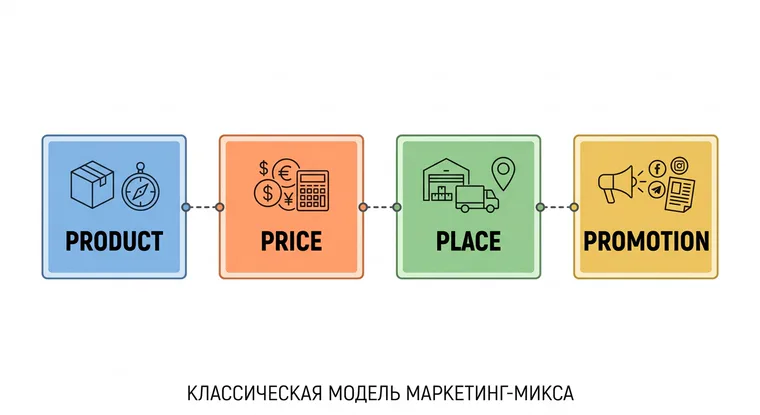
The four elements are connected. Change one and you may need to adjust the others. If the team raises the price, it may need to strengthen the product with clearer warranties and service, reconsider partner channels, and explain the added value in its presentations and case studies.
How do you apply 4P in practice?
Applying 4P is a diagnostic exercise. Choose one service and one customer segment, then examine each of the four elements. In project businesses, the service could be a bathroom renovation, apartment furnishing, a design project, or ongoing advertising management.
Step 1. Define one product in a sentence: what you sell, what result you promise, and where its boundaries lie. “We do renovations” is too broad to define a product.
Step 2. List what the standard service includes: measurements, estimates, purchasing, quality control, photo reports, acceptance documents, and warranty. Clarify where extra work starts and who approves it.
Step 3. Describe pricing as a system: payment stages, deposits, fixed-price conditions, and change rules. This often reveals a mismatch: marketing promises a fixed price, sales offers flexibility, and delivery works case by case.
Step 4. Map Place as a series of contact points. Where does the customer inquire, receive an estimate, decide, and pay? If you have many channels, choose two or three important ones and describe the path to payment.
Step 5. Break Promotion into messages and actions. What does the advertisement say? What is sent in the first reply? How does a manager respond to “too expensive”? What does the customer see in the contract and reports?
Step 6. Find contradictions between the elements: an ad promises one thing while the estimate shows another; the price rises but the product stays the same; partners bring customers but there are no rules for their fees.
For an example of how connected processes work, see 101's article on separating accounting from sales: leads are handled in a CRM, while money and margins are tracked in management accounts. Read “Do you need a CRM? Start with accounting, then automate sales” (Russian).
How does 4P help manage marketing?
The main benefit is control. Marketing becomes a set of decisions about an offer instead of a list of activities. The team can see which element it is changing and what outcome it expects.
It also helps teams work together. A marketer can ask delivery staff to define a staged renovation service with transparent reporting. Sales can present the same offer consistently. Delivery can protect the scope of work and the rules for changes.
4P also helps diagnose slow growth. Suppose paid traffic brings inquiries but few contracts. The weakness may lie in Product (an unclear offer or insufficient trust), Price (a confusing estimate), Place (a difficult path to an estimate), or Promotion (promises that attract the wrong expectations).
Partner channels provide another example. When designers, suppliers, or agents bring customers, Place and Promotion overlap. Decide what partners tell customers, what materials they receive, how fees are calculated, and how agreements are recorded. See 101's guide to working with designers (Russian).
A sales funnel is easier to plan with this view. The funnel connects Place and Promotion: its stages, materials, and the moments when a customer needs help deciding. See 101's guide to sales funnels for renovation and construction (Russian).
Where does 4P fall short?
4P works as a foundation. For services, quality also depends heavily on people and processes. The 7P extension adds People, Process, and Physical Evidence. These categories help discuss the team, the way work is done, and proof of quality such as procedures, photo reports, acceptance documents, and checklists.
Another limit is the company's viewpoint. 4P starts with what the business sells. The 4C model adds the customer's viewpoint: Customer Solution, Cost, Convenience, and Communication. It can help test whether an offer designed internally makes sense to buyers.
A third limit is economics. A business can have strong Product and Promotion but still lose margin through extra work, discounts, and overruns. In project businesses, marketing decisions soon depend on accounting. Without project-level numbers, arguments about 4P can become a matter of taste.
Transparency helps. When customers can see the estimate's structure, change rules, and process for accepting work, they can assess the offer more easily. Clear accounts and documents also support the promises made under Product and Promotion.
For more on the management side of money, margin, cash gaps, and pricing, see 101's article about its business and money Telegram channel (Russian).
A quick 4P checklist
Use this checklist before launching an ad, changing prices, adding partners, or hiring a sales manager. Note any question that has no clear answer.
- Product: Can you describe the service in one sentence, with clear scope and extra-work rules?
- Product: Do you have proof of quality, such as a portfolio, acceptance procedure, photo reports, or documents?
- Price: Can you explain its structure, and do customers hear about change rules before signing?
- Price: Are payment stages tied to results, and does the team understand them?
- Place: Is the path from inquiry to estimate short and free of unnecessary handoffs?
- Place: Do partners know who brings customers, what they may promise, and how fees are calculated?
- Promotion: Do advertising and sales make the same promises as the estimate and contract?
- Promotion: Is there a follow-up process for leads who say they need time to think?