


In project construction and renovation, marketing feels strange: there are applications for a week, then silence, then a surge again. “Free promotion” helps to even out the flow, but it has its own price: time, discipline and careful packaging of work.
Another nuance: in construction, people rarely buy from the first touch. A person looks at a portfolio, compares, asks friends, reads reviews, and returns in a month. Therefore, free promotion works well where the mark remains for a long time: cards in cards, reviews, cases, articles, videos.
And third: the meaning of promotion is lost when applications are “lost” in correspondence, calls and signs. Blog 101 looked at where exactly a company is losing leads and why this happens. Why leads are lost in the sales department and how to fix it.
Contents:
- What is considered free promotion and what rules help to recoup your time?
- Method 1. Maps and directories: pick up local demand
- Method 2. Reviews and photos from the customer: increase trust without a budget
- Method 3. Portfolio and cases: sell with projects, not promises
- Method 4. Social media content: regularity is more important than reach
- Method 5: Local Communities and Message Boards: Quick Taps
- Method 6. Partnerships: designers, realtors, completers
- Method 7. SEO without complicated crutches: “eternal” pages and queries
- How to link free promotion to money and not lose applications?
What is considered free promotion and what rules help to recoup your time?
Free promotion is an action where the budget for placement is zero, the money is spent on working hours. In construction, this is often more profitable than advertising when there is no stable conversion: first you put things in order in the packaging, then you increase your coverage.
In order for projects to bring free promotion, rules are needed. There are three of them: to be noticeable at the time of demand (maps and search), to look reliable (reviews, cases), to respond quickly and record contacts (so that the lead does not disappear).
Method 1. Maps and directories: pick up local demand
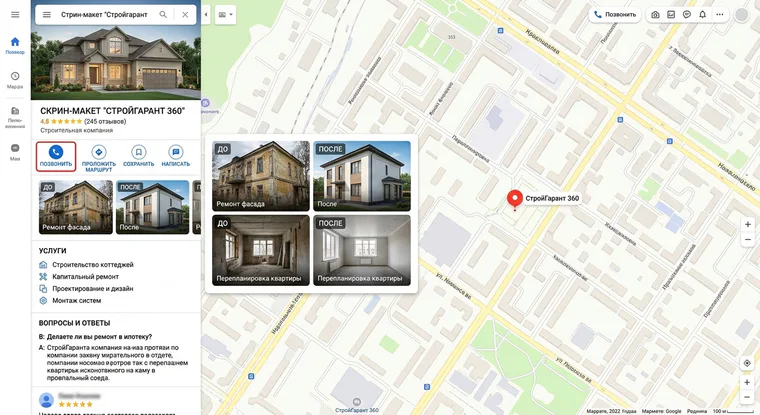
When a person already wants a renovation, he often looks for a contractor nearby: “bathroom renovation + area”, “finishing + city”. The company’s card in maps and directories covers this demand without a budget for clicks.
The problem is that for many people the card looks empty: a couple of photos, one number, no list of services, no geography, no replies to reviews. Algorithms love fullness, and so do people.
What should you do in one evening to make free promotion through cards go faster:
- Fill in the services with human wording (“turnkey bathroom renovation”, “rough electrical work”, “acceptance of apartment”), without general words.
- Add 15–25 photos: before/after, components, cleanliness of the object, team, process.
- Set a clear schedule, geography of work and methods of communication.
- Immediately write 5-7 questions and answers that are often asked in private messages (terms, guarantee, contract, how do you calculate the estimate).
Method 2. Reviews and photos from the customer: increase trust without a budget
Repair reviews work more powerfully than any posts. A person reads the experience of others and looks for a match with his own situation: a similar apartment, similar fears, a similar budget. Therefore, free promotion through reviews rests on one skill: ask on time and ask correctly.
The best time to ask for feedback is when the customer is already satisfied with the stage (the electrical work has been completed, the rough parts have been completed, the tiles have been done). When the project is completely finished, a person gets tired of construction and switches to life.
The script can be kept in notes and sent as a message: short, with a direct link to the site, with a hint on what to write about (deadlines, communication, cleanliness, agreement between the estimate and the fact). Plus ask for one photo and permission to use it in your portfolio.
Method 3. Portfolio and cases: sell with projects, not promises
Project business wins over teams because it can demonstrate the process and the result. Cases turn an abstract “turnkey repair” into a clear picture: what happened, what they did, how long it took, how difficult areas were solved.
A case can be put together even without a website: a separate post on social networks, a pin, an album, an article on a simple page. It is important that each case reads like a story with numbers.
Mini-case structure that helps free promotion:
- Initial data: type of object, area, condition, timing.
- Task: what the customer wanted (practice, style, budget).
- Solution: key work and materials.
- Control: how the stages were accepted, how additional work was recorded.
- Result: timing, final cost, what was the output.
If you want to go deeper into the topic of applications and packaging, there is an analysis in the 101 blog: How to attract applications for apartment renovation?.
Method 4. Social media content: regularity is more important than reach
Social networks in construction work when you stop “blogging” and start keeping a production log: short videos, photos of stages, analysis of components, answers to questions, explanation of estimates. Such content does not require a budget, but it does require the habit of recording work.
One pitfall: spraying all sites. Choose 1-2 channels that you can realistically commit to in terms of time, and release materials on schedule. Blog 101 has a large text about how to approach hiring SMM and what tasks to set. Where to find SMM: job description of SMM for apartment renovation.
A monthly plan can be based on recurring situations at sites. Three pillars that quickly raise free promotion:
- “How we do it”: stages, checklists, quality control.
- “How not to lose money”: typical mistakes of the customer and contractor, additional work, payment schedule.
- “Before/after”: visual changes plus an explanation of what exactly was changed technically.
If you work via Telegram, a selection on the topic will be useful: Telegram channels about repairs: subscribe to learn more about this area.
Method 5: Local Communities and Message Boards: Quick Taps
In every city there are district chats, residential complex public pages, “give/sell” groups, chats for new buildings, where people are looking for craftsmen. There you don’t need to buy advertising, you need to respond quickly and to the point: with a price range, a deadline, one case and a clear next action.
Similar logic works on message boards. Even when the site pushes for paid promotion, basic placements and proper packaging often generate first hits without a budget.
Where else to look for leads and which sources more often give applications, we looked at material 101: Where to look for leads for apartment renovation or construction?.
Method 6. Partnerships: designers, realtors, completers
Partnerships provide applications that are already warmed up with trust. The designer needs a contractor who can handle the project. A realtor needs a contractor to prepare an apartment for sale or rent. The assembler needs someone who meets deadlines and takes care of materials.
To make free promotion through partners stable, agree on the rules onshore: what exactly is transferred, how percentages are calculated, how leads are recorded, who is responsible for complaints, what the project report looks like.
There is a separate article in blog 101 about communication with designers and how to build a flow of orders through them: How to approach an interior designer and receive orders from him.
Method 7. SEO without complicated crutches: “eternal” pages and queries
SEO is often thought of as a story for large companies. In practice, “minimum SEO” is suitable for a project-based business: several pages for key services and regular answers to frequently asked questions. This accumulates and brings requests even when you are busy at the site.
It is important to look at deadlines soberly. According to 101 observations, tangible results from SEO usually appear months later, often closer to 8 months, when the search engine has time to “trust” the site and content.
What you can do without an agency budget:
- Collect 30–50 queries via Wordstat and search suggestions (questions, areas, types of jobs).
- Make a page for each service (price, stages, terms, what is included, which often becomes additional work).
- Once a week, publish one question-and-answer material and support it with a case study from the site.
If you want to put marketing on the shelves specifically for construction, look at the selection of materials in the section: Marketing and Sales, as well as the article How to promote a construction company.
How to link free promotion to money and not lose applications?
Free promotion has a weak point: the channel can give an appeal, then everything comes down to processing. If you answer after 6 hours, if you forget to call back, if you mix up the estimate, if you don’t record the agreements, the channel is “to blame” only in words.
To connect free promotion with money, you need a short processing discipline:
- Reply within 15 minutes and agree on a time to call.
- Ask the same set of questions (object, area, deadlines, what has already been done, who makes the decisions).
- Give a budget and name the next step (measurement, estimate, meeting at the site).
- Record the contact and source (maps, reviews, designer, LCD chat).
There is a separate material about the funnel and where companies lose customers on the way to the contract: Sales funnel: how not to miss the customer at one of the stages of the transaction.
When the number of applications increases, another challenge arises: project transparency. Helps here Appendix 101 — it’s easier to keep money, participants, reports and agreements for each object in one place.
| Free promotion channel | What to measure | How to quickly understand that a channel is live |
|---|---|---|
| Maps and directories | Shows, calls, routes, reviews | There are card views and incoming geo queries |
| Reviews | Number of detailed reviews, availability of photos, company responses | Conversion from views to requests is growing |
| Cases | Save, forward, ask questions in PM | People write with a specific request “as in the case” |
| Communities and boards | Feedback, dialogues, on-site meetings | Quick orders appear for the next 1–2 weeks |
| Partnerships | Number of transferred leads, conversion to contract, average bill | The partner repeatedly brings people |
| SEO | Positions, traffic, requests from service pages | Organic growth is growing, hits from search are appearing |