

Contents:
Problems with purchasing materials for construction and renovation
Materials account for a substantial share of a renovation budget, but that share varies by project. If a contractor receives purchasing funds into their own account, it is important to assess separately how the contractual arrangement and applicable tax regime affect income and obligations. Russian changes are covered in the article on the 2026 tax reform (in Russian).
How do construction and renovation companies usually organize purchases? Many 101 App users say they handle purchasing through their own accounts:
- Receive an advance from the client to buy materials.
- Allocate the money across renovation stages.
- Place orders at construction supply stores and depots.
- Pay from their own account.
- Give the client receipts, or report in the 101 App using its QR-code scanner, as evidence that the money was spent for its intended purpose.
Receiving funds for materials can be part of an agreed purchasing arrangement. Its terms must be checked against the contract and current rules; company size alone does not guarantee tax safety. Under genuine agency arrangements, the agent’s fee and the client’s funds are accounted for separately. The fee is not yet net profit: it must cover expenses and taxes. Russian patent tax rules for builders (in Russian) require a separate check and do not replace that assessment.
Some people even argue that routing all these amounts through their business provides clients with a high level of service. That arrangement may be convenient for the client, but its financial effects on the company need to be assessed. What should you do? Optimize purchasing, stop routing unnecessary millions through the company, reduce warehouse costs and motivate staff to work responsibly. A procurement manager’s job description can help organize this.
A procurement manager’s duties
A construction procurement manager is responsible for the entire material supply cycle:
- finding and selecting suppliers by price, quality and delivery times;
- collecting and approving requests from site supervisors and tradespeople;
- monitoring warehouse stock and delivery dates;
- organizing logistics: delivery, unloading and checks;
- maintaining source documents such as delivery notes, invoices and acceptance records;
- reporting purchases to accounting and management.
A procurement manager should understand how purchasing decisions affect the company’s financial model. They connect builders waiting for plasterboard on site with the site supervisor (article in Russian), who monitors every ruble of the project and wants to prevent idle time. The procurement manager’s task is to buy the right materials on time, reduce unnecessary storage and respond promptly to changes.
A procurement manager’s job description framework for a construction company
The following framework helps define the role internally and distribute responsibility within the team. It does not replace a legally compliant job description: adapt the wording to your company, contractual relationships and internal documents.
Functions
- plan material requirements by work stage;
- collect and clarify requests from site supervisors and tradespeople;
- compare supply options by price, lead time and suitability;
- monitor delivery, acceptance and purchasing documents;
- warn the team in advance about risks to schedules and materials.
Authority
- request clarified quantities, deadlines and priorities from the team;
- return incomplete requests for revision before placing an order;
- suggest substitute materials when supply conditions change;
- work with approved requirements, estimates, schedules and purchasing history.
Responsibilities
- maintain the agreed purchasing schedule and current purchasing documents;
- record discrepancies during delivery and acceptance;
- escalate risks that could stop work on site in good time;
- define the limits of responsibility in the company’s internal documents.
Performance indicators
- the share of confirmed deliveries arriving within the agreed time;
- the number of unresolved delivery discrepancies;
- instances of downtime caused by missing materials;
- savings measured against an agreed, comparable specification, rather than an abstract low price.
How to organize procurement in a construction company?
Start by considering your business goal. The main goal of an entrepreneur is to increase profit. If you take a different view, this article will not help you. It is also important to distinguish a goal from a mission: your desire to make the world better can be part of the mission. A financial goal helps support that mission, so keep it in mind. Without money, there is no mission.
Think through the service you provide to the client: material selection, approval, payment, delivery and storage. Purchasing through the company’s account affects accounting and contractual obligations. Tax arises under applicable rules, rather than automatically on every transaction.
Tax conditions depend on the country and regime. For Russia in 2026, the Federal Tax Service states that businesses under the simplified taxation system, USN, are exempt from VAT if their 2025 income did not exceed RUB 20 million, subject to statutory exceptions. If income exceeds RUB 20 million during 2026, VAT obligations arise from the first day of the following month. Do not simply add USN and VAT rates and treat the sum as a share of every payment: tax bases and deductions must be checked separately. The Federal Tax Service’s explanation of VAT under USN (in Russian) applies specifically to Russia.
Consider an arrangement in which the client pays suppliers’ invoices directly while your team handles selection, approval, delivery and storage. Agree the fee for this work in the contract, for example 10% of an agreed purchasing base. This is a calculation example, not a mandatory rate or guaranteed saving. Compare the full cost and responsibilities under both arrangements.
How do you organize construction material purchases? Share your experience with the community of progressive builders; your peers have already described their approaches (in Russian).
How to optimize purchasing and reduce warehouse costs?
This is a recurring question for builders and renovation contractors. Buying everything in advance, storing it somewhere and delivering small batches as needed sounds convenient. For a small company, its own warehouse means additional premises, storage and delivery costs. Compare them with staged deliveries from the store first.
We therefore recommend considering optimized purchasing from stores. You probably have a few regular suppliers for everything from screws to concrete. Propose the following arrangement:
- The project client pays the supplier an agreed advance under the contract. For example, the purchasing plan for project X is RUB 1–2 million; this is a hypothetical Russian monetary example, not a price benchmark for every project. Before paying, agree the specification, deadlines, storage conditions and advance refund terms.
- The store receives the funds, can use them for further purchases and dispatches or delivers materials to your site as needed, based on your requests.
- Discuss an advance-payment discount, for example 5%. It is negotiable: the supplier may offer a different percentage or refuse. Record the agreed terms in writing.
The supplier may store agreed materials in its warehouse and dispatch them in batches. Confirm availability, timing and storage costs before paying the advance. This arrangement is useful if the reduction in your costs justifies the supply terms and prepayment risk.
You can discuss purchasing arrangements and management accounting with the 101 community. Check access conditions and the available materials against the current offer: the article about the private channel for PRO+ users (in Russian).
How to track purchases in the 101 App?
If the client pays the supplier’s invoices, your team can receive a separate agreed fee for selection, ordering, negotiations and timely delivery. For example, the parties may agree on 10% of a defined base. Set responsibility and the calculation method in the contract. The following example shows purchasing and fee records in the 101 App.
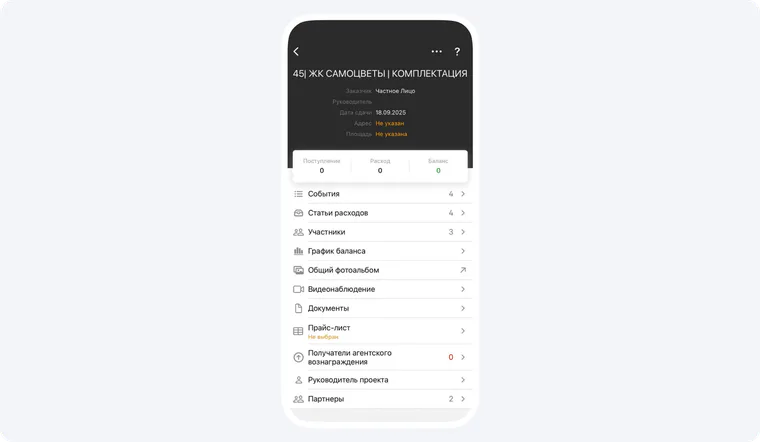
1. Create a separate project
Use the same name as the main project, adding PURCHASES or PROCUREMENT if you manage the full procurement process rather than buying only basic construction materials.
2. Create a Transfer event
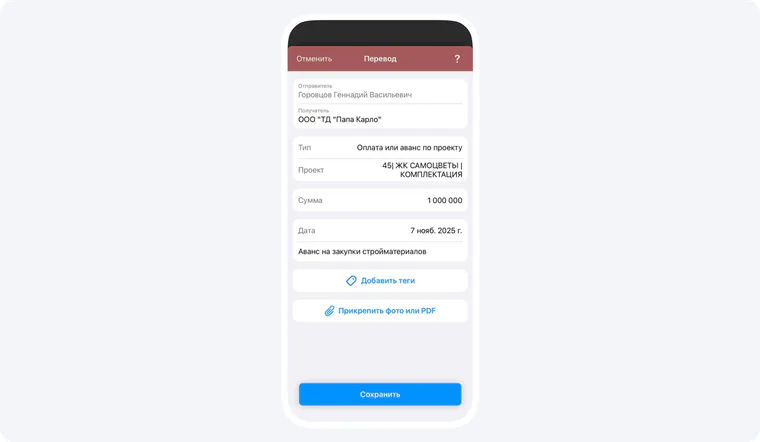
For example, the client paid RUB 1,000,000 directly to the supplier. Record the actual transfer from the client to the supplier, state in the description that it is a pass-through payment and attach the payment order. This records funds moving between those participants; it does not mean the million was received into your company’s account.
3. Set the agreed Markup
Enter only the agreed markup, for example 10%, and its recipient. Check the calculation base and markup allocation for the expense item; the amount must match the contract.
4. Create an Income event
When the client pays the agreed fee to your company, record the actual receipt separately from the direct payment to the supplier. The fee is not yet net profit: related expenses and taxes must be accounted for first. Record transfers of available funds to the Company Fund separately under your accounting arrangement.
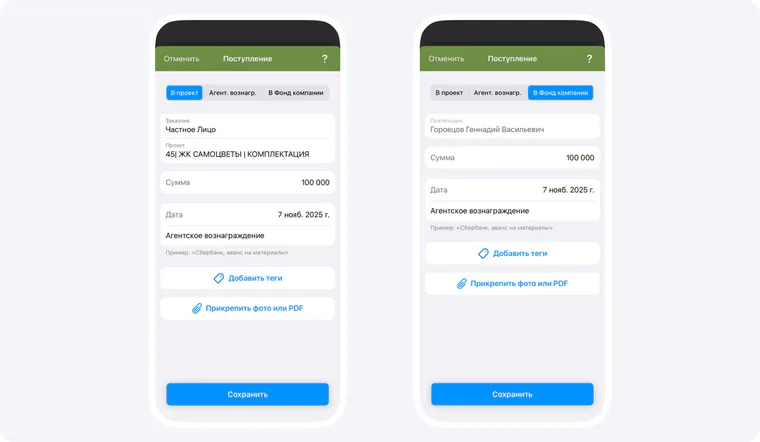
Examples of recording fee receipts in a project and the Company Fund. The screenshots show the Russian-language interface.
A free consultation with a 101 App expert can help you review purchasing records using your business as an example and discuss events, documents and reports. The service helps organize data; legal obligations are determined by contracts and applicable rules.
Set aside consultation time without travel, calls or supplier negotiations. Prepare a sample project and your purchasing questions. Results and time savings depend on your processes; recovering lost money in the first week and saving 20 hours are not guaranteed.