
Corporate events are often discussed in extremes: “They are a waste of money” or “The team will fall apart without them.” The reality is calmer. An event works when it has a purpose, clear participation rules, and a transparent answer to the question of who pays.
There is another, more important issue: corporate events and team activities almost always slip through the cracks of management accounting. Money leaves someone’s card “for food,” “for taxis,” or “for gifts.” By the end of the year, it feels as though a lot has been spent on people, with no way to assess the impact.
This article looks at corporate events as a whole: the different formats, who really needs them, how to agree on payment, and how to fit them into the company’s overall financial system, including funds and regular contributions.
Contents:
What are corporate events?
Corporate events are any organized activities that a company associates with its team: from a company-wide celebration to a training day, and from a group trip to a short meeting between new employees and their manager.
The defining feature is simple: the event affects working relationships. It helps people get to know each other, agree on rules, ease tension after a difficult period, celebrate a result, complete training, or help a new employee settle in faster.
A useful management framework is to treat a corporate event as an internal project. It has a goal, a budget, a schedule, people responsible for it, and a final review of what worked and what should change. This is an organizational approach; a separate project in the 101 app is optional for each event.
Why do they matter for company culture?
Company culture exists even without posters listing values. It shows up in small things: how mistakes are discussed, tasks are handed over, conflicts are resolved, and decisions are made. Events create a space to discuss and reinforce these practices.
Here is a familiar situation in a project-based business. The team has grown from 6 to 25 people, adding site supervisors, procurement staff, a cost estimator, and a project manager. Issues start getting “lost” between roles. One solid team review at the end of the month often brings more order than a tenth group chat.
Events are useful during calmer periods too: they create regular opportunities to communicate outside the usual “firefighting.” Then, when a rush hits, the team does not waste time working out who is responsible for what.
Formats: from mandatory to voluntary
One common mistake is to call every activity “team building” and try to judge all of them by the same measure. Different formats offer different kinds of value and call for different approaches to payment.
Here is one way to group corporate events by purpose. All of these formats can exist in the same company, in different proportions.
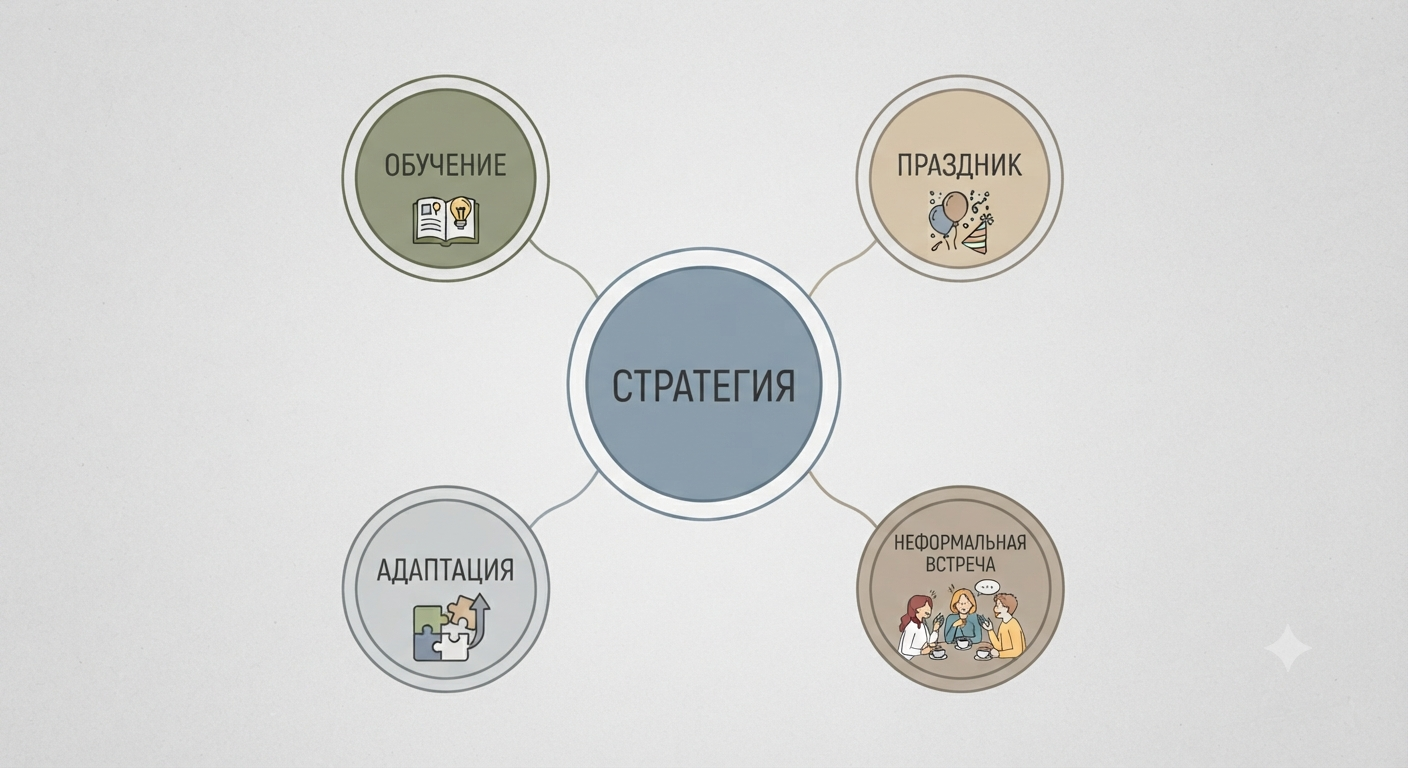
- Work-related events: a strategy session, seasonal planning, a quality review, safety training, or product training.
- Cultural rituals: celebrations, awards, company day, or a team lunch after a project handover.
- Onboarding: a meeting for new employees, a tour of the warehouse and project sites, or an introduction to reporting and communication rules.
- Informal gatherings: going to a bar after a week without a day off, playing a game together, or taking a small-group trip into nature.
An important detail: “informal” does not mean “pointless.” After completing a demanding project together, the team often needs a chance to unwind. The question is how to set the boundaries: what has been agreed, who takes part, who pays, and how expenses are recorded.
Who pays, and how can you agree without resentment?
The party that benefits from the event as a management tool and sets the rules should pay. If the company needs the event for management purposes, the company should cover the cost. If it is the employees’ own initiative, they can split the cost on one condition: participation is voluntary.
A typical conflict looks like this: the manager “invites everyone,” some team members do not drink or find noisy gatherings tiring, and people end up contributing money “to keep things friendly.” That damages trust more than having no corporate event at all.
| Situation | Who initiates it | Who pays | How to document it |
|---|---|---|---|
| Training, strategy, mandatory meetings | The company | The company | A budget, a person responsible, and a review of the results |
| A celebration for the whole team | The company | The company | A separate budget and participation rules |
| A small group going to a bar | Employees | Employees, or a shared funding arrangement | Voluntary participation and a clear limit if the company contributes |
| Personal gifts for colleagues | Employees | Employees | Entirely optional, with no collection “from everyone” |
How can events fit into the company’s financial system?
The most practical approach is to treat corporate events as part of management accounting. As with a construction site or an agency project, track the plan, actual costs, people responsible, documents, and conclusions.
In the 101 app, corporate event expenses can be recorded in expense reports by expense category, with receipts and documents attached. General company expenses belong to the Company Fund without a link to a project. If the company chooses to track the activity through a project, reports can be linked to a separate project; a customer must be set up for that project. The corporate activity itself is different from an event in 101, which is an individual accounting record, such as an expense report or a transfer. For more on financial accounting and organizing corporate events, see the articles on project financial management and New Year celebrations. Project financial management, New Year celebrations in a construction company (in Russian).
What to do:
- Define the event’s purpose and a measure of success: what should change afterward.
- Set the participation rules: who must attend, who can choose, and whether an alternative format is available.
- Build the budget by expense category: venue, food, transport, host, gifts, branded merchandise, and accommodation.
- Assign responsibility for the money: who approves spending and who makes sure the paperwork is complete.
- Collect the actual expense records: receipts, completion certificates, and agreements with contractors. For funds advanced to cover company expenses, the approach in the article on tracking expense advances (in Russian) can help.
- Hold a short review: what to keep, what to remove, and how to stay within the budget next time.
If spending “on people” is often scattered across the team, it helps to establish a common rule for recording corporate event expenses and a shared set of expense categories. General company expenses can use the Company Fund without a project; a project is suitable if the company chooses that accounting approach. This makes the financial cost of company culture visible, while the conclusions from event reviews help assess the impact.
Funds: how to set money aside for corporate events
When corporate events depend on one-off decisions, they become a source of stress at the end of the year: spending feels painful, a celebration is needed, and time is running out. Funds help reduce this uncertainty when the company allocates money to events in advance under agreed rules.
In a system of funds, corporate events usually fall under a “bonuses and motivation fund” or a separate “corporate events and training fund.” Here, funds are budget allocations in the company’s financial policy. In the 101 app, each company has one Company Fund; these allocations do not mean creating several Company Funds in the app. The 101 article on a system of funds outlines a clear structure: a reserve fund, a development fund, a warranty obligations fund, and a bonuses and motivation fund. A system of funds for business (in Russian).
The practice is simple: the company chooses a percentage of profit or a fixed monthly amount and transfers that money to the fund under its own policy. The 101 app lets you maintain the Company Fund and record its transactions. Regular contributions require organizational discipline: recording a transaction in the app does not transfer money by itself. This helps the company set aside a corporate event budget in advance and account for it separately from day-to-day expenses.
Funds also help with a shared funding arrangement, where the company pays part of the cost and employees contribute the rest: the company sets its own contribution limit in advance. Each person then decides whether to contribute.
A short event policy checklist
Corporate events become a more relaxed part of company culture when there is a short policy. It can fit on a single page and be discussed with the team at the start of the season.
- Purpose: why we are doing it and what result we expect.
- Participation: what is mandatory and what is voluntary.
- Payment: who pays, whether there is a limit, and whether costs are shared.
- Accounting: where the budget is tracked and documents are kept: the Company Fund or a project, expense reports, expense categories, and receipts.
- Funds: whether regular contributions are made for corporate events and motivation.
If you want to bring this into one system, start small: common rules for recording corporate event expenses, a clear budget, and one person responsible. For general company expenses, the Company Fund without a project is suitable; a separate project is an option if that accounting approach is chosen and a customer is set up for it. After a month, this routine may make expenses more manageable; after a quarter, it may become a habit.