Building homes as a business requires project and cash flow management. Money comes in according to the payment terms, while the project's outcome also depends on how the work is organized: who does it and when, how materials are purchased, how quantities and responsibilities are recorded, and how a potential cash shortfall will be covered.
If you plan to earn money from building individual homes, treat each house as a project with a schedule, budget, risks and communication with the customer. This allows you to compare decisions with planned and actual results.
The following is a management guide to building homes as a business, from choosing a niche to controlling finances and paperwork, with examples and resources from 101.
Contents:
- Starting a home-building business: niche and offering
- The business owner's role: organizing processes
- The economics of a house: estimate, margin and cash shortfall
- Documents and responsibilities: contracts, subcontracting and engaging workers
- Site processes: schedules, materials and quality
- Sales and trust: how to win home-building projects
- Scaling: how to grow while meeting deadlines
- Digital control: managing finances and reporting in the 101 App
Starting a home-building business: niche and offering
Before signing a contract, define your offering: a completed home, a house shell, building services, interior finishes, or procurement and supply. Record which work and materials are included, what is excluded, which deadlines and requirements for the result will be agreed with the customer, and how acceptance will take place.
Start with work for which your team has the necessary skills and resources. Before expanding the scope, check who will be responsible for the new tasks, their design, procurement, deadlines and quality.
For the first discussions, break your proposal down into a model: the result for the customer, the boundaries of the work and the main risks. The following are possible options that need to be clarified for the specific project.
| Model | What is agreed with the customer | Main risks |
|---|---|---|
| House shell | Foundations, walls, floor structures and roof, as specified in the agreed design | Errors in the estimate and structural design, delays in materials |
| Building services | The systems included, testing and acceptance documents | Coordination between disciplines and allocation of responsibilities |
| Turnkey home | A package of work and a coordinated schedule within the boundaries agreed in the contract | Coordination of deadlines, subcontracting, procurement and quality |
Hypothetical example: a team knows how to build house shells and takes on a turnkey project. If the building services have not been designed, procurement is not aligned with the schedule, and responsibilities have not been allocated among the contractors, the project faces additional schedule and quality risks. These gaps matter under any model of work; expanding the offering requires the corresponding management arrangements.
The business owner's role: organizing processes
One of a business owner's tasks is to organize the project: connect people, schedules, procurement, money and control. Technical work can be distributed among the people carrying it out while maintaining clear areas of responsibility.
If you are starting as a tradesperson, set aside time and assign responsibility for planning, procurement, supervision, customer relations, recording quantities and financial accounting. When you have several sites, these tasks need to be coordinated across projects.
Check the resilience of your operation: can the team continue the project if a key person is temporarily unavailable? If not, identify which knowledge, access rights and decisions depend on one person, and arrange cover.
The economics of a house: estimate, margin and cash shortfall
An estimate sets out the planned price and costs, while a payment plan shows the expected timing of cash receipts and payments. To assess the outcome, separately compare the plan with actual revenue and costs. Planned profit does not yet establish actual profit or the availability of money in the account.
Distinguish revenue, cash receipts and profit. An advance may arrive before the work is performed, and recognized revenue may differ from the cash already received. Gross profit and net profit take different groups of expenses into account; before making comparisons, define what the measure includes and the period it covers.
For the structure of an estimate, see How to calculate a renovation estimate (in Russian) and How to prepare an estimate (in Russian). For a house, you also need to determine work quantities and materials, account for the costs attributable to the project, and allow for planned profit. Check whether the rates and construction methods are applicable to the particular house.
Plan cash flow separately for each stage: when the customer is due to pay, when materials and labor need to be paid for, and what cash balance is expected. Comparing costs with the estimate is insufficient for forecasting a cash shortfall: you need a calendar of receipts and payments that accounts for the opening balance and possible delays.
Documents and responsibilities: contracts, subcontracting and engaging workers
In the contract, agree on the scope and boundaries of the work, the result, deadlines, payment, acceptance and responsibilities, taking applicable rules into account. Warranty terms need to be checked for the particular contract and country; the term “turnkey” does not determine them. For the points to check, see the Guide to construction contracts (in Russian). The article provides an overview and does not promise a ready-to-use contract file.
If you engage subcontractors, agree on the scope of work, quality requirements, acceptance procedure, payment and responsibility for breaches. The working arrangements need to be aligned with your obligations to the customer; subcontracting alone does not determine who is responsible to the customer or the extent of that responsibility.
Prepare a set of project documents based on the contract and applicable requirements: the main contract, schedules and estimate appendices, acceptance documents, agreed changes, subcontracting documents and proof of payment. The list needs to be refined for your country and project. For an overview of different contractual relationships, see Types of contracts a builder needs (in Russian).
The form of engagement must match how the work is actually organized and the applicable rules. Check the worker's tax status separately: on its own, it does not determine whether the relationship is one of employment or contracting. Clarify the requirements for engaging people and registering the business for your country and the particular way you operate.
Site processes: schedules, materials and quality
When preparing the schedule, consider the construction methods, project complexity, climate and contractor's resources. A delay may increase the cost of maintaining the site and require procurement and workforce activities to be rescheduled. Check the schedule and budget together, taking the specific conditions of the project into account.
Organize regular checks: repeated reviews help you see the actual state of the project and update the plan when conditions change.
- Record the week's work plan: quantities, people responsible and checkpoints.
- Check that materials are ready before the crews start: what has been ordered, what is in transit and what is already on site.
- Carry out stage acceptance before structural elements are covered: record photos, issues and the agreed decision on corrections.
- Measure actual quantities and compare them with the estimate: what has been completed, added or removed.
- Complete the stage documents and agreed changes, and retain proof of payment.
- Provide the customer with a report on deadlines, costs, risks and upcoming work in the agreed format.
To organize your approach, read Project management technologies in construction (in Russian). Choose tools based on the project's scale, the allocation of responsibilities and the reporting required.
Sales and trust: how to win home-building projects
To choose a contractor, a customer needs information about the offering and the way you work. Show the scope of work, estimate, contract terms, acceptance procedure and communication arrangements. Your website and advertising can explain these terms alongside examples of completed projects.
Hypothetical example: two contractors offer similar work. One describes only the result, while the other also shows the stages, the procedure for agreeing changes, and financial reporting. The second proposal makes the terms easier for the customer to check; it does not guarantee agreement on the price or the absence of disputes.
Start by checking whether your proposal contains the following:
- a clear offering (what turnkey home construction includes and what counts as additional work);
- publicly available working terms (estimate, contract, stages and acceptance);
- regular project reporting and photographic records;
- case studies and reviews that show the process and the result.
When preparing your website, use Renovation company website: what to show customers and how to promote it as a reference for the brief you give the developer. Add the requirements of your audience and your particular offering.
If you are considering tenders as a channel for winning work, assess the requirements of the particular procurement process, documents, security requirements, participation costs and performance terms in advance. The article Is it worth bidding for construction and renovation tenders? (in Russian) provides an overview using Russian procurement as its context. Its legal examples concern Russia and do not establish the rules for other countries.
Scaling: how to grow while meeting deadlines
Before starting a second site, check the shared constraints: managers, workers, supplies, money and time for supervision. If decisions and information remain with just one person, several projects may compete for that person's resources.
Compare possible directions for expansion: new districts and cities, additional types of work, or greater volume within your current niche. For each option, assess resources, risks, demand and management costs. These are different decisions that need to be compared against the conditions of your business.
Before expanding, document repeatable procedures: estimate structure, contract preparation and review, acceptance, procurement, reporting and financial accounting. Then determine who can take on the tasks, what authority and access they need, and how the results will be checked.
Digital control: managing finances and reporting in the 101 App
If you are building several homes, agree on a consistent accounting procedure: which income and costs belong to each project, who enters the data, and how deviations from the estimate are checked. The 101 App supports project accounting; the completeness of the financial picture depends on which data has been entered and how it has been checked.
At the end of the week, compare each home's actual costs, cash receipts and payments with the plan. Separately update the cash forecast for the next stages, taking expected payments and obligations into account. This data will help you discuss changes with the customer; having a report does not in itself prevent a cash shortfall.
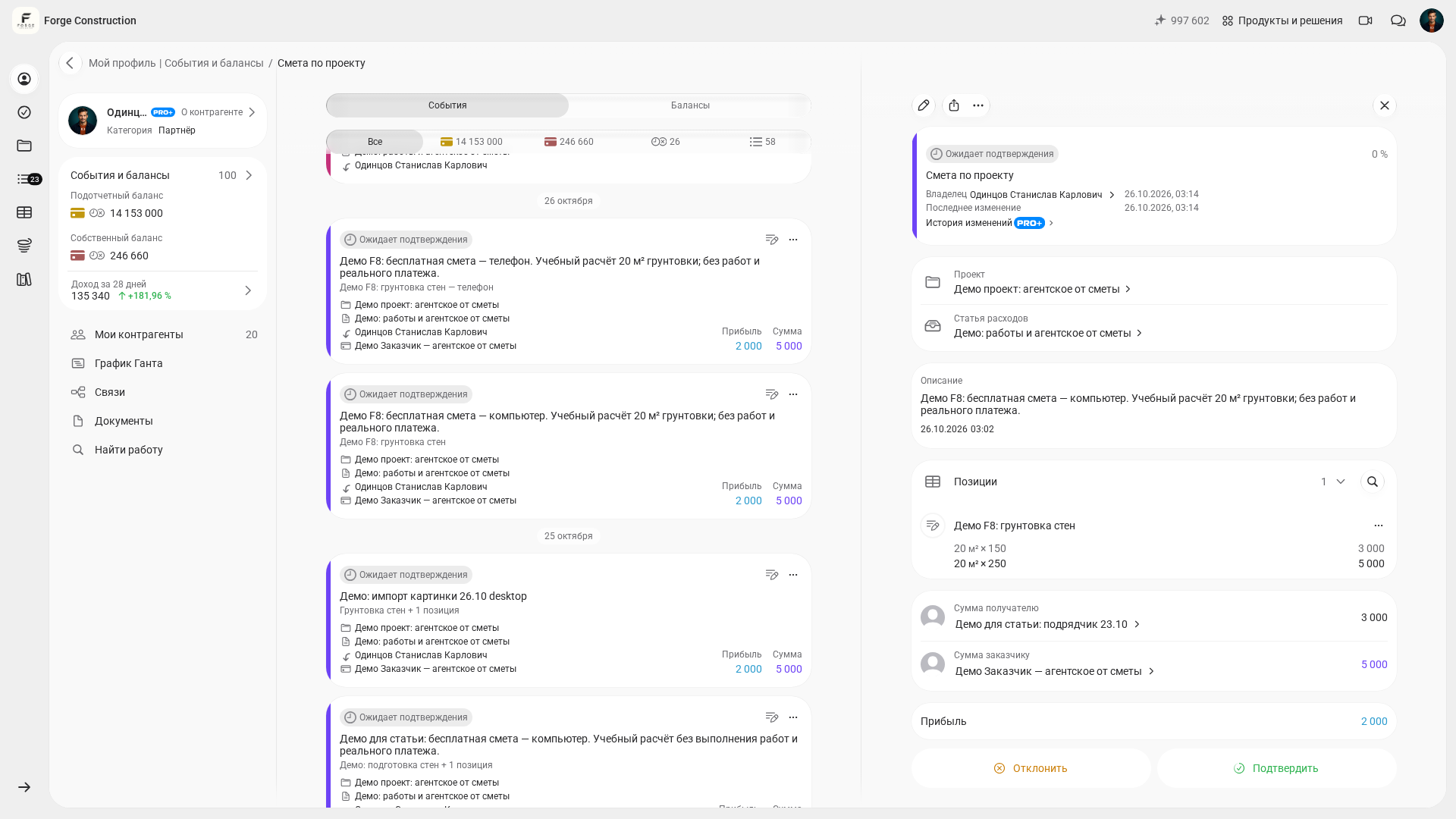
To calculate planned line items, enter the quantity, unit of measure and price, then check the total and the contents of the estimate. The guide Free estimates in 101: prepare a calculation and check the result explains how to prepare the calculation in the web version on a computer and phone. A saved estimate describes planned work and cost; it does not confirm that the work has been completed or paid for.
The screenshots show two separate demonstration estimates in the Russian web interface of 101. This is a learning example in rubles (RUB) for a single line item covering 20 m² of priming: the calculated amount for the recipient is 20 × 150 = 3 000, the amount for the customer is 20 × 250 = 5 000, and the difference is 2 000. No work was performed and no real payments were made. The difference relates only to this line item; it is not the estimate for an entire house, a cash balance or the business's net profit.
To check how the app fits your processes, request a demonstration and work through a specific scenario: an estimate, cash transactions, materials accounting and information for the customer. Clarify the available features and plan, and which information your team will need to enter.
Building homes as a business requires several parts to work together: a clear offering, a sound estimate, financial accounting, contracts, acceptance and control of execution. Check how they connect on a specific project and use the resulting data when planning the next site.