
“Calculate the cost of a service” sounds simple until you start adding up the actual expenses. Payments to tradespeople are clear, and so are materials. Then travel, downtime, rework, logistics, management, advertising, taxes and software enter the picture. If these costs are left out of the calculation, the service price becomes arbitrary.
A workable calculation has two layers. The first is the selected cost base per unit of service. To calculate the full cost, include direct costs and an allocated share of indirect costs without counting anything twice. The second is the price for the client: it should cover the selected base and leave the planned financial result. If the base contains only variable costs, the difference between it and the price first goes toward covering fixed costs.
Below is a practical approach to calculating job costs for renovation and project-based services. For a closer look at what costs include, see the separate article “How to Calculate and Optimise the Cost of a Service”.
Contents:
- What to calculate: cost, price or profit
- Cost, markup and margin: common points of confusion
- What makes up the cost of a service or job
- Step by step: how to calculate the cost of a service
- How to set prices: by the hour, by quantity or in packages
- How to record calculations in a price list and prepare estimates faster
- Summary: a checklist for revising service prices
What to calculate: cost, price or profit
Messages often mix up three questions: “How much should we charge the client?”, “How much does it cost you?” and “How much will the company keep?” These are different figures, and the calculation follows a different order for each.
For a quick starting point, first choose a unit of service: an hour, m², a site visit or a project. Then define the costs included per unit, choose the target share of the price left after those costs, and calculate the client price. Finally, check two results: planned profit after the full cost base, and contribution margin—the contribution toward fixed costs, calculated as revenue minus variable costs.
A short renovation scenario: a crew prices wallpapering from its price list, work is under way and payments are coming in, yet there is no cash left in the account. One possible reason is that the rate includes only the tradesperson’s pay, while overheads were left out of the calculation. Profit and cash balances also differ because of the timing of receipts and payments.
Cost, markup and margin: common points of confusion
To calculate the cost of a service correctly, distinguish costs, price and the financial result. The full unit cost includes direct costs and an allocated share of indirect costs. Price is the amount the client pays. Markup is an addition to the selected cost base. The difference between revenue and the full cost base included in the calculation gives the calculated profit after those costs. To arrive at net profit, also account for all applicable taxes, other income and expenses not already included. Contribution margin, or the contribution toward fixed costs, is calculated separately: revenue minus variable costs.
The main trap is confusing markup with margin. Markup is calculated on the selected cost base; the difference as a share of price is calculated on the selling price. A 50% markup therefore gives a different margin percentage. Both formulas must use the same set of costs. To explore the formulas with numbers, see “Margin and Markup: What Is the Difference and How Do You Calculate Them?”.
Let P be the unit price and C the selected cost base per unit. For C > 0 and P > 0, the formulas are:
- Markup (%) = (P − C) ÷ C × 100%
- Difference as a share of price, or margin for the selected cost base (%) = (P − C) ÷ P × 100%
In construction and renovation, it is useful to consider the share of price left after costs together with the costs included. With a variable cost base, that share measures the contribution toward fixed costs and subsequent profit. With a full cost base, it shows the calculated result after the included expenses. For an educational comparison, you can choose 20% and 30% scenarios; assess their suitability against the costs, demand and conditions of the particular service. This example does not establish a verified universal market benchmark.
Record what the cost base includes next to the percentage. Margins for different services can be compared correctly when the same cost-accounting rules are used.
What makes up the cost of a service or job
The full cost of a service consists of direct costs and an allocated share of indirect costs. Direct costs can be assigned to a particular job or site. Indirect costs are allocated among services under a chosen rule. Direct and indirect classify costs by how they are assigned; fixed and variable classify them by how they respond to volume. These classifications overlap: a direct cost can be variable or fixed. Include each amount in the calculation only once.
Direct costs in renovation and construction services commonly include the pay of tradespeople and the site supervisor assigned to the job, consumables, tool and equipment rental for the task, delivery and subcontracting. For more on this topic, see “Direct Costs: What to Assign to a Project” (in Russian).
Overheads include the office, administration, advertising, communications, software, training and some taxes that cannot be precisely assigned to a single order. The difficulty is that overheads rarely appear as one line. They are hidden in small recurring payments and in the salaries of people who do not work on site.
Project-based services—design, supervision, procurement and consulting—are calculated in a similar way, but the unit of measurement is more often an hour of a particular role: a designer, procurement specialist or project manager. Set the hourly rate with leave, gaps between projects and communication time taken into account.
Step by step: how to calculate the cost of a service
The following approach can be used to calculate job costs for a price list and to check the economics of a project that has already been signed. After several repetitions, it becomes a habit. Keep the same set of costs throughout all steps and avoid counting the same expense more than once.
- Choose a unit of service: m², point, linear metre, site visit, hour or project. You need it to record a price and compare planned and actual figures.
- Collect the direct costs per unit: tradesperson’s pay, consumables, delivery, subcontracting and equipment rental. If something is purchased as a batch for the whole site, convert it to a cost per unit.
- Check the other costs that vary with volume: on-site communications, small logistics expenses, tool wear and additional consumables. Add only amounts not already included in direct costs or overheads. If you use a percentage estimate, state its base and the costs it covers. For the separate contribution-margin calculation, identify all variable costs, including direct variable costs already counted; do not add them again.
- Allocate the remaining overheads per unit. A basic method is to divide monthly overheads by the planned number of service units the company expects to sell during the month: m², hours or projects. That quantity must be realistic and greater than zero. Choose a measure suited to the expense base and adjust the allocation as utilisation changes. Do not include costs from previous steps again.
- State a planned risk reserve separately: rework, material delays and disputed additional work. If the reserve is included in the price calculation base, record that condition explicitly and avoid duplicating expenses already allowed for. When checking actual results, use actual costs; an unused planned reserve does not itself become an expense.
- Convert the selected cost base C into price P. For a target fraction m of the price left after the selected costs, use P = C / (1 − m), where 0 ≤ m < 1. For example, enter 30% as 0.30; do not use 30 in the denominator. State whether C includes the full cost or only variable costs. In this algorithm, the price is calculated from the full planned cost base, with a separately identified reserve if you decide to include it.
- Check the calculation: does the price fit demand and market conditions, can you explain the scope of work to the client, and does the price cover the full planned cost base? A planned percentage does not itself guarantee sales or profit.
- After the work is completed, compare revenue with the full actual cost base and calculate contribution margin separately: revenue − all variable costs. This contribution covers fixed costs; what remains after them gives the operating result. Net profit requires all other applicable income, expenses and taxes not already included to be taken into account.
A brief hypothetical example per m². Suppose the entire selected cost base per unit is 700 ₽ and the client price is 1120 ₽. The tradesperson’s pay is already included in the 700 ₽. The difference is 420 ₽; the markup on the selected base is 60%, and the difference as a share of price is 37.5%. If 700 ₽ is the full cost base included in the calculation, 420 ₽ is the calculated result after that base. If 700 ₽ includes all variable costs, 420 ₽ is the contribution toward fixed costs and subsequent profit. If all you know is that the tradesperson is paid 700 ₽, the full cost and profit still need to be calculated. The 60% and 37.5% figures are comparable here because both formulas use the same cost base of 700 ₽.
How to set prices: by the hour, by quantity or in packages
The same cost calculation can be presented through different pricing models. There is no universal option: the aim is to choose a model that reduces disputes and protects the margin.
| Model | When it is suitable | What to specify |
|---|---|---|
| By quantity (m², point, linear metre) | Standard work with a clear result | Scope of work, preparation tolerances and what counts as additional work |
| By time (hour/day) | Diagnostics, small service jobs or an unpredictable scope | Minimum call-out charge, time-recording rules and reporting |
| Fixed project fee | Design, procurement or renovation management | Stages, revision limits, response times and handover format |
| Packages | When the client wants to choose a service level | What is included in the basic package, what is optional and the rules for changes |
Packages can reduce disputes about discounts: the client chooses the scope and service level. In construction, this might mean “basic renovation”, “renovation with procurement” or “turnkey renovation with support”. Each package still has your cost base and the target share of price left after those costs.
How to record calculations in a price list and prepare estimates faster
One reason service-cost calculations do not become established practice is that they are prepared for a particular deal and the spreadsheet is then lost. A practical approach is to cost the service, record the result in a price list and update it when rates, utilisation and expenses change.
In a 101 price list, an item with a selected unit of measurement can have its cost and price entered separately. Their visibility depends on the participant’s permissions. Use the entered values to check the difference between price and cost; the result depends on which costs you included in the base. That difference alone does not establish the company’s net profit. The markup formulas in this article refer to the item’s price and cost; check any additional charges under the expense category’s rules separately. For the meaning of these figures, see “Price and Cost: What Is the Difference?”.
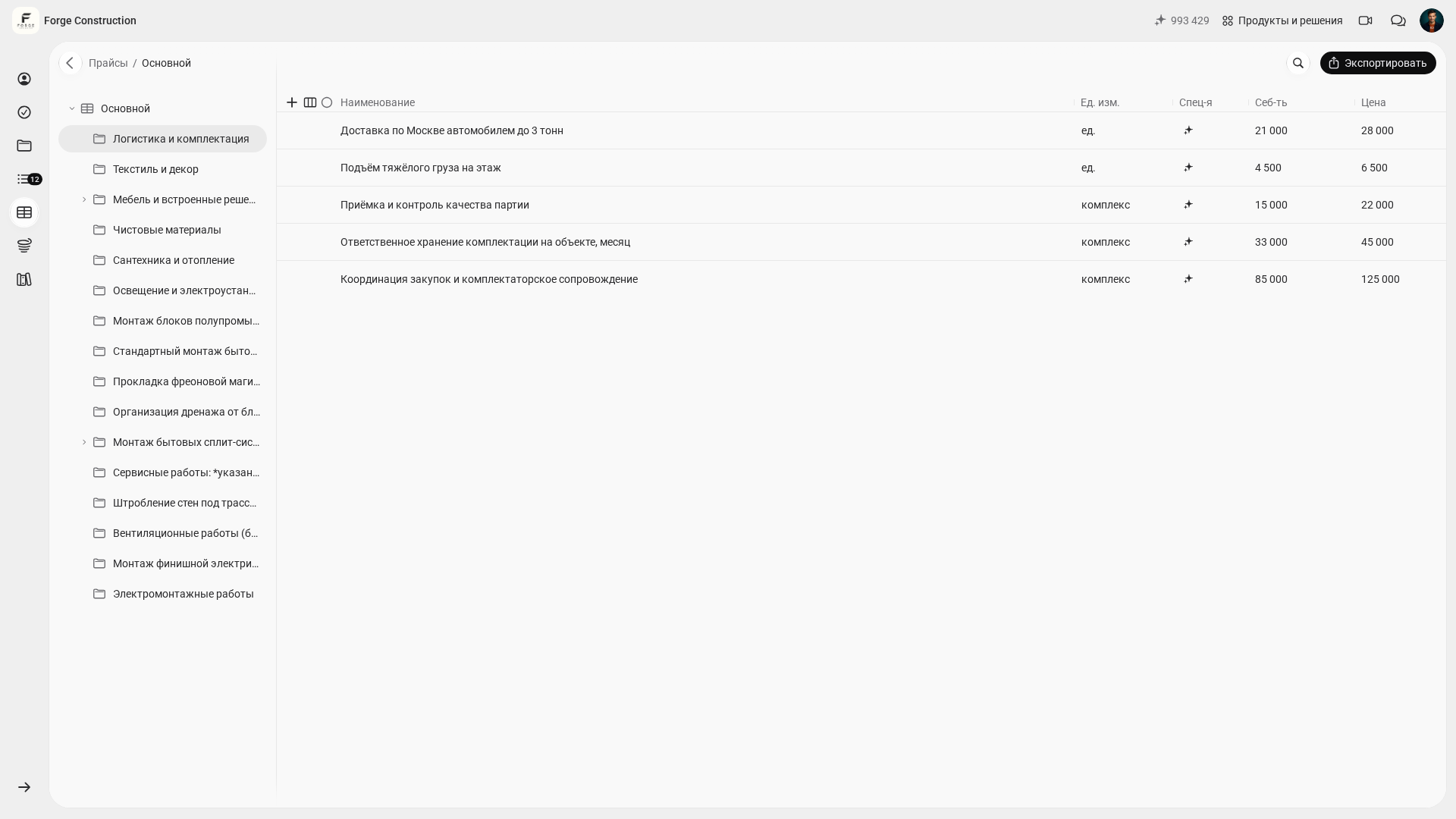
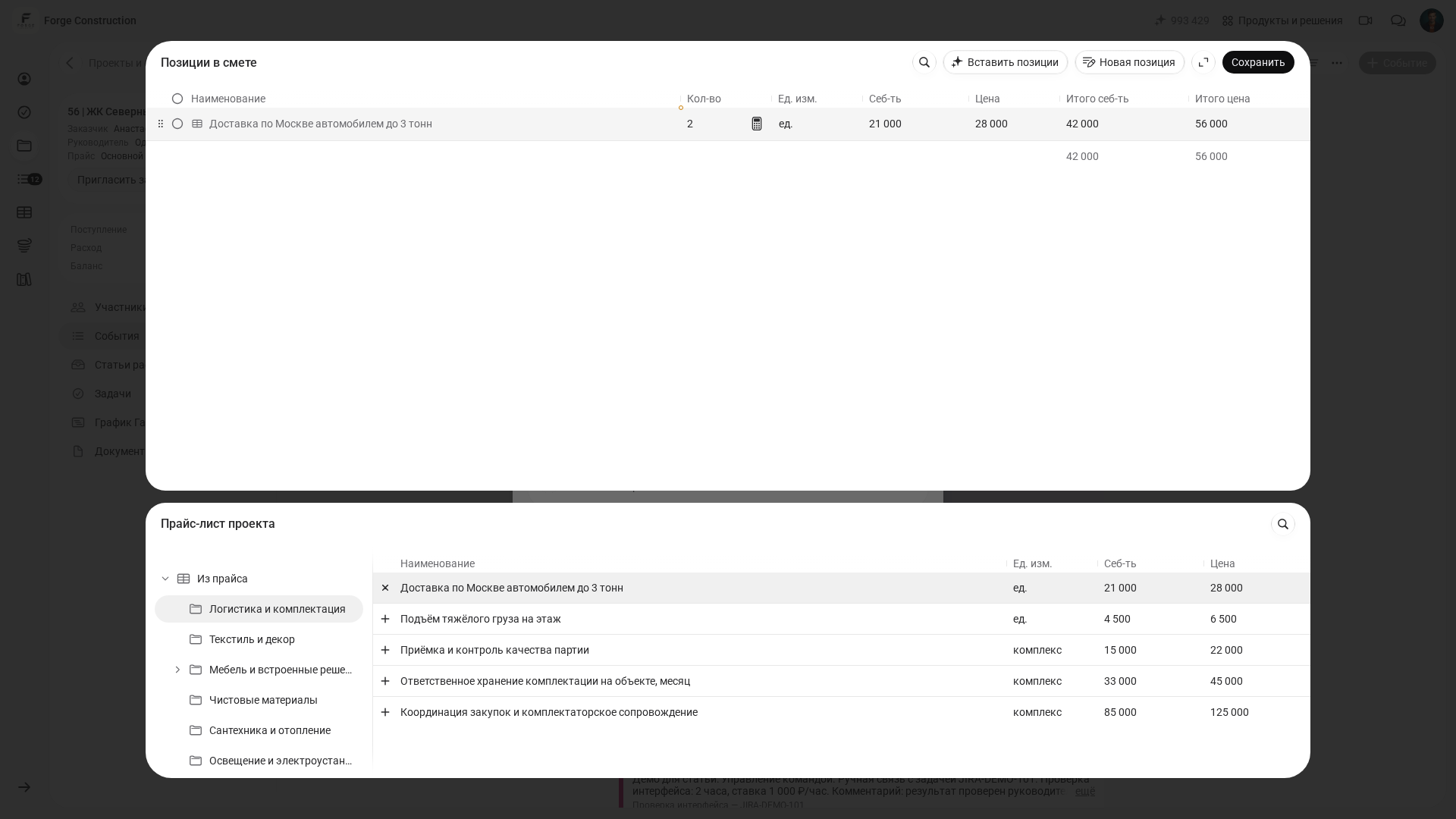
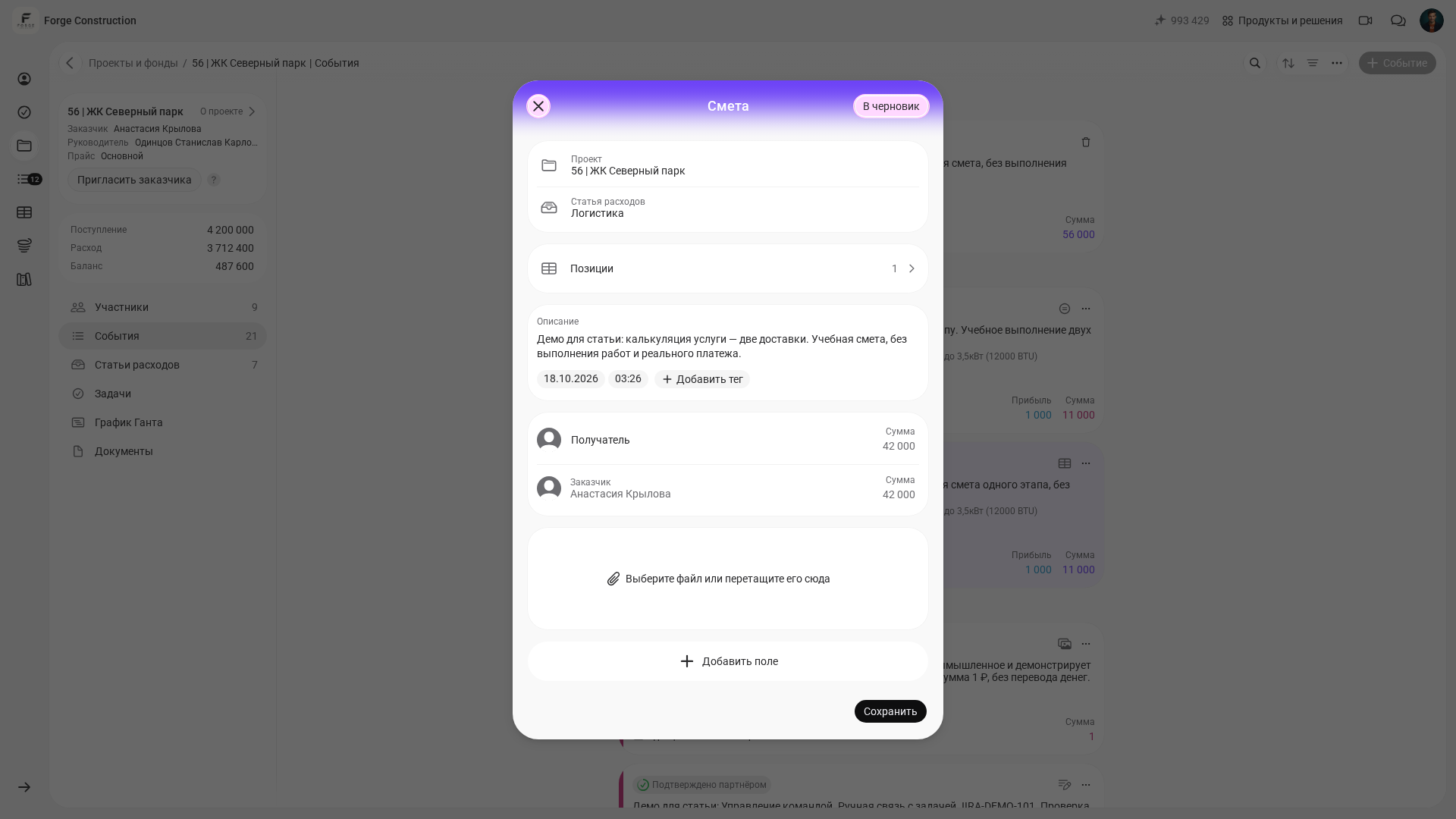
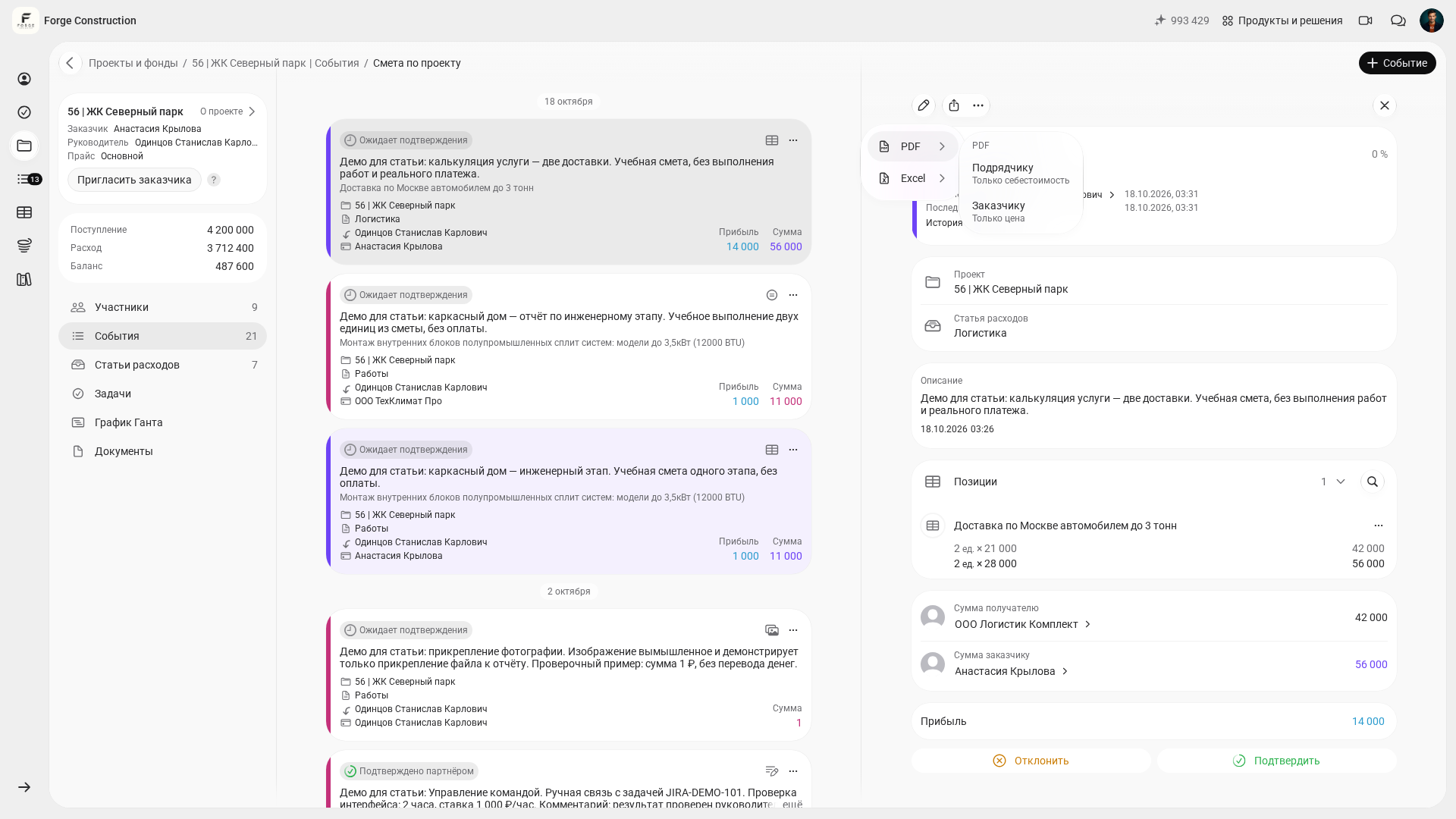
The price list can then be used for an estimate. In 101, a planned calculation for a stage or part of the work is recorded as an Estimate event, labelled «Смета» in the Russian interface: add items from an available price list, enter the quantity and check the units of measurement. In the training example, after selecting the expense category «Логистика» (“Logistics”), the item «Доставка по Москве автомобилем до 3 тонн» (“Delivery within Moscow by vehicle up to 3 tonnes”) was added: 2 units at a cost of 21,000 and price of 28,000 per unit give totals of 42,000 and 56,000. Before saving, the main form displayed 42,000 for the recipient and 42,000 for the client; the saved card shows 42,000 and 56,000. Therefore, check the line totals, the form’s total fields and the result after saving. The training estimate card shows the status «Ожидает подтверждения» (“Awaiting confirmation”) and a difference of 14,000 labelled «Прибыль» (“Profit”). This difference is calculated from the entered price and cost values; the estimate does not establish that work was performed, payment was made or net profit was earned. The «Поделиться» (“Share”) → PDF menu offers «Заказчику» (“For the client”, «Только цена» / “Price only”) and «Подрядчику» (“For the contractor”, «Только себестоимость» / “Cost only”); access depends on permissions. Generating a document is a separate action and must not be treated as an automatic result of saving an estimate. After receiving the document, check its contents and amounts before passing it on. For more on preparing estimates, see “How to Calculate a Renovation Estimate” (in Russian) and “Online Estimate Calculation”.
Another practical point is to maintain one up-to-date version of the price list. If the team uses the same version, it is easier to answer clients’ questions about rates and update the figures consistently. This way of working with rates is described in “Online Rates in the 101 App” (in Russian).
After calculating prices, check the financial result by project. Contribution margin, or the contribution toward fixed costs, equals revenue minus all variable costs. This amount covers fixed costs; the remaining result still needs to be checked against other income, expenses and taxes if they have not been included. When calculating profit after the full cost, do not deduct overheads already included a second time. For more on these measures, see “Contribution Margin” and “How to Calculate Business Profitability”.
Summary: a checklist for revising service prices
Use a short plan for your first revision of service prices. The amount of work depends on how complete the data is and how many services you offer; start with the most frequent items.
- List the 10–20 services you sell most often and assign a unit of measurement.
- Calculate the direct costs per unit for each service: labour, materials, delivery and subcontracting.
- Determine the remaining monthly overheads and choose how to allocate them per unit: by hours, m² or projects. Check that these amounts have not already been included.
- Add direct costs and the remaining indirect costs without duplication to obtain the full cost. Separately identify all variable costs to calculate the contribution toward fixed costs; account for a planned reserve under an explicitly recorded rule.
- Choose the target share of price left after the selected costs, state what the cost base C includes and calculate the price using P = C / (1 − m), where m is entered as a fraction from 0 up to, but not including, 1.
- Record the figures in the price list and agree on consistent calculation and updating rules within the team.
- Each month, check profit after the full cost base and the contribution toward fixed costs; update the price list when rates, utilisation and expenses change.