
In construction, money rarely stays in one place. Customer advances arrive in the company bank account, the procurement team pays for purchases by card, the site supervisor holds funds to account for, subcontractors ask for transfers “by tomorrow”, and the customer wants a clear report. Without a responsibility centre in place, financial management ends up relying on memory and messages.
Responsibility centres help organise these finances: each business unit, project or team gets its own share of the budget, clear spending rules and a person accountable for the results. In construction and renovation, this often marks the point when questions such as “Where did the money go?” and “Who approved this purchase?” stop coming up.
This guide explains what a responsibility centre is in a construction company, which centres can be useful in renovation work, how to introduce them without unnecessary bureaucracy, and who should be accountable.
Contents:
- What is a responsibility centre and why does a construction company need one?
- Which responsibility centres work in construction and renovation?
- Who is accountable for a responsibility centre, and what authority do they need?
- How do you set up responsibility centres in practice?
- How do you link responsibility centres to budgets and reports?
- How do you maintain discipline through automation and daily habits?
- Common mistakes when setting up responsibility centres
What is a responsibility centre and why does a construction company need one?
A responsibility centre is a part of a business for which you can set a separate budget, record actual results, review variances and appoint an accountable manager. It might be a project, a work area, the procurement department, the office or a line of business. For each centre, define the decisions its manager is authorised to make and the measures used to assess performance.
The main reason responsibility centres are useful in construction is the project-based nature of the business. Money is tied to individual projects, along with cost overruns, amounts owed, rework and outstanding advances. Project-based accounting helps you review receipts, costs, profit and settlements with participants separately.
Responsibility centres do not replace accounting. Accounting handles tax and statutory reporting. Responsibility centres support management accounting: they help you make decisions while a project is still under way. For the financial foundations, see financial accounting for income and expenses in construction.
Which responsibility centres work in construction and renovation?
Management accounting distinguishes four types of responsibility centre. A cost centre is accountable for controllable costs, a revenue centre for revenue, a profit centre for revenue and costs, and an investment centre also for the capital employed and investment decisions. The type of centre depends on its manager’s authority. Managers are assessed on measures they can influence; a project’s overall financial performance is analysed using all the costs attributable to it.
The following is an example structure for a company running 5–15 projects at the same time. Choose the centres and their types to suit your team’s processes and delegated authority:
- Project responsibility centre — the main unit. It covers the estimate, planned versus actual figures, subcontractors, funds held on account, project stages and completion documents.
- Procurement responsibility centre — material purchases, delivery, returns, incorrect or mixed-up supplies, and supplier management.
- Site operations responsibility centre — work crews and site supervisors whose decisions affect overruns, including rework, additional quantities of work and downtime.
- Equipment and tools responsibility centre — hire, maintenance, consumables and transfers between projects.
- Office responsibility centre — ongoing expenses such as rent, communications, accounting, software services and administrative salaries.
- Sales and marketing responsibility centre — leads, site surveys, quotations, customer acquisition costs and conversion rates.
Assign an accountable manager and an agreed set of performance measures to each responsibility centre. Where a process involves several centres, define their authority, approval procedures and cost-recording rules in advance.
Who is accountable for a responsibility centre, and what authority do they need?
A responsibility centre works when its manager has agreed performance measures and the authority to achieve them. On a project, this role can belong to the project manager or site supervisor, within their delegated authority for purchasing, selecting subcontractors and approving work. Assess the person on the decisions and measures they can actually control.
A practical division of roles looks like this:
- The owner or director sets the rules: budget categories, approval responsibilities, spending limits and how often planned and actual figures are reviewed.
- The project manager or site supervisor manages the project responsibility centre: oversees the estimated budget and actual costs, monitors the project balance and ensures advances are accounted for.
- The procurement manager manages the procurement responsibility centre: is accountable for prices, delivery times, returns, accurate documents and transparent purchasing.
- The accountant or finance specialist maintains the accounting methodology: consistent transaction-recording rules, checks on supporting documents, reconciliations and reports, including profit and loss, cash flow and the balance sheet.
A clear process for funds held on account helps avoid constant manual supervision of spending. It needs a person accountable for the money and timely expense reporting. This is covered in the article on accounting for funds held on account (in Russian).
How do you set up responsibility centres in practice?
A common implementation mistake is to start with an ideal structure that looks impressive in a presentation but is difficult to use on site. In construction, it is more useful to follow the money: where it comes in, where it is spent and where control is lost.
The following approach can be introduced in a small company without a dedicated finance department.
- Choose your basic accounting unit. In construction, this is usually the project. If you have many similar projects, group them by type: apartment renovations, commercial projects or detached houses.
- Define 8–15 expense categories without breaking them down to every last screw. Add more detail once disciplined record-keeping is established.
- Assign a manager to each responsibility centre and document their authority: which payments they can make independently and which require approval from their superior.
- Set spending limits and a simple approval process: what must be approved before payment, what can be recorded afterwards, and the deadlines for submitting receipts and completion documents.
- Prepare the plan: an estimate, a preliminary calculation or a budget by project stage. Make sure the plan is linked to expense categories.
- Record actuals: link every transaction to a responsibility centre and expense category. Payments made from funds held on account must still be linked to the project and category.
- Review planned and actual figures for key projects every week. Each month, consolidate the company figures and make decisions about staffing, prices, mark-ups and workload.
For a broader introduction to management accounting, see how to organise management accounting in a project-based business. It explains implementation mistakes and the approach that keeps your figures in order.
How do you link responsibility centres to budgets and reports?
A responsibility centre becomes useful when it helps answer three questions: how much have we earned, where is the money now, and whom do we owe? These are the core questions covered by the profit and loss statement, cash flow statement and balance sheet. The blog explains why these reports are fundamental in three essential reports for business owners: profit and loss, cash flow and the balance sheet.
Construction has a particular challenge: cash shortages between project stages. Money is due under the contract, but subcontractors need to be paid today. A cash flow forecast and disciplined project payment management help in this situation. For more on managing these shortages, see what a cash flow gap is and how to avoid one.
Direct costs are charged to a specific project, while general company expenses are recorded separately. To analyse full costs, you can allocate a reasonable share of overheads to projects using a predetermined basis that reflects resource use. Reports should show direct costs and allocated expenses separately. When assessing the accountable manager, consider the costs they can control; allocating expenses to a project does not, by itself, extend that manager’s authority.
How do you maintain discipline through automation and daily habits?
Setting up responsibility centres on paper is straightforward. Maintaining discipline is harder when the team is out on site, purchases happen every day, receipts pile up and reports are submitted late. In 101, money received, reports of completed work and purchased materials, and transfers to payees are recorded as separate events. For a project, you can compare “Поступление” (Receipts), “Расход” (Recorded costs) and “Баланс” (Balance): the balance is the difference between receipts and recorded costs. These figures alone do not establish the project’s profit or the amount of money held by an individual participant.
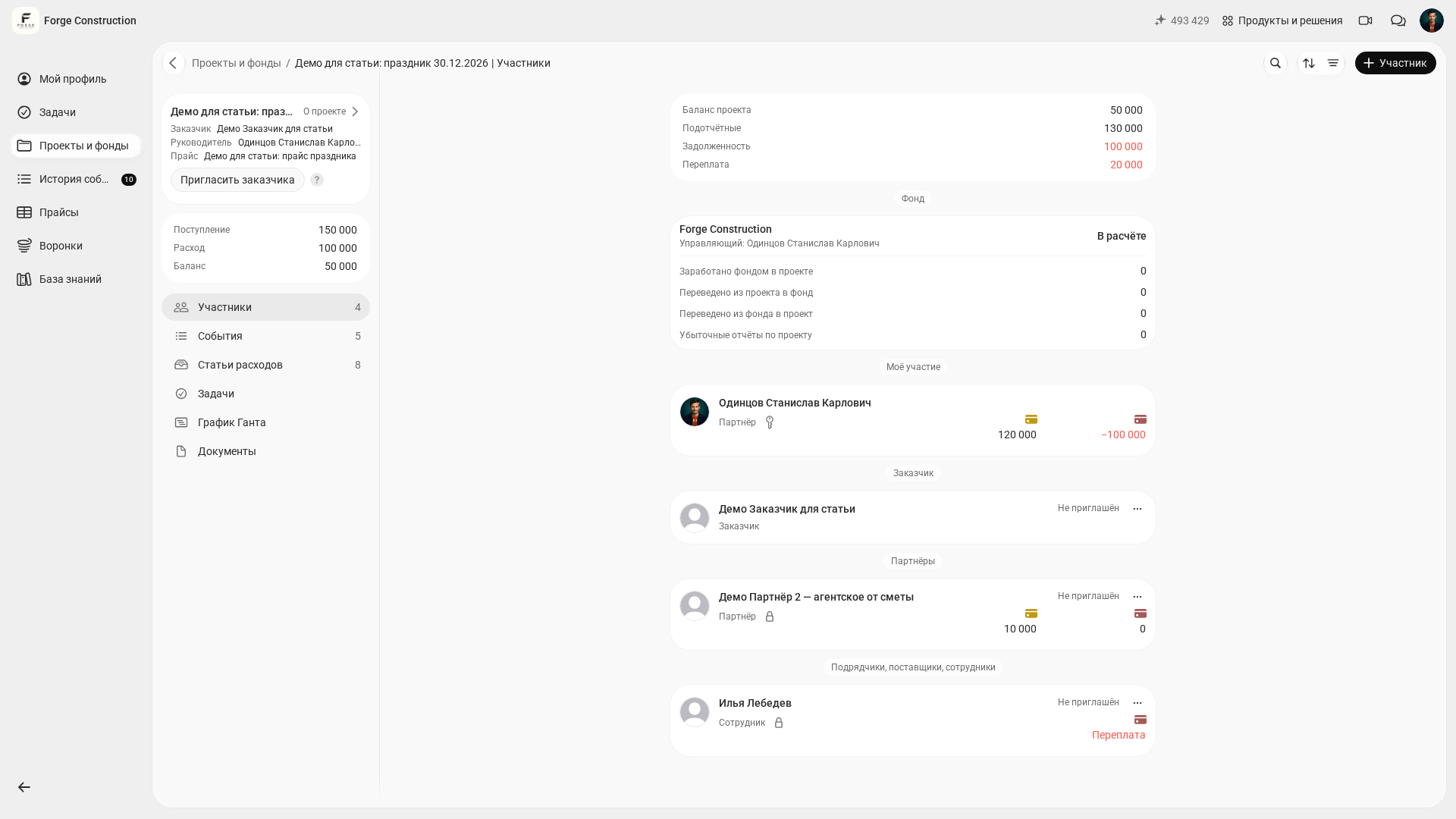
To see how budgets, expense categories and comparisons of planned and actual figures fit together, read project financial management: how to manage a budget and control spending.
Expense reporting is another point where accountability often breaks down. If reports are collected only once a month, the figures arrive late and decisions are made without reliable information. The article on simplifying construction reports (in Russian) explains which reports a construction business needs and how to make them easier to prepare.
Common mistakes when setting up responsibility centres
Too much detail from day one. With 80 expense categories, the team stops selecting the right ones and starts using “Other”, making the figures less meaningful. Start with a short list and expand it as you collect actual data.
A responsibility centre without an accountable decision-maker. If the site supervisor is “responsible for the project” but procurement makes payments without linking them to that project, financial accountability breaks down. Set clear rules for who spends, who approves and who submits supporting documents.
One person entering all the records after the event. An accountant can meet reporting requirements, but management accounting depends on the daily work of tradespeople, procurement staff and project managers. If one employee enters everything later, the figures will be delayed and distorted.
No regular review of the figures. A short quarterly audit is useful: reconcile a sample of payments, funds held on account, expense categories and the way planned and actual figures are compared. The approach is explained in the article on auditing management accounting.
Responsibility centres connect decisions with their financial consequences: who made a decision, what it cost, and how it affected the project’s results and cash flow. Agreed authority, clear accounting rules and regular performance reviews help managers spot variances in time.