A company’s cash cycle measures the time between paying suppliers and receiving money from customers: funds go into work and purchases, then return as payment. In theory, it all looks straightforward. In practice, money almost always moves with delays, in instalments and through several people.
This makes it easy to end up in a situation where there is a profit on paper, work is progressing and the team is busy, yet the bank account is empty. This happens when management focuses only on “receipts” and “outgoings”, overlooking the third element: obligations and future payments.
Contents:
What is a company’s cash cycle?
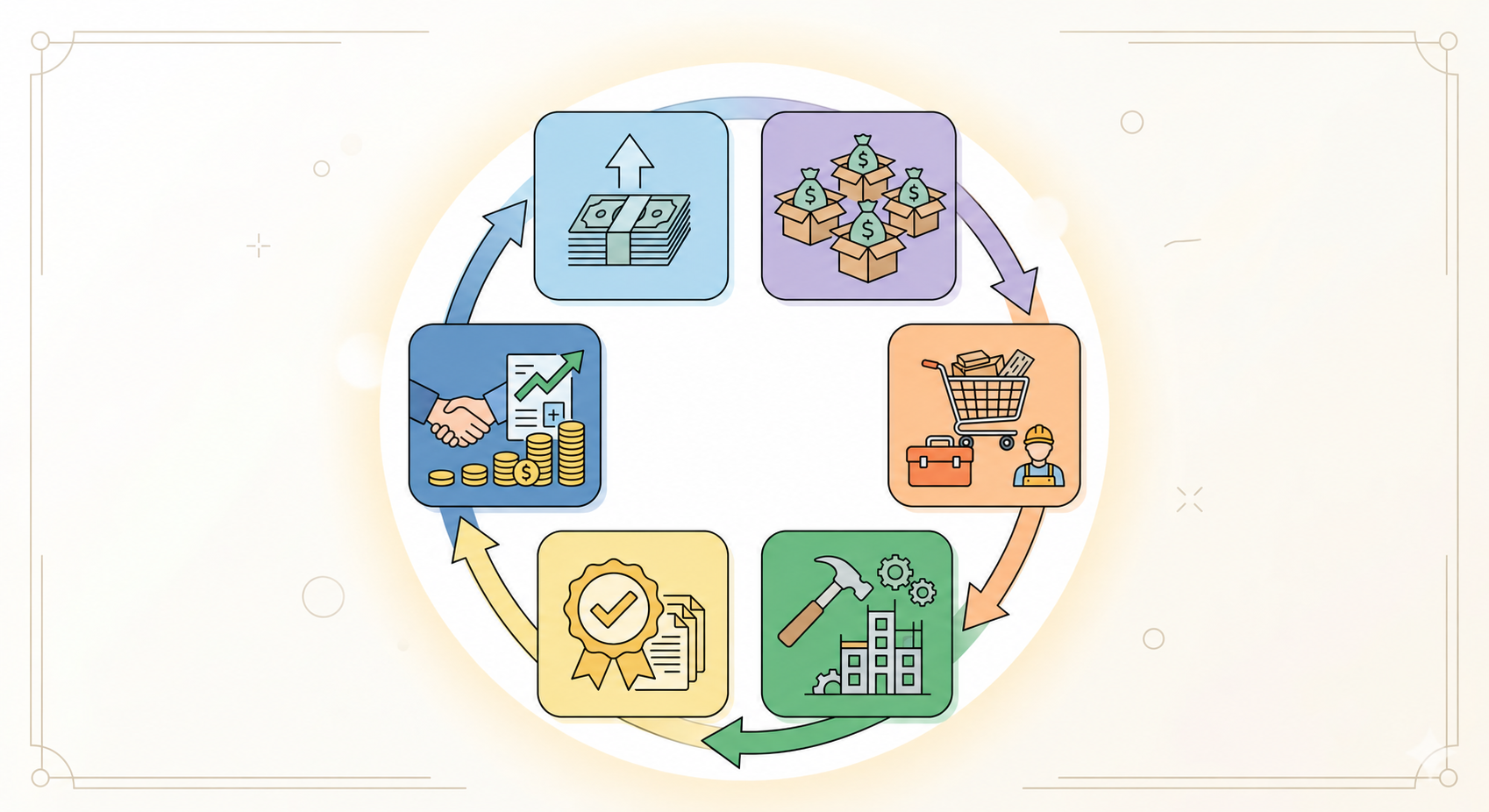
In the standard model, the financial cycle, or cash cycle, is the period between paying suppliers and receiving payment from a customer. In a project business, cash movements are often tied to stages of work: customer advance → purchases and advances to contractors → execution → acceptance → final payment.
It is useful to distinguish two similar terms here. The operating cycle runs from acquiring resources for the work to receiving payment from the customer, including the wait for that payment. In the standard model, cash cycle = DIO + DSO − DPO: DIO is the average inventory holding period, including work in progress; DSO is the average time from a credit sale to payment by the customer; DPO is the average time from a credit purchase to payment to the supplier. All three measures are expressed in days and calculated using data from the same period. In this model, the operating cycle equals DIO + DSO, while supplier payment terms reduce the cash cycle.
Until the cycle is set out in words and numbers, it is impossible to manage it. All that remains is a set of impressions: “there should be enough money”, “the customer is paying”, “we are making a profit”. Those impressions often end in a cash shortfall.
What are the stages of the cash cycle?
There is little “magic” in the cash cycle and plenty of mechanics. Money moves through a recurring pattern, even when a business provides different services or handles different sites.
Below is an example of cash movements in a project: construction, renovation, an event or another project format involving contractors, materials, advances and acceptance. The sequence covers both payments for work and sources of financing; the order depends on the contract. Advances and stage payments can reduce the financing required: in a simple model, the cash cycle is zero when customer payments and supplier payments fall due at the same time, and negative when the customer pays earlier. For this kind of project, a schedule of specific cash receipts and payments matters.
- Money coming in. An advance, a stage payment, a loan, a partner’s funds or collection of a customer receivable.
- Allocation. What can be spent on the project, what needs to be set aside for recurring expenses and taxes, and what should be kept in reserve.
- Money going out. Materials, contractors, wages, rent, logistics and funds advanced to employees for expenses.
- Future obligations. What you have already committed to pay: approved invoices, contractor payment schedules and contracted purchases. Expected future purchases are included separately in the payment plan.
- Acceptance and revenue recognition. Signed acceptance certificates, confirmed quantities of work and completed stages provide evidence that work has been performed. The timing and amount of revenue are determined by the contract terms and applicable accounting rules; an event alone does not mean that revenue is recognised automatically.
- Money coming back. Final payment, retentions, additional work, refunds and penalties: everything that affects the cash actually received.
Where does money most often get lost?
In project businesses, money rarely disappears “into thin air”. It usually ends up in one of three places: receivables (customers owe money), inventory (materials have been purchased), or employee expense advances and other prepayments (money has been paid out, with the expense report or settlement to follow).
A cash shortfall looks like this: on a particular day, the company cannot make a payment because the available balance between receipts is smaller than the required payment that has fallen due. The project may still be profitable.
A common mistake is to pool the money from several projects and make decisions based on the total balance. One site may then be running at a loss and consuming working capital, another may be kept afloat only by new advances, and a third may look profitable until its required payments fall due.
To find where money is getting tied up in your business, start with two questions: what have you already paid for in advance (materials or contractor advances), and what has not yet been paid to you (stages, accepted work or additional work)? This makes it clear why money is moving slowly through the business.
Three reports that keep the cycle under control
The cash cycle becomes visible through three management reports: the cash flow statement, the income statement and the management balance sheet. The first shows cash, the second shows profit, and the third shows where resources and debts sit.
| Report | The question it answers |
|---|---|
| Cash flow statement | When cash actually came in or went out, and how much |
| Income statement (P&L) | How much the business earned under accrual accounting, and how profitable it is |
| Balance sheet | What assets, liabilities and equity the company has at the reporting date, including receivables, inventory and loans |
If you are short of cash “right now”, start with the cash flow statement: it shows actual receipts and payments and helps you understand their patterns. A future cash shortfall is assessed separately using a payment calendar of expected receipts and required payments. The 101 blog article on cash flow statements explains the three categories: operating, investing and financing activities.
If there seems to be plenty of work but little return, you need an income statement. It shows revenue and expenses for the period, as well as net profit or loss under accrual accounting, even if some of the cash will come in or go out later.
If you cannot understand why the bank account is empty despite healthy revenue, you need a balance sheet. It shows receivables and payables: who owes you money and whom you owe.
How are the operating cycle and working capital connected?
All else being equal, the longer the operating cycle, the more resources the business keeps tied up in the process. In construction and renovation, the cycle can last months or even years because of lengthy work, work in progress and the wait for customer payments.
In this article, working capital is used in the broad sense of current assets: money in bank accounts, materials, receivables and other resources in current circulation. A separate measure is net working capital: current assets minus current liabilities. English-language sources often use “working capital” to mean this net figure. Revenue recognition and the receipt of money from a customer are accounted for separately.
The practical conclusion is simple: at the same volume of work, and without additional supplier credit or a customer advance, a longer cycle usually increases the financing required. The customer has delayed payment, acceptance documents are held up and purchases have already been made. The company has to slow down work or obtain additional financing, including using its own funds.
Breaking a project into stages and clearly accepting the work at each stage often helps manage the length of the cycle. In construction, this comes down to documentation and discipline, so it is useful to agree in advance how and when acceptance will be confirmed. As a separate Russian example, you can read the article on the KS-2 work acceptance form (Russian example, in Russian).
How can you set up control over cash movements?
Setting up control of the cash cycle means establishing a series of agreements within the company: what is recorded immediately, who confirms it and how often the payment plan is updated. If events are recorded late, the budget becomes guesswork.
A practical process looks like this.
- Describe the project stages and the revenue recognition rules under the contract and applicable accounting rules; define what acceptance, certificates and other events confirm.
- Build a calendar of customer receipts: advances, stage payments, final payment and retentions.
- Build a calendar of required payments: contractors, materials, taxes and recurring expenses.
- Set up separate “pots”: project funds, the company fund, employee expense advances and reserves.
- Update actual cash flow and the payment calendar weekly; use the calendar to watch two dates: the next possible cash shortfall and the next large receipt.
- Close the income statement and balance sheet each month to see the profit and where money is tied up.
If accounting is kept in a system where each site is a separate project, this control becomes easier: receipts, expenses, obligations and the balance are brought together in one place. In 101, this is handled through the “one site, one project” approach and by recording events as they happen.
To explore the topic further, it is useful to keep several 101 blog articles to hand: cash flow statements, income statements and balance sheets, cash shortfalls, working capital and the difference between revenue and profit. They address the typical questions that come up after a first attempt to map the cash cycle.
If you would like to examine the cycle using your own figures and understand exactly where money is tied up — in receivables, materials or contractor advances — a short demo can help you see what project accounting looks like in practice.