
Revenue and profit are often confused because both relate to money. Yet they answer different questions. Revenue shows how much you have sold. Profit shows how much remains after expenses.
In project-based businesses such as construction, renovation and fit-out procurement, advance payments, work stages, acceptance certificates, material purchases and subcontracting make the distinction more complicated. Your bank account may hold a substantial amount even when the business only breaks even for the month.
Below, we explain the difference in plain language, break profit down into its different measures and provide a short calculation procedure. Along the way, you will find links to useful 101 articles for a closer look at the details.
Contents:
- Two questions that distinguish revenue from profit
- Revenue: when is money considered earned?
- Profit: what is it, and why are there several measures?
- Cost of sales, margin, gross profit and net profit: how do they relate?
- A step-by-step approach to calculating project profit
- Common pitfalls: revenue without profit
- What should you monitor regularly to keep track of money?
Two questions that distinguish revenue from profit
The easiest way to remember the difference is this: revenue answers “How much did the customer buy from you during the period?” Profit answers “How much did the business earn from those sales after all expenses?”
Consider a hypothetical renovation example with newly specified amounts. A stage of work was completed and accepted during the month, giving recognised revenue of 600,000 ₽. The costs attributable to that stage are 240,000 ₽ for the tradespeople’s work, 180,000 ₽ for materials used, 15,000 ₽ for delivery and 15,000 ₽ for waste removal. Total costs are 450,000 ₽, leaving a difference of 150,000 ₽ from revenue. In this example, we treat all the listed costs as both direct and variable, so the difference also equals the contribution towards fixed costs. General company expenses, interest and taxes have yet to be included: net profit has not been calculated. Payment dates are checked separately.
Focusing only on revenue can lead you to overestimate the company’s financial health. Focusing only on profit without understanding revenue makes it difficult to manage sales and the team’s workload. You need both measures within a consistent accounting approach.
Revenue: when is money considered earned?
This article uses accrual-based management accounting: revenue is recognised as obligations to the customer are fulfilled, regardless of the payment date. In renovation and construction, completed stages and signed work acceptance certificates help substantiate the work performed. An advance payment for future work does not, by itself, mean that revenue has been earned. Set out your specific recognition policy in your accounting model, taking the contract terms and applicable rules into account.
Agree at the outset on exactly what you treat as revenue in management accounting. For staged work, you can use the amounts in acceptance certificates for the period, provided they reflect fulfilled obligations and your chosen recognition model. For a closer look at what counts as revenue and where the boundaries lie, including advances, refunds and offsets, see the 101 article “What Is Revenue?”.
Another point: money received into your account and revenue from work belong in different reports. Cash receipts matter for your ability to pay and for cash flow gaps. Revenue matters for assessing sales and project economics. There is a separate article on what a cash flow gap is, what causes it and how to address it.
Profit: what is it, and why are there several measures?
Profit is the difference between income and expenses for the same period; revenue is the starting point for the core project calculation. The question is which expenses you include. Management accounting therefore considers results at several levels, from an individual project’s result to the company’s net profit after all expenses, interest and taxes under the chosen model. Net profit is not the amount an owner can freely withdraw: check available cash, liabilities and the business’s needs separately.
For a project-based business, it is useful to calculate contribution margin separately: project revenue minus variable costs. These costs change with the volume of work within the relevant range. Materials, piece-rate pay, subcontracting and logistics belong here to the extent that they actually depend on volume. Direct costs are classified on a different basis: they can be traced to a particular project, and some may be fixed. The result after direct costs can therefore differ from contribution margin. See the 101 article on contribution margin.
To assess the company’s result, you also need to account for its infrastructure: office costs, management staff, marketing, software, interest and taxes. Gross profit uses a separate calculation: revenue minus the cost of goods sold or work performed, with the included costs defined in your accounting model. Gross profit and contribution margin may differ. For more detail, see the 101 article on what gross profit is and how it differs from net profit (in Russian).
Cost of sales, margin, gross profit and net profit: how do they relate?
To distinguish revenue from profit without a cheat sheet, it helps to understand which costs have been deducted from sales in each calculation. Each measure has its own management use; gross profit and contribution margin group costs in different ways.
Start with cost of sales. When calculating profit for a period, you need the cost of the goods sold or work performed to which the revenue relates. In a project-based business, this may include labour, materials used, delivery, subcontracting and an allocated share of overheads. Define the included costs and the allocation basis in advance. If overheads are already included in cost of sales, you must not deduct them again from the result. For a detailed explanation and formulas, see the 101 article “The Cost of a Service: What It Is and How to Calculate It”.
| Measure | What does it show? | How do you calculate it in renovation and construction? |
|---|---|---|
| Revenue | Sales recognised during the period | The value of fulfilled obligations under the chosen model; for staged work, acceptance certificates may substantiate it |
| Result after direct costs | What remains from the project before unallocated general expenses and other expenses | Project revenue − direct costs attributable to that revenue |
| Contribution margin | The amount available to cover fixed costs and generate profit | Project revenue − all variable costs attributable to that revenue |
| Gross profit | The result after cost of sales, before other expenses | Revenue − cost of goods sold or work performed, including overheads allocated to that cost |
| Net profit | The company’s financial result for the period after all income, expenses and taxes | Profit before tax, already including interest and other income and expenses, − income taxes under the applicable model |
Margin and markup are also often confused. When calculating percentages, first use the same set of costs for the comparison. Markup is the difference between the price and the chosen cost base divided by that cost base; margin as a percentage is the same difference divided by the price. If this is relevant to you, see the 101 article on the difference between margin and markup.
A step-by-step approach to calculating project profit
For a quick calculation, start with clear rules. Choose a period and align the recognition of revenue and its related expenses: recognise costs of completed work in the same period as the revenue from that work, regardless of the payment date. Attribute general expenses to the appropriate period under your chosen model. Track receipts and payments separately to monitor cash.
Here is a practical sequence for renovation, construction, fit-out procurement and design projects:
- Choose a period, such as a week or a month, and establish a rule for recognising revenue from fulfilled obligations; for staged work, check the supporting acceptance certificates.
- Compile recognised revenue for each project separately for the chosen period.
- Compile the direct costs attributable to that revenue: materials used, delivery, waste removal, subcontracting and piece-rate pay. For tools, determine the costs attributable to the work under your chosen model, such as hire charges or a share of the cost of use. The purchase date alone does not determine the expense for the period.
- Calculate the result after direct costs: project revenue − direct costs attributable to that revenue. To calculate contribution margin, separately deduct all variable costs from revenue, including the variable portion of indirect costs, if any.
- Include general company expenses such as office costs, advertising, accounting, communications and services. If you allocate them across projects, choose a basis in advance, such as hours worked, and deduct each amount only once. For the company-wide result, add up the project results and include only expenses for the period that have not already been counted, along with other income, interest and taxes under your chosen model.
- Separately check actual bank and cash receipts and payments, cash balances, receivables and payables. Compare expected receipt dates with required payment dates to identify the gap between “earned” and “received”.
If you want to use the calculation in management, the next step is to calculate profitability. It helps you compare projects and services. For the formula and the reasoning behind it, see the 101 article “How to Calculate Business Profitability”.
Common pitfalls: revenue without profit
The financial result can be distorted when expenses are spread across different periods and handled by different people, while some costs are left out of the project altogether. Check for these situations:
- Advances are recorded as revenue. The month then appears to show growth even though the work is still ahead.
- Direct costs are recorded, but general company expenses are omitted. Individual project results appear positive, yet once general expenses are included, the company’s profit may be lower or turn into a loss.
- Funds entrusted to participants and small purchases are left out of the analysis. Surprises emerge at the end of the month.
- The estimate is prepared once, with no comparison between planned and actual figures. Costs change while the contract price stays the same.
- Money arrives after work has been formally accepted. There is profit on paper but a cash shortage.
For general expenses that get lost between projects, see the separate 101 article “Hidden Business Expenses: Where to Look for Money” (in Russian). It explains why company turnover can grow faster than profit.
What should you monitor regularly to keep track of money?
The minimum set for regular checks includes recognised revenue, the related direct costs by project, general company expenses, a payment calendar, receivables (who needs to pay you) and payables (whom the company needs to pay). For final net profit, also check other income and expenses, interest and taxes under the chosen model. This set helps you assess the financial result while monitoring cash separately.
If you want to build a system, it is worth reading how management accounting works in project-based businesses: “How to Set Up Management Accounting”. It explains the components of the financial picture and why it is important to separate projects from company expenses.
When records are kept in spreadsheets and chats, the connection between revenue, expenses and profit can be lost. A purchase receipt is forgotten on one project, a subcontractor payment is overlooked on another, and company money gets mixed with project funds on a third. Such omissions make it harder to reconcile the financial result and cash movements.
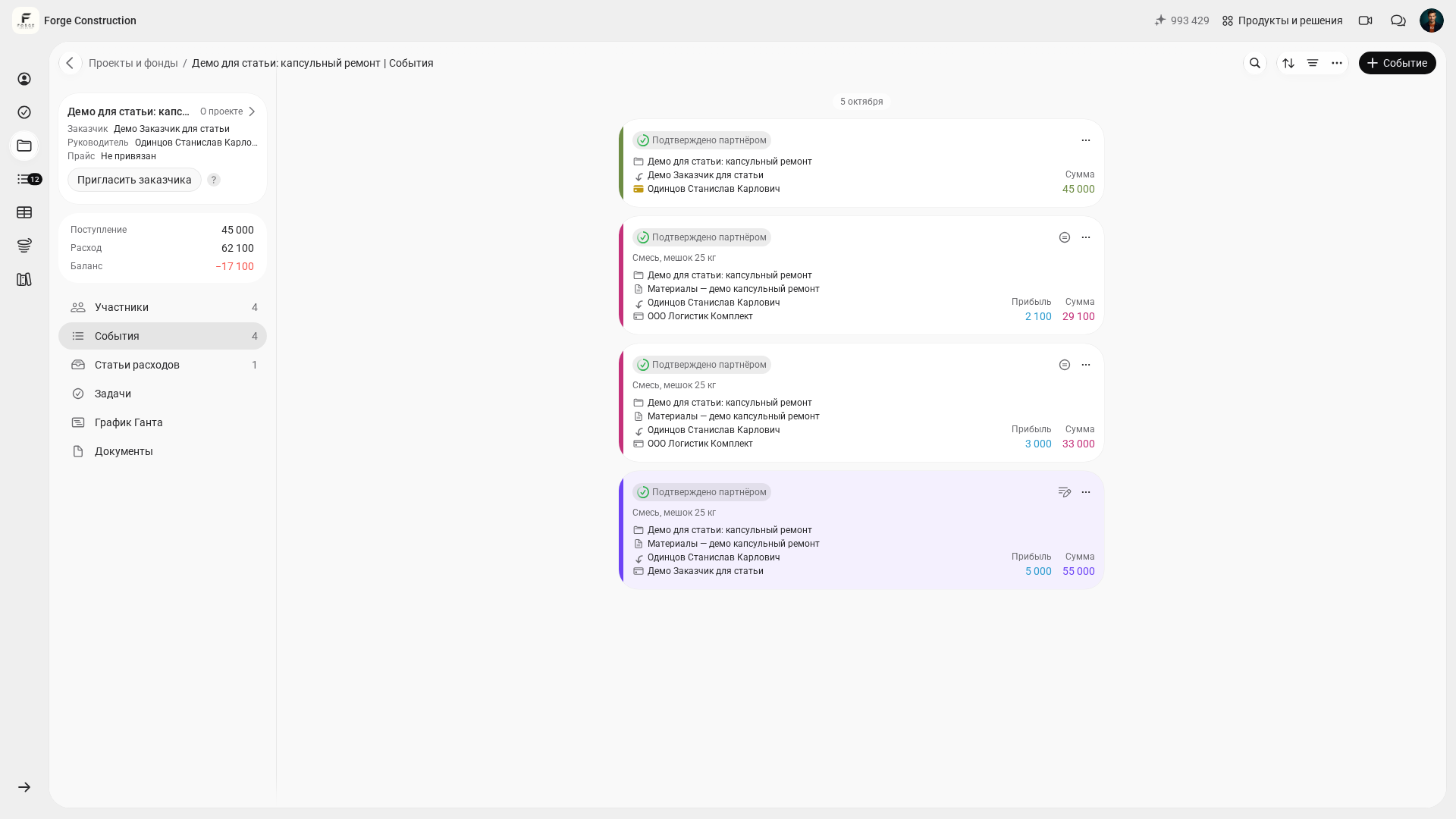
In the 101 app, you can record receipts and expenses by project, and internal company expenses in the Company Fund. The project balance shows the difference between receipts and recorded expenses. It is not the money held by an individual participant or net profit calculated on an accrual basis. To calculate net profit for a period, separately reconcile recognised revenue, the costs attributable to it, other income and expenses, interest and taxes under your chosen model. If you would like to see how the records look on screen and how to adapt the setup to your processes, a demo and setup assistance from an expert can help.
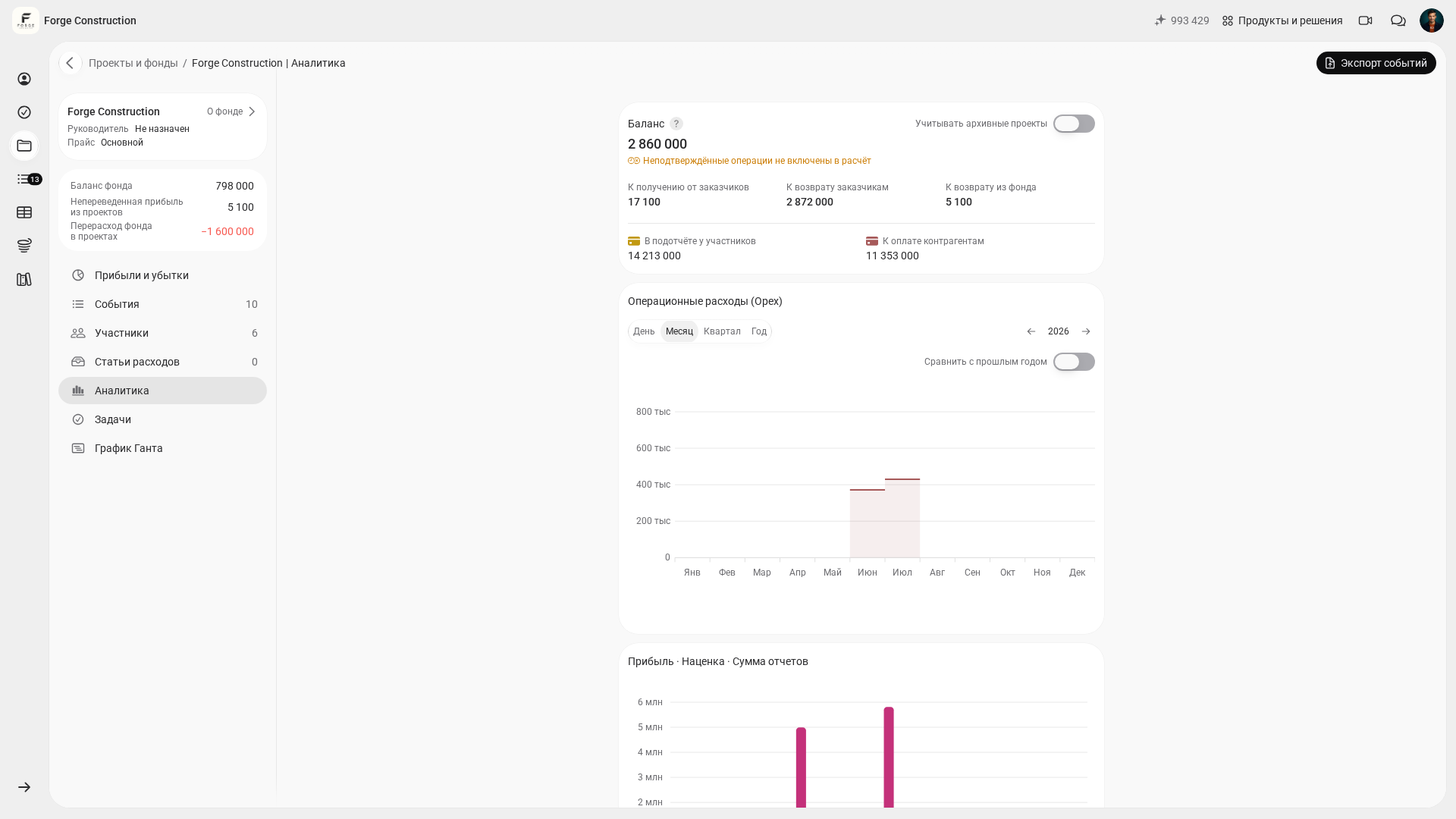
If you need a deeper analysis of profitability, planned versus actual figures or expenses by category, first define the measures, period and included costs. Check which data and reports are available under your plan and permissions: built-in reports do not cover every management question. Draw conclusions about which areas reduce margins and where improvements are possible from a verified calculation.
To bring the terms “income”, “revenue” and “profit” together in one overview, you can read the introductory 101 article “Revenue and Profit: What Is the Difference?”. It makes it easier to establish a shared vocabulary within the team.