
Administrative expenses are the costs of managing the company as a whole: administrative work, the office and the services that support it. They are usually tracked separately from the costs of individual projects. These expenses affect the company’s final profit.
A common situation in a project-based business is that individual projects are profitable, turnover is growing and the team is busy, yet little cash is available. One reason is administrative expenses and other shared costs that get spread across projects and rarely appear in clear, useful analysis.
Below, we examine what administrative expenses include and practical ways to optimize them without disrupting the team’s work or turning the exercise into indiscriminate cuts.
Contents:
What are administrative expenses, and why track them separately?
This article takes a management accounting perspective: administrative expenses support the company’s overall management and administrative work. Selling, launching, supervising and closing projects, including their paperwork and financial settlements, involve different costs. Whether a particular expense is administrative depends on its purpose and the company’s accounting rules. This is a working classification for business analysis; financial accounting and tax requirements depend on the applicable rules.
If these expenses are not tracked separately, project economics can be distorted. One project absorbs the office rent and management salaries, while another remains “clean” and looks more profitable. Decisions can then go wrong: one type of project seems profitable and another unprofitable, although the difference may come from how shared costs are allocated.
There is another practical reason to track them: some administrative expenses create a recurring cost burden. Even if the number of projects falls, rent, essential services and a minimum team may remain. You can analyze this behavior by distinguishing fixed and variable costs (in Russian). The fixed/variable classification describes how costs behave when the volume of work changes; an administrative function describes their purpose. For example, fixed production costs belong to the production function.
What do administrative expenses include?
The composition of administrative expenses depends on the business model. Their defining feature is support for the company’s overall management and administration. If a shared expense needs to be allocated across projects, first determine its function: indirect production or selling costs may also need to be allocated.
The easiest approach is to group administrative expenses into meaningful categories. This makes it clear where the large amounts are, where small recurring charges are hidden and where costs are growing faster than the team and revenue.
A typical breakdown looks like this:
- Management and administrative staff: salaries for the director, operations manager, administrator, office manager, accountant (in-house or outsourced), HR staff and lawyer, to the extent that they work on company-wide tasks.
- Office and infrastructure: rent, utilities, communications, internet, hosting and equipment maintenance, to the extent that they support the company’s administrative work.
- IT and services: subscriptions, phone systems, cloud services, task trackers, banking services and electronic document management used for overall management.
- Management processes: business travel, business hospitality, training, recruitment and company events, where applicable, when they relate to company-wide tasks. Classify costs for a particular project or sales activity according to their purpose.
- Financial and legal support: banking services, card acquiring fees and other commissions, contract support, audits and consulting. Treat the portion that supports overall management as administrative. For example, analyze the commission on a particular sale together with the related selling expenses.
The team may see office supplies, document delivery, replacement tools “for all sites” and project managers’ phone costs as minor expenses. Classify these payments by purpose: office supplies may support administration, shared tools may support production work, and a manager’s communications may serve a particular project or several sites. Set an allocation rule for shared costs. Individually, these payments may be small, but together they can create a substantial burden.
If you run a project-based business and already account for projects separately, it is useful to track administrative expenses in a separate part of your accounting so that they do not get mixed into site costs. This gap between the project and the company is often what people mean when they discuss hidden expenses.
How do administrative, selling and project expenses differ?
Confusion often begins when comparing the costs of a particular project, selling expenses and administrative expenses for managing the company as a whole. It is important to distinguish a cost’s connection to a project from its function. Until the rules are documented, people assign identical payments to different categories and reports become unreliable.
A useful starting point is to distinguish “project expenses” from “company expenses.” Materials, work and contractors associated with a particular site are recorded in that project; shared company costs are recorded separately. To assess the full economics of each project, decide in advance which shared costs will be allocated across projects and how.
Selling expenses are the costs of bringing sales in and fulfilling them: marketing, sales, delivery to the customer, marketplace commissions and lead generation. The purpose of a delivery matters: transporting materials to a construction site, for example, may be a project cost. See our separate guide to selling expenses (in Russian).
Administrative expenses support the overall management of the company: the administrative office, management salaries, essential services and accounting. Relative to an individual project, these costs are often indirect and require allocation. Costs belonging to other functions can also be indirect. For more on how costs are assigned, see the article on direct and indirect costs (in Russian).
How can you calculate and control administrative expenses?
Optimization starts with a reliable foundation: what exactly counts as an administrative expense, who is responsible for each category and how often you review the report. You can then make informed decisions about which expenses to reduce.
It is useful to analyze administrative expenses alongside two questions. First, what proportion of contribution margin do they absorb? Second, how do they change as turnover grows? Even an “expensive office” needs to be assessed alongside your accounting rules and recording discipline: without these, it is difficult to identify the cause of overspending.
You can introduce a practical approach in stages and then make it a routine:
- Step 1. Define a list of administrative expense categories (10–20 broad categories) so that the team shares the same understanding of the classification.
- Step 2. Establish a rule: every expense must be recorded with a date, a category and supporting documentation (an invoice, receipt or acceptance certificate).
- Step 3. Assign someone responsible for each category. The idea is simple: no money is “nobody’s responsibility.”
- Step 4. Once a month, compile a report on administrative expenses and compare it with the plan: where have you overspent, why, and is it a one-off or a new normal?
- Step 5. Once a quarter, review the category structure: remove duplicates, consolidate categories and add expenses that have become recurring.
If you already use management accounting, add the three main reports for a business owner: the cash flow statement, profit and loss statement and balance sheet. They help you see how administrative expenses affect cash, profit and liabilities.
Another source of losses is manual data collection: receipts in chats, copying information into spreadsheets and repeated calculations. This work consumes paid time from employees and managers. Account for its costs according to the function performed, retaining the connection to administrative tasks where one exists. Typical losses include missing receipts, formula errors, delayed reports and overspending noticed too late.
How can you optimize administrative expenses?
Optimizing administrative expenses rests on two principles: first make the costs visible, then change the rules. Trying to “cut the budget” without a clear picture is risky: you may disrupt processes that maintain quality, deadlines and sales.
The following practical approaches tend to produce results most often:
- Check payment terms when outsourcing work. Where a role does not require a continuous workload, consider outsourcing accounting, legal work or HR documentation. During difficult periods, paying for the actual volume of work may reduce the fixed cost burden. A contractor’s retainer remains fixed within the terms of the contract.
- Review the office and infrastructure. Floor space, warehouses, parking and workstations may remain from an earlier period without being reviewed for a long time. Determine the function of each cost by its use: an administrative office supports management, while warehouses and parking may support production, sales or a particular project. Optimize each part according to its purpose.
- Put all subscriptions on one list. Services often duplicate functions: several cloud services, two messengers and two task trackers. Assess whether you can standardize services while retaining the features the team needs.
- Make sure every payment is recorded. Administrative expenses are difficult to calculate accurately when some cash payments or informal arrangements remain outside the records. Incomplete entries distort analysis and make it harder to prevent repeated overspending.
- Set limits for small expenses. Establish clear rules on which amounts can be spent without approval and which require advance approval. Keep necessary spending possible within these rules.
- Automate the collection of source documents. Less manual copying means fewer errors and faster visibility of deviations.
- Free up expensive staff time from routine work. If a manager spends time consolidating spreadsheets and searching for receipts, the company is paying management-level rates for work that could be automated.
- Review recurring contracts. Security, cleaning, equipment maintenance, communications and document logistics. Negotiation or a change of supplier may save money; compare terms alongside quality requirements.
- Bring purchasing under control. Stationery, equipment and office supplies. It helps to have a single person responsible and a rule of “buying from a list once a week.”
- Assess the effect on profit and business performance. If administrative expenses fall while project completion slows or sales decline, the cost of those savings may exceed the benefit. Assess expenses alongside business performance to reach a sound conclusion.
How does the 101 app help?
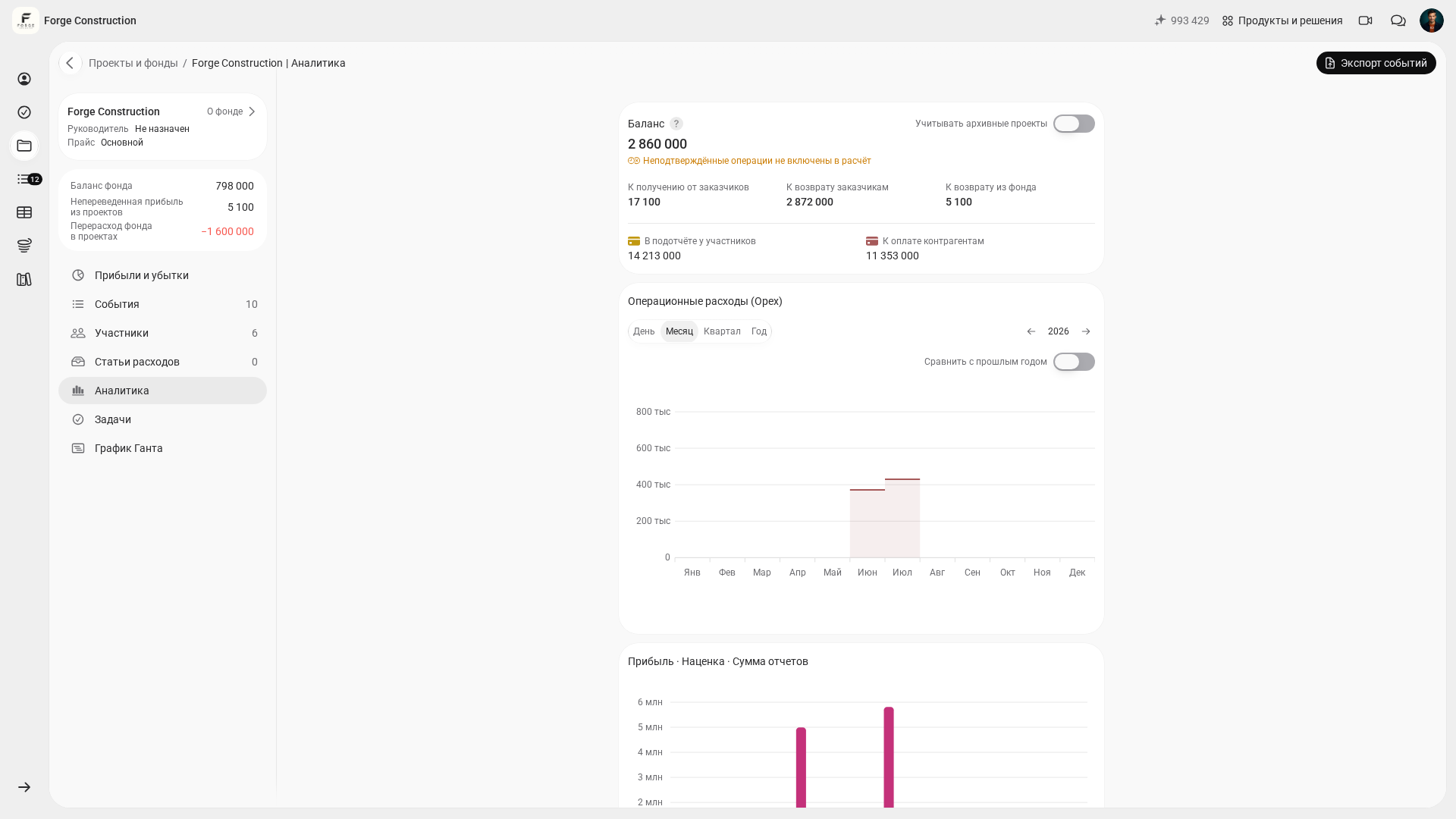
In a project-based business, it is useful to separate two layers: project finances and company finances. In the 101 app, the Company Fund is designed to record internal expenses and is described in the materials on PRO+ features. It is used to record rent, salaries, advertising, taxes, training, communications and services. These expenses may serve different functions; only the relevant portion is administrative. Separate records help you see both site costs and shared expenditure. To assess the company’s final profit, include both layers and establish separate rules for allocating shared costs. Check the availability of the Fund and analytics against your current plan and access rights (help in Russian).
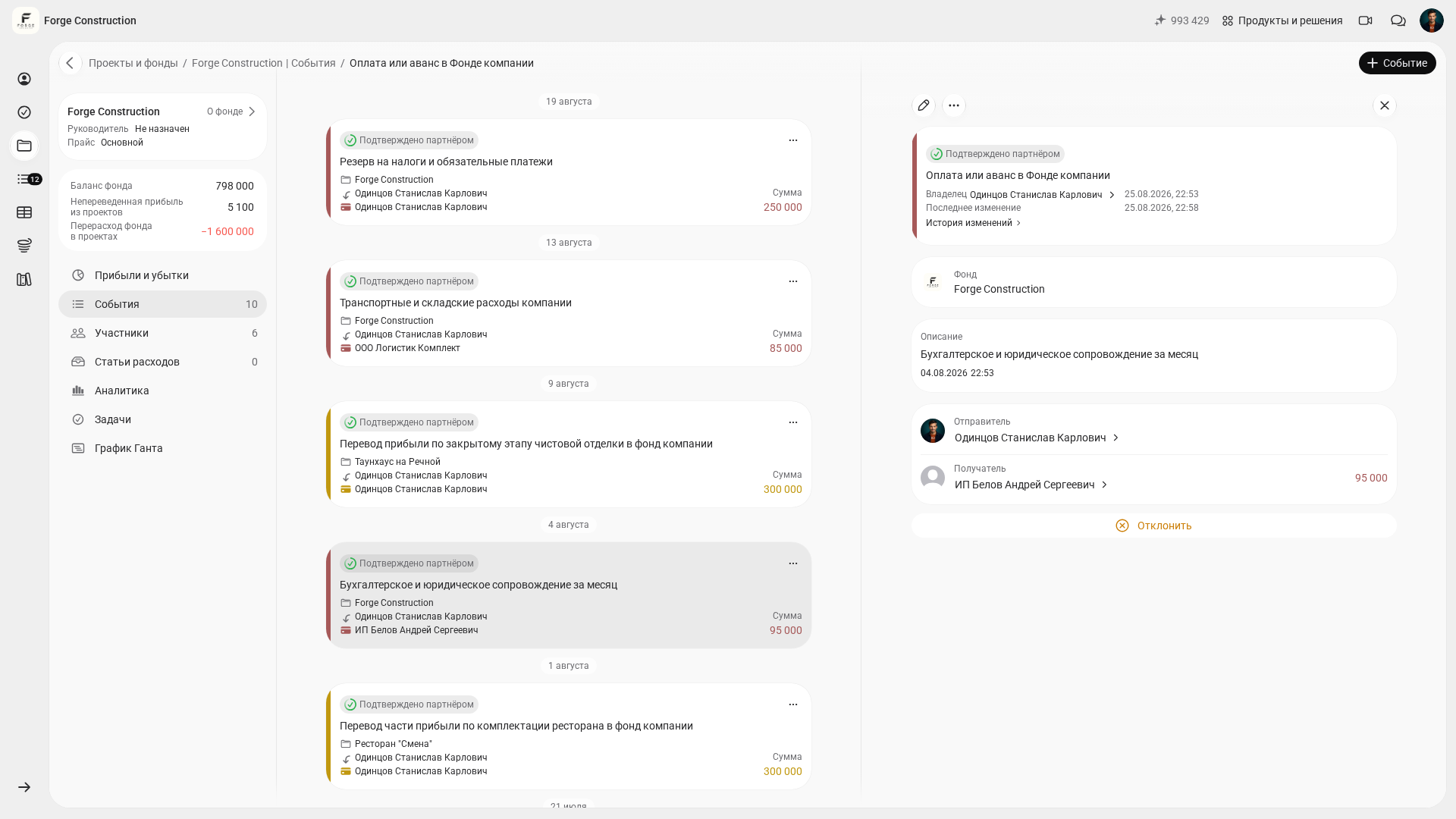
When Company Fund expenses are assigned to categories, you can see which areas absorb the most money: the office, advertising, vehicles, equipment or legal services. This helps you compare months, identify deviations and make decisions based on figures. View company expenses in “Аналитика” (Analytics). When making comparisons, choose periods with the same coverage and a comparable set of data.
Another benefit is consistent expense recording: assign roles, agree on a common accounting rule and record expenses in one tool so that data is not lost and reports do not have to be compiled manually. The recording procedure is described in the help article on the company’s internal income and expenses (in Russian).
For a foundation in organizing project expenses, read the article on allocating expenses to categories (in Russian). A clear category structure helps you spot deviations and manage planned versus actual results.
If you would like to examine administrative expenses using actual figures and understand where there is room for optimization, a product demonstration is a straightforward way to do so: an expert can show you how the Company Fund and PRO+ analytics work for your type of business.