

Resource planning becomes necessary when you have several projects, fewer people and machines than tasks, tight deadlines, and a client who expects clear dates. At that point, simply setting a deadline stops helping: the date exists on paper, the crew has no work area ready, the site supervisor is pulled between sites, and materials arrive before storage is available or after the work should have started.
Here we explain what resource planning means, the principles behind it, common mistakes, how it differs from scheduling and task planning, and who can benefit from it.
Contents:
What is resource planning?
Resource planning means arranging work in advance over time so that every task has the resources it needs: people, equipment, materials, money, access permissions, and management attention. Essentially, it answers two questions: who will do the work, and what will enable you to finish on time?
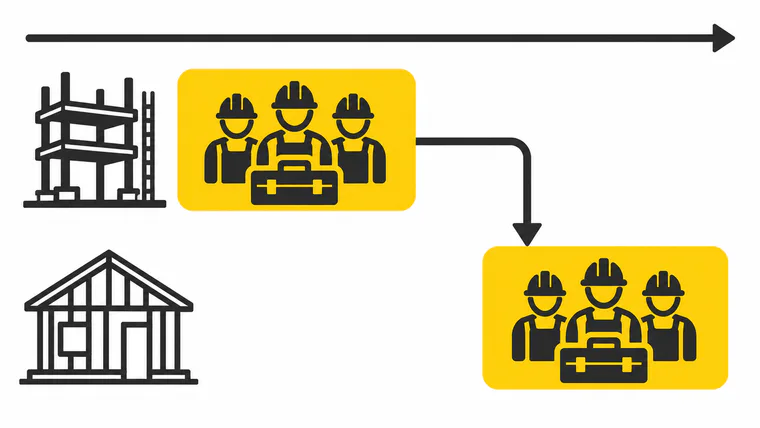
Project resources are always limited. Resource planning therefore usually involves a choice. You can keep the deadline and add capacity through a second crew, subcontracting, rented equipment, or faster delivery; keep existing capacity and move the deadline; reduce the scope; or change the construction method.
Which resources should you plan, and where do mistakes happen?
In construction and renovation, resources often mean crews. Crews matter, but they are only part of the picture. A realistic plan depends on four resource groups: people, equipment, materials, and money.
People are more than a tiling crew: their skills and roles in the process also matter. One tradesperson completes many small tasks and keeps the work moving; another works more slowly but avoids rework. These differences mean different risks, durations, and costs in the plan.
Equipment and tools are often left out of planning. A mixing station, wall chaser, plate compactor, scaffolding, or lift has limited availability. When its booking is missing from the schedule, downtime and urgent extra costs follow.
Materials are considered in terms of site readiness on a particular date: what must be delivered before work begins? This includes logistics, storage space, delivery windows, and supplies grouped by stage. Materials delivered too early obstruct work and increase the risk of damage. Late deliveries disrupt the schedule.
Money is a project resource just as people are. Contractors wait for payment, suppliers require advance payment, and staff need expense advances on time. The chain from work plan to payments to actual expenses therefore affects how many projects a company can handle simultaneously. The 101 blog explains this through project financial discipline and management accounting: accounting for income and expenses, management accounting mistakes (in Russian), and three reports for the business owner (in Russian).
Principles of resource planning
Resource planning starts with a clear work structure: what must be done, in which order, which activities can run in parallel, and which depend on approvals or deliveries. A capacity spreadsheet comes after that structure is understood.
Next come dependencies. In renovation, wiring precedes plastering, plastering precedes finishing, and finishing precedes plumbing fixture installation. In construction, the sequence includes technical preparation, concrete work, structural installation, building services, finishing, and commissioning. Until these dependencies are described, you cannot calculate staffing requirements because you do not know where people can work tomorrow.
The third principle is to reserve specific time windows for resources at each site. A crew is not simply booked for March: it is plastering from 3 to 8 March and finishing window reveals from 9 to 12 March. This level of detail is unexciting, but it reveals conflicts between sites.
The fourth principle is to distinguish estimated effort from calendar duration. Forty person-hours describes an amount of work; start and finish dates depend on working calendars, people's availability, and the sequence of operations. With an eight-hour working day, for example, one worker completes 40 person-hours in five working days. Two equally productive workers complete that amount in two and a half working days if the work can run in parallel and there is no additional coordination effort. Calendar duration may be longer because of weekends, deliveries, or necessary pauses in the construction process. Any extra coordination effort must be accounted for separately: the number of workers alone guarantees neither the deadline nor the quality.
Key rules for a workable plan
Rule 1. Keep one reliable record of resource bookings. If the site supervisor tracks capacity on a phone, the manager in a spreadsheet, and procurement in a chat, the plan exists in three versions. Decisions then rely on impressions.
Rule 2. Plan for the actual site. Real projects include rework, approval delays, failed deliveries, and unexpected events. Allow reserves of time and capacity; otherwise, the first change breaks the plan.
Rule 3. Include checkpoints in the plan. Without control dates, a plan remains an attractive arrangement of lines. Milestones are clearer: rough electrical work completed, walls accepted for painting, or a stage handed over. For an introduction to milestones and dividing work into verifiable tasks, see project management fundamentals for entrepreneurs (in Russian).
Rule 4. Record every change in terms of its resource impact. If a client adds underfloor heating, changes the tiles, or requests a wall relocation, the change creates new requirements for people, materials, time, and money. Leaving these changes out of the resource plan forces the team to catch up through overtime while the profit margin disappears.
Rule 5. Update the plan regularly. A renovation company often needs a short daily coordination meeting across sites and a weekly review of crew bookings. A construction company may use site meetings plus weekly reviews of procurement and subcontracting. Updating the plan should be a management action rather than an attempt to catch up with events.
How does it differ from other approaches?
Scheduling. A calendar schedule answers when stages should be finished. Resource planning answers what will make that schedule possible. In practice, the two work together: establish stages and dependencies, check available resources, and adjust the schedule. For the scheduling and dependency layer, see the 101 article on creating a construction schedule.
Task boards, Kanban, and task trackers. A board shows the flow of small tasks and helps you keep track of assignments. It rarely tells you whether enough people will be available next month, because tasks often have neither effort estimates nor dependency links. Kanban is useful on site; a resource plan helps the manager allocate people and subcontractors between sites. You can connect the approaches by keeping milestones and stages in the schedule and day-to-day details on the board. Read more about applying Agile and Kanban to construction in Agile in construction (in Russian).
Budgeting. A budget answers how much money you intend to spend. A resource plan answers when money is needed, and for what, to keep work moving. In a project business, this covers supplier payments, crew pay, staff expense advances, and subcontractor advances. When these flows are disconnected from the work schedule, cash shortfalls become recurring events.
Choosing one system to cover everything. In reality, a combination of tools often works better: one layer for scheduling, another for communication and documents, and another for finance and reporting. The 101 article on project management tools (in Russian) and the guide to choosing a project management system explain this approach.
Who benefits from resource planning?
Resource planning is especially useful when projects compete for shared resources:
- You have two or more sites at once and share key people, such as the site supervisor, procurement specialist, estimator, and lead tradespeople.
- Equipment or tools move between sites.
- Subcontractors are booked in sequences and time windows for ventilation, screeds, façades, or specialist work.
- Supplies have long lead times, as with windows, kitchens, building services equipment, lifts, or steel structures.
With one project, a stable team, short delivery lead times, and a mostly unchanged schedule, resource planning often becomes a formality. A calendar schedule, disciplined change management, and a clear financial picture are usually sufficient in that situation.
How can you introduce resource planning?
A common implementation mistake is trying to calculate capacity for every task and getting lost in detail. Start at the level where decisions are actually made: stages, key resources, time windows, and constraints.
A practical weekly approach looks like this:
- Choose a planning horizon: two weeks for day-to-day coordination, six to eight weeks for crew bookings, and three to six months for equipment and major deliveries.
- Describe stages and dependencies in one calendar schedule; a simple timeline is sufficient.
- Build your resource pool: crews, key specialists, equipment, and critical supplies.
- Assign resources and duration to each stage, then check for staffing and equipment conflicts.
- Introduce a change rule: assess every new requirement for its impact on time and resources.
- Set an update rhythm: brief daily coordination and a weekly capacity review.
The next question is where to keep this information so that it does not fragment into chats, notes, and spreadsheets. The 101 blog offers a practical guide to testing a system quickly and knowing what to check first: how to choose a project management system.
To connect resource planning with money, start by linking key stages to payments and actual expenses. In the 101 App, a project is organised as a financial model with income, expense categories, balances, documents, and an event history. Money becomes part of project management rather than remaining only in a bank statement.
Book a demonstration to see how this would work in your processes: the number of sites, team roles, how staff receive expense advances, how expenses and approvals are recorded, and which reports managers need. Resource planning can then support project control through figures instead of remaining a separate exercise.