

A crisis rarely arrives as a single blow. More often it brings a series of small events: leads become more expensive, deals take longer, suppliers change their terms, and customers negotiate every line item. In this situation, it helps to review how you manage money, sales and expenses in advance.
The aim of this article is simple: help you keep your business standing without panic or trying to be a hero. We will look at money, sales, the team and the rules worth revisiting when the market is unsettled.
Contents:
- What threatens a business during a crisis in 2026?
- How can you quickly see where the business is losing money?
- A 14-day crisis management plan
- Expenses: what should you cut and what should you keep?
- Revenue: how can you protect sales and margins?
- What should you do about the team and suppliers?
- How can you avoid being overwhelmed by taxes?
- How can you introduce accounting systematically?
- The owner's mindset: how can you avoid freezing decisions?
What threatens a business during a crisis in 2026?
A crisis undermines familiar assumptions. Things that previously “somehow worked out” may require management discipline: payment deadlines, accurate costs and agreements with the team.
The main threat is almost always the same: the business loses its financial rhythm. Revenue arrives later, expenses leave earlier, and the gap creates a cash shortfall. It often sounds like “everything is fine; we are just short this week”, then happens again 10 days later.
There is another threat: the owner responds only to urgent matters. Resources go into putting out daily fires, while the systematic decisions that create resilience are postponed. The 101 Blog explores this in “The 2025–2026 crisis: systematic businesses will survive” (in Russian).
To assess the danger quickly, check four signals. If two or more apply, treat crisis management as a project with deadlines and responsible people:
- payments “after completion” become more common and advances become rare;
- new orders have lower margins than old ones, although the workload is not falling;
- payables to suppliers, contractors and tax authorities grow, while receivables drag on;
- customers ask for a discount before discussing the scope of work.
How can you quickly see where the business is losing money?
Start by mapping money: where it comes from, where it goes and where it gets stuck. In a project business—construction, renovation, design, an agency or custom manufacturing—it is easier to think in projects: each site or contract is a separate financial unit.
Next, distinguish profit on paper from money in the bank. A profitable project can have a cash shortfall because of its payment schedule. An unprofitable project can keep turnover moving while consuming the team's time. The latter can become a burden.
A useful guide to project budgeting is “Project financial management: budgeting and controlling money”. It explains project balances, expense categories and planned-versus-actual tracking without spreadsheets.
If you have little data, start with the minimum: a list of active projects, three figures for each—income, expenses and balance—and an overall payment calendar for 30 days. This is enough to identify bottlenecks and make decisions without guessing.
A 14-day crisis management plan
A crisis plan works when its horizon is short and its goal clear. That goal might be to get through 90 days without losing control, preserve the team and quality, and keep margins acceptable.
Here is a two-week plan. It suits contractors, agencies, studios and any business whose money flows through projects.
- Step 1. Establish a financial “point of truth”: account balances, debts, receivables and payments due over the next 30 days.
- Step 2. Break revenue down by source: returning customers, referrals, advertising and partners. Find one source that brings in money faster than the others.
- Step 3. Freeze expenses that do not support sales or production. If an expense cannot be tied to a specific result in the next 30–60 days, it can wait.
- Step 4. Rebuild your price list: check costs, allow for increases in material and contractor prices, and set rules for advances and stages.
- Step 5. Review projects: where margins are below plan, customers delay approvals or the team is idle.
- Step 6. Agree with the team to record expenses and statuses daily. In a crisis, a week's delay in data can lead to a wrong decision.
- Step 7. Set aside one day each week for a crisis review: money, sales, risks and decisions. Without this, the plan falls apart.
For guidance on what to include in that review, read “Financial risk management”. It explains what to monitor so a risk does not become a surprise.
Expenses: what should you cut and what should you keep?
Crisis cost-cutting is often blunt: “cut everything”. It produces a short-lived effect, then harms quality and deadlines. A workable approach is to divide expenses into three baskets and examine each.
The first basket brings in money within 30–60 days: lead generation, proposals, production and quality control. Precision matters here; savings are secondary.
The second supports stability: accounting, legal compliance, key people and maintenance of critical tools. These costs often seem “hidden”, yet they keep the business from falling apart. “Hidden business expenses: where to find money” (in Russian) offers a useful guide to finding money inside processes.
The third includes things that are pleasant, habitual or good for appearances but produce no measurable result in the coming quarter. This is where the main savings potential lies.
Revenue: how can you protect sales and margins?
During a crisis, customers compare and negotiate more. “Give them a discount” seems quick, but it almost always eats into margins. The business then tries to compensate with volume, the team burns out, quality falls and returns increase.
The workable sequence is to strengthen the value of the offer first, then add flexibility. In project businesses, this usually means packaging stages, a transparent work plan, clear responsibilities and fixed rules for changes.
For consistent pricing, review pricing methods and how they relate to costs. Read “Pricing methods for project businesses during a crisis” (in Russian).
Another possible failure is seeing revenue without seeing margins by project. Money arrives and it feels as if “work is moving”, while small overruns swallow profit. Calculate margins at project level and check profitability regularly. Useful reading includes “How to calculate business profitability” and “What is margin and how does it differ from markup?”.
If revenue has fallen, start by diagnosing the causes. Often the issue is not a “dead market” but specific bottlenecks: conversion, response speed, referrals or gaps in customer contact. See “Why revenue falls and what to do about it” (in Russian).
What should you do about the team and suppliers?
In a crisis, agreements based on trust and habit break down more often. Someone delays delivery, asks for extra payment halfway through or disappears at handover. Order is needed to make decisions quickly, rather than for control's sake.
Start simply: set rules for payments, advances, completion documents and stage handovers. One standard across all projects is useful. A new site then does not require a whole new set of agreements.
If you work with many contractors and suppliers, check where money gets stuck because expenses or statuses have not been confirmed. The 101 Blog explains how to collect contractor data without a bottleneck in “Project accounting without a bottleneck” (in Russian).
How can you avoid being overwhelmed by taxes?
Legal and tax risks are sometimes met with “I'll deal with that later”. The problem is that “later” may coincide with a cash shortfall, making a fine or additional assessment critical.
For businesses in Russia: if you use the simplified tax regime based on “income minus expenses”, check which expenses are deductible. This affects the tax base and decisions about cost structure. Read “Russia's simplified tax regime: deductible expenses under income minus expenses” (in Russian).
Microbusinesses in Russia should separately review rule changes and prepare in advance. In other countries, check local requirements; Russian tax regimes do not apply there. For the Russian example, see “How a microbusiness can navigate Russia's 2026 tax reform” (in Russian).
How can you introduce accounting systematically?
A crisis makes feedback speed crucial. If project expenses and statuses arrive once a month, it is already too late to manage them. Establish a rhythm: record events on the day they happen, reconcile briefly each week and review profit monthly.
If accounting still lives in spreadsheets, that is a normal stage. The question is whether the spreadsheet provides one source of truth or every department has its “own version”. Read the 101 Blog's guide to data aggregation and a spreadsheet that works: “A tracking spreadsheet that actually works”.
As the business grows or projects multiply, moving control into an accounting system becomes more convenient. Read about treating a project as a financial unit and owner reports in the article on project budgeting, which also links to “Three main reports for a business owner” (in Russian).
To strengthen analytics and see margins and money movements without manual formulas, look at PRO+: its extended analytics helps assemble a picture of projects and the company fund faster.
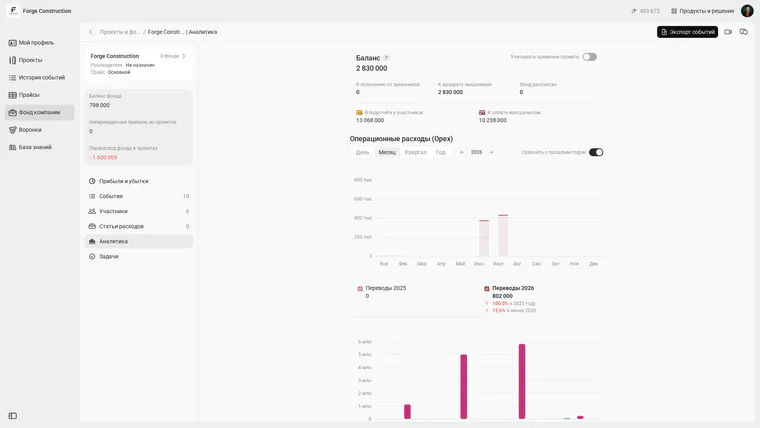
Company fund analytics in 101. The interface is in Russian; amounts belong to a demonstration example. “Balance” is a calculated settlement position, not the amount of money in bank accounts or cash.
To understand how this works in your business, discussing a case at a meeting is convenient. During a free presentation, you can discuss which reports matter first and how to check money movements in your business.
The owner's mindset: how can you avoid freezing decisions?
During a crisis, thinking easily narrows to “how do we reach the end of the month?” This is understandable, but makes management reactive. The business depends on chance: a fortunate payment, a missed transfer or a customer unexpectedly approving an estimate.
A simple technique is to separate daily and strategic decisions. Daily decisions support stability: money, payment schedules and project statuses. Weekly strategic decisions answer three questions: what earns a margin, what consumes time without a return and which risks are growing?
An honest quarterly goal also helps. Instead of “take on more sites”, “push advertising” or “save on everything”, a crisis goal is concrete: preserve margins, reduce cash shortfalls, maintain quality and stabilise sales from one key channel.
For an industry-specific perspective, read “The 2026 crisis: a contractor's plan” (in Russian) and “When will the renovation crisis end?” (in Russian). They help compare expectations and build an action plan for construction and finishing work.