

Contents:
Why a tracking spreadsheet cannot save the business
In many construction and project companies, the main management tool looks the same: a huge tracking spreadsheet in Excel or Google Sheets. Columns for project, counterparty, expense category, date, and amount, plus formulas and pivot tables, make it seem that perfecting the file will make the records work by themselves.
In practice, it works differently. Site supervisors and foremen see it as office paperwork. Receipts sit in the car’s glove box, advances are paid from cash or a card, and entries reach the spreadsheet weekly or monthly. The manager opens the file and sees figures that are already out of date. In 101 articles, we have repeatedly examined the consequences of tracking construction expenses this way.
Excel and a notebook can serve as first steps. But as projects and contractors multiply, reports become a maze of tabs. Financial decisions start to rely on guesses and messenger conversations instead of transparent figures for each project.
That is the starting point for any discussion of tracking spreadsheets: a file of formulas has value only when actual business events reach it—receipts, completion certificates, advances, payments, purchases, and finished work.
The financial director’s role without illusions
Many founders hope to solve financial disorder by hiring a finance specialist or an entire outsourced firm. It sounds reasonable: a capable person will put the numbers in order and start producing reports.
In reality, without proper data aggregation, the finance specialist spends most of their time chasing information from people on site. Once a month, they call foremen, collect receipts from chats, reconcile bank transfers with cash, and try to identify which project incurred each expense. Only a few hours remain for real analysis before the report is due.
A financial director adds value when structured events are already at hand: who paid what, when, for which project and how much; what income arrived from a client; and how much of each person’s advance remains unaccounted for. Then they can build models, calculate margins, and plan for cash shortfalls. This is the point made in 101’s materials on financial accounting of a construction company’s income and expenses (in Russian).
Without live data, the financial director becomes an expensive manual data collector. The company pays for work that could largely be automated.
What data aggregation means in a company
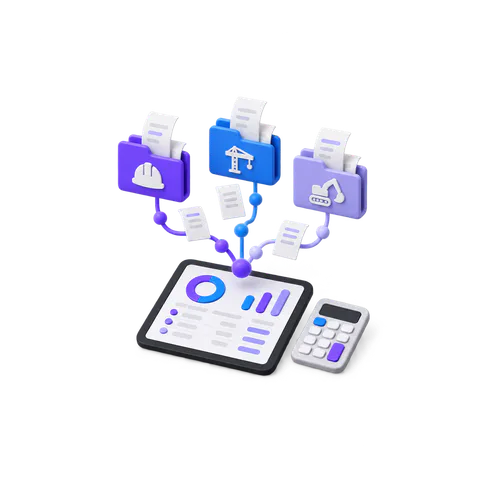
First, each real business event is recorded separately. Data aggregation then groups those records by project, category, period, or another attribute and produces summary indicators. The primary records can live in a spreadsheet, a dedicated app, or a database. What matters is that site activity enters the system promptly and appears in the summary.
In a construction or project company, the underlying records describe project events: buying materials, issuing advances to accountable staff, completing a stage of work, or receiving money from a client. In tools such as the 101 App, each event is recorded against a project, income or expense category, and counterparty.
A good data aggregator does three things at once:
- captures figures directly from the field—from the phone of a foreman, site supervisor, or procurement worker;
- links each amount to a project, category, and person immediately;
- updates analytics and tables as soon as an entry is made.
Only then does management accounting become a daily practice instead of an abstraction. We explored this further in our article on management accounting in project businesses (in Russian).
What a live tracking spreadsheet looks like
Imagine a tracking spreadsheet that actually works in real time. Instead of dozens of inconsistent tabs, it has one basic structure holding all company events. Each row has a required set of fields.
The minimum fields in a live tracking spreadsheet are:
- event date;
- event type (income, expense, transfer, advance, repayment);
- project or job site;
- counterparty (employee, contractor, supplier, or client);
- income or expense category;
- amount and currency;
- payment method (cash, card, or bank transfer);
- comment or link to the source document.
You can build any number of reports on top of this raw table: profit by project, cash movements, the company fund, contractor performance, and the return on advertising channels. In the 101 App’s PRO+ plan, such reports are assembled automatically from recorded events and show analytics for expenses, profit, margins, and the Company Fund.
The key point is that a person on site records only their own event, while summary tables and charts update automatically. Managers and finance specialists no longer have to gather numbers by hand each month; they can focus on analysis.
The combination: spreadsheet + app + finance specialist
A tracking spreadsheet, an aggregation app, and a financial director have different roles.
An app or other digital tool collects primary data: who bought what, who received an advance, how much work was completed, and which completion certificates the client signed. In the 101 App, this flow creates a clear view of each project and of advances issued to staff.
The tracking spreadsheet is a layer above that flow. It helps organize information for the owner: see profit by project, monitor which advances still need to be accounted for and when profit can be withdrawn, and plan crew capacity and investments. Our 101 articles on tracking construction expenses (in Russian) explain how systematic records reduce the risk of cash shortfalls.
In this setup, the financial director is no longer the person in charge of the spreadsheet. Their responsibility is to interpret data, plan scenarios, identify growth opportunities, set budgets, and monitor financial plans. They see cash movements in figures arriving daily, instead of piecing them together at month-end.
How to start moving toward reliable records
No tracking spreadsheet will work until the team has a simple way to put actual events into one system. Start with a clear plan.
Step 1. Decide which events you want to see in the table. At a minimum: all project expenses, all client income, all movements of advances issued to staff, and all internal company expenses (rent, advertising, and administrative salaries). Define the required fields for each group: project, counterparty, category, amount, and date.
Step 2. Choose an aggregation tool your team will actually use each day. The 101 App is one option: foremen and site supervisors report events from their phones, scan receipts, record completed work volumes, and mark which project money came from. This format suits entrepreneurs and small companies that need to see cash movements by project without complex software.
Step 3. Give the finance specialist live data. Once an app or database captures all events, they can configure tracking spreadsheets and reports for your needs: profit by project, the Company Fund, cash forecasts, and profitability by business line. In our 101 material on management accounting apps (in Russian) we examine which tasks this approach can handle.
The tracking spreadsheet then becomes a useful interface to the data, not an intimidating artifact. The finance specialist works with current figures rather than guesses and requests to “send me every receipt from the last month.”
How often should the tracking spreadsheet be updated?
Every working day is a good target. Events enter the system as they happen, through an app or form, and summary tables and reports are recalculated automatically. By the end of the week, you have a nearly accounting-level picture of transactions in a management accounting format.
Do you need a financial director if you have a good app?
The app handles data collection and initial structuring. A financial director is needed to build budgets, manage cash shortfalls, and plan growth and investments. The better the aggregation process, the less time the specialist spends gathering figures and the more effective their work becomes.
What if the team does not want to record events?
People on site need to see a personal benefit: clear advance records, transparent settlements, and no lost payments. Simple procedures, a few real examples, and training framed as “how the app saves you time” help.
How can you tell that the tracking system works?
There are two simple signs. First, in two or three minutes you can say how much money is available for each project today and where spending is over budget. Second, financial reports inform decisions: you change prices, contractor terms, or advance-payment practices based on figures rather than impressions.