
Profitability indicators are a group of financial metrics that answer one question: how much profit does each rouble of the chosen comparison base generate? The base is usually revenue, costs, assets or equity. The principle is the same: the chosen measure of profit goes in the numerator, a consistent comparison base goes in the denominator, and the result is expressed as a percentage.
Profitability is often confused with profit. Profit shows the result in roubles for a period or a project. Profitability shows the “quality” of that result: how profit relates to the scale of the work and the costs involved. Two projects can generate the same profit while one uses more resources and the other delivers the same amount with less investment.
In project-based businesses such as construction, renovation and engineering, profitability is particularly useful because revenue can grow faster than the money in the bank account. Profitability and cash availability still need to be assessed separately: increased inflows or advance payments alone do not establish a project's financial result.
Contents:
What are profitability indicators?
Profitability indicators follow one principle: the numerator contains the chosen measure of profit, and the denominator contains a consistent comparison base. Both the profit measure and the base can vary, so the indicators share a calculation principle while having different economic meanings.
Hypothetical example. Suppose a manager sees an annual profit of RUB 1,000,000. The manager then compares two projects from the overall portfolio: one generated RUB 250,000 in profit on revenue of RUB 1,500,000, while the other generated the same RUB 250,000 on revenue of RUB 3,000,000. The profit in roubles is the same, but its share of revenue differs. This is a reason to examine pricing, the scope of work and the costs included; the specific cause must be established from the underlying data, not from a percentage alone.
For these comparisons to work, agree at the outset which measure of profit you are using (contribution margin, net profit or project profit) and which base you are choosing (revenue, costs, assets or equity). For project profit and project cost, define in advance which expenses are included and apply that definition consistently to every project being compared.
Which profitability indicators are used most often?
When managing a construction company, it helps to keep several metrics at hand. They answer different questions about pricing, asset efficiency, returns on equity and the outcome of a particular project.
| Indicator | Formula | Why calculate it? |
|---|---|---|
| Net profit margin | (Net profit for the period / Revenue for the same period) × 100% | Understand how much net profit remains from each rouble of revenue |
| Return on assets (ROA) | (Net profit for the period / Average asset value over the same period) × 100% | Assess the return generated by equipment, warehouses and money in bank accounts |
| Return on equity (ROE) | (Net profit for the period / Average equity over the same period) × 100% | Assess the return on equity for the period |
| Project return on cost | (Project profit / Project cost) × 100% | Compare the return on costs for comparable projects |
| Contribution margin ratio | (Contribution margin / Revenue) × 100% | See the share of revenue available to cover fixed costs and generate profit |
The table uses net profit margin. The CFA Institute's list of financial ratios distinguishes operating margin from net profit margin. The abbreviation ROS is also used for operating return on sales, as in this learning section from The Open University; clarify which measure of profit is being used when making comparisons.
For a closer look at the reasoning, see these 101 resources: “How to calculate profitability: a formula, an example and a calculation using data from the 101 App”, along with a separate guide to assessing the profitability of a construction business.
How do you calculate profitability and choose the base?
The basic formula is: profit / base × 100% = profitability. The base depends on the question: revenue is used to assess profit as a share of sales, and cost is used to assess the return on spending; assets and equity provide a view of company efficiency beyond a single project. Use profit and revenue from the same period, and keep the definitions of profit and the method of calculating the base consistent when making comparisons.
For ROA and ROE, a simple average base for the period = (opening value + closing value) / 2; this calculation is given in OpenStax, Appendix A. If the denominator is zero, the indicator is undefined. If average equity is negative, the usual interpretation of ROE does not apply; A. Damodaran discusses this limitation in his email of 22 April 2025, section 3.2.
Hypothetical example. Suppose two site supervisors each manage five projects, and at the end of the month each has a contribution margin of RUB 300,000. The amount is the same. The manager then compares their contribution margin ratios: 28% for the first supervisor and 12% for the second. The difference is a reason to examine pricing, the scope of work and variable costs. The cause must be established from the detailed records; the percentages alone do not prove overspending or a price change.
To make the calculation useful, establish these accounting rules:
- Define the profitability indicator you are calculating—based on revenue, based on cost or the contribution margin ratio—and specify the profit measure you will use.
- Take the chosen profit measure from one set of accounting records, whether for a project or the company, and match its period to the base.
- Choose the base to suit the question: revenue to assess profit as a share of sales, cost to assess the return on spending, or equity to assess its return for the period.
- Calculate the percentage and compare it with the previous period and other projects using the same method.
Contribution margin is revenue minus variable costs. If you use this measure, the article on contribution margin explains how to calculate its share of revenue.
How do you interpret percentages and compare projects?
Profitability is interpreted through comparisons and trends. If one project delivers 12% and another 28% under the same calculation method, that is a reason to examine the terms, the estimate, the contractors and the scope of work. The figure alone does not tell you what to do or establish a specific cause for the difference, but it shows where to investigate further.
Hypothetical example. Suppose a contractor takes on a project where the client approves decisions quickly and pays on time. The work feels straightforward. If the final return on cost is lower than on a comparable standard project, it is worth examining purchases and additional site visits: overspending on these items may be one of the causes. A smooth working process does not by itself guarantee the expected financial return.
Another useful approach is to calculate several metrics together. Profitability measures efficiency, while cash availability depends on cash movements. If revenue is growing but cash is short, assess the risk of a cash flow gap and reconcile payments across projects.
Common calculation mistakes
The main mistake is mixing bases, profit measures and periods. If you use revenue as the base in one calculation and cost in another, a direct comparison of the percentages loses its meaning. Compare indicators calculated using the same method for comparable periods.
A second common problem is incomplete project expenses. Materials have been charged to the project and work has been paid for, while delivery, tool hire and small purchases have been left out. The percentage is inflated, leading to incorrect conclusions.
A third mistake is calculating profitability only for the company as a whole and ignoring individual projects. In construction, two projects may account for the overall result while the others generate revenue without a comparable outcome. It therefore helps to calculate profitability for each project first. Calculate the overall percentage for the selected group as (total profit / total corresponding base) × 100%. Do not add individual project percentages or take their simple average. When assessing the whole company, also include its general expenses under the chosen accounting method.
How to use data from the 101 App to calculate profitability
Profitability becomes easier to manage when data is collected regularly in one place. In the 101 App, you can record project inflows and expenses and view their balance. Assess the balance of inflows and recorded expenses separately from profit calculated on an accrual basis: it is not an automatic calculation of accounting profit. Profit shown in individual calculations or for individual projects does not automatically equal the net profit of the whole company either. To calculate profitability, specify the profit measure, the period and which costs are included.
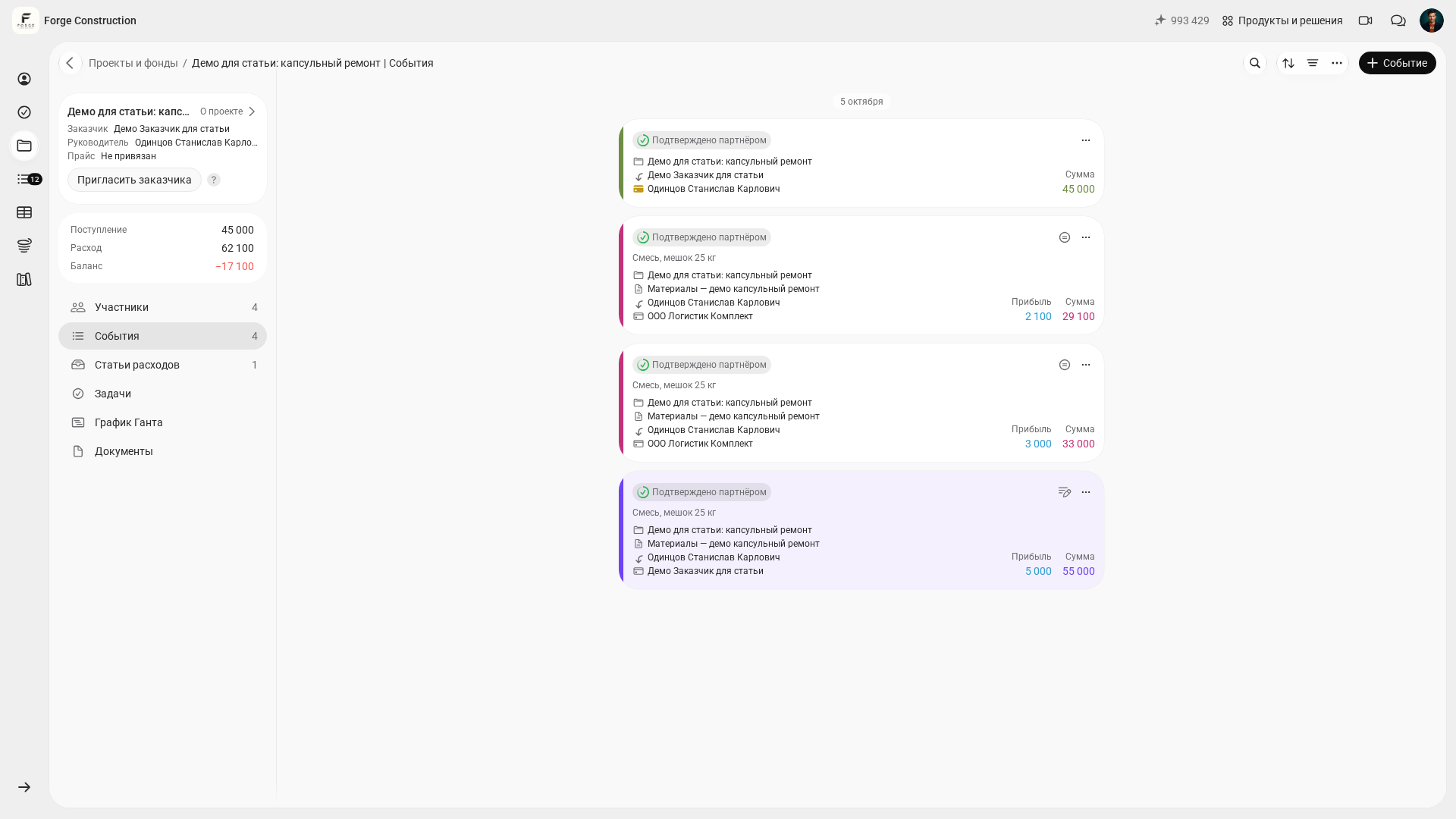
Hypothetical example. Suppose a manager has 12 projects, with payments made by card, through a business bank account and in cash. The company's overall cash position can be compiled manually, but the records for individual projects may be incomplete. Allocating financial events to the corresponding projects makes it possible to compare inflows and expenses and check that the records are complete. Assessing profitability then requires a calculation of profit and the corresponding base using the chosen method.
If you want to track several other metrics alongside profitability, see the article on key business performance indicators and the article on a business analytics system (in Russian).
To see how this would work for your projects and your accounting rules, join a free presentation of the 101 App.
If you need more extensive analytics for your company and projects, PRO+ may be useful. Its capabilities are covered in the article about the PRO+ plan (in Russian). Check the current pricing table for the specific features available with your access rights.