
Contents:
What is a revenue breakdown and why use one?
In management accounting, revenue reflects obligations fulfilled and documented through completion certificates, project milestones, or closing documents. Cash may arrive earlier as an advance or later because a client pays late; that timing does not change when the work is recognized as revenue.
A revenue breakdown answers two practical questions: what generates income, and which parts deserve further investment? Separating revenue into components reveals what is stable, what is seasonal, and what depends on a single large customer.
Consider a renovation company that also sells materials. At month end, revenue of RUB 12,000,000 looks strong. A closer look shows RUB 7,000,000 from low-markup materials and RUB 5,000,000 from labor, with labor supporting the business. Without that breakdown, advertising, hiring, and crew allocation decisions become guesswork.
What makes up revenue?
Start by defining what counts as revenue. Under the accrual method, revenue arises when an obligation is fulfilled: a milestone is completed, a completion certificate is signed, or a project is handed over. The Russian-language article What Is Revenue (in Russian) explains this approach.
Then group revenue by source. Typical sources include goods, services, rent, and licenses. In construction and renovation, services or labor are often the main source, while materials belong in a separate group.
A two-level structure makes the breakdown useful:
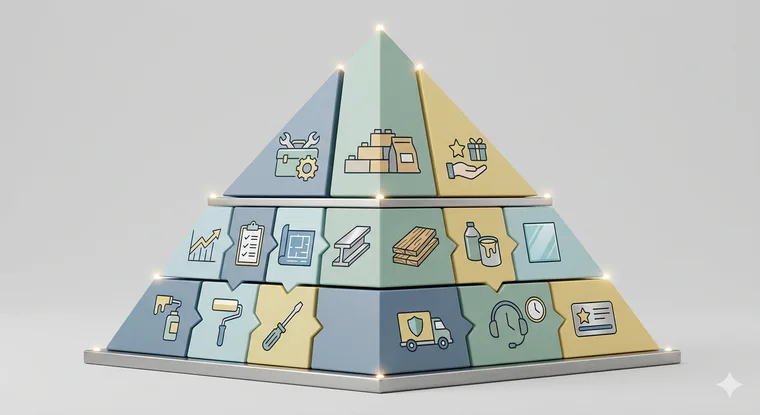
- Level 1: revenue type, such as labor, materials, additional services (design, procurement, technical supervision), and service contracts.
- Level 2: detail within each type. Split labor by type and milestone, materials by group, and additional services by package.
This gives you an overview while letting you investigate which service carried the month.
Key revenue views for management decisions
A revenue view examines the same income from a different angle. The more project-based the business, the more valuable views by project and by responsible person become.
Suppose a manager sees labor revenue growing. But one site supervisor is overloaded, another has no projects, and deadlines are slipping. A breakdown by responsible person makes that imbalance visible.
Which views should you use?
- By project or site: the basic construction view shows where revenue is earned, milestones are closed late, and extra work arises.
- By business line and product: apartments, houses, commercial properties, or individual services.
- By sales channel: advertising, referrals, partners, and repeat customers.
- By manager, site supervisor, or crew: who generates revenue, maintains quality, and faces delays.
- By customer: concentration in one customer, repeat business, and portfolio composition.
- By milestone: if revenue is recognized by milestone, this shows where handover and signatures stall.
To put revenue in a broader management context, see the Russian-language article Six Business Performance Indicators (in Russian). It explains why revenue alone is insufficient and which other measures to track.
Common revenue mistakes in construction and renovation
Mistake 1: treating cash receipts as revenue. Advances are common in construction and may fund materials and crew payments. Cash has arrived, but the corresponding obligations may still be unfinished. The Russian-language article What Is Revenue (in Russian) discusses accrual revenue and how it differs from turnover.
Mistake 2: confusing materials sold with profit earned on materials. Combining materials and labor in one line can distort the picture: turnover rises, while the underlying economics may not improve. Show materials separately and compare them with the margin on materials to understand their contribution to profit.
Mistake 3: failing to separate extra work. Additional work can materially affect project profitability. Without its own category, you cannot tell whether customers actually buy a turnkey renovation or a renovation plus a stream of additional services.
Mistake 4: analyzing revenue without costs. Revenue composition alone cannot show where money remains in the company. Review expenses by project and category alongside it. For an introduction, see How to Track Construction Expenses Properly (in Russian).
How do you build a monthly revenue breakdown?
Use these steps without introducing a complex methodology:
- Step 1. Define when revenue is recognized: at a signed completion certificate, a finished milestone, or a completed event. If you recognize it on payment, the breakdown will fluctuate with the advance-payment schedule.
- Step 2. List sources: labor, materials, and additional services. Decide whether materials will form a separate group.
- Step 3. Choose two or three main views for the first month. For construction, project, revenue type, and sales channel are usually enough.
- Step 4. Assign every revenue item to a project and a source. Unclassified items soon become an unmanageable “other” category.
- Step 5. Reconcile the breakdown with documents and the recognition rule: identify the certificate, completed milestone, or partly fulfilled obligation.
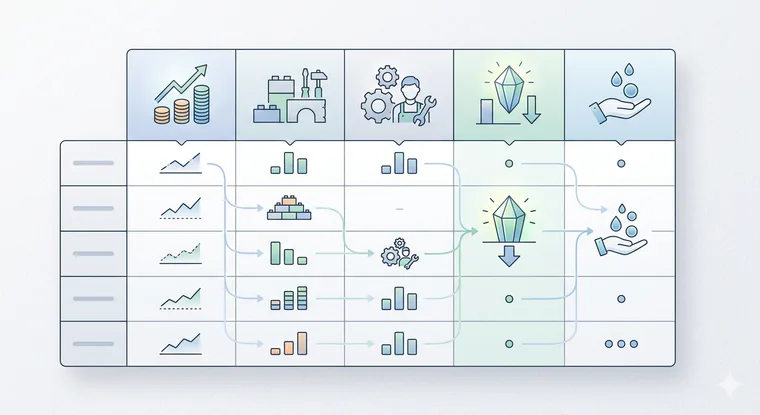
- Step 6. Build a table with projects or business lines in rows and revenue sources in columns. Put sales channels on a separate tab.
- Step 7. Choose three actions from the results: what to strengthen, reduce, or repackage as a product.
If you want to see how projects, events, and figures connect without manually joining chats and spreadsheets, attend a 101 product demonstration. It shows where revenue appears in reports.
How does revenue relate to profit, cash flow, and working capital?
The revenue breakdown belongs in the profit and loss statement (P&L): it shows how much was earned and from which activities. A cash-flow statement shows when money arrives. The balance sheet and working-capital analysis show where money is now and why it may be unavailable. The Russian-language article Three Main Reports for a Business Owner (in Russian) explains the P&L, cash flow, and balance sheet together.
Combine the breakdown with other measures to make decisions:
- Revenue breakdown and margins: knowing which sources leave money behind helps you select your product mix. See Marginal Profit (in Russian) for the underlying concept.
- Revenue breakdown and cash flow: compare projects whose work is recognized as revenue with cash shortfalls and late payments.
- Revenue breakdown and working capital: growth often requires more cash tied up in materials, crew advances, and logistics. The Russian-language article Working Capital (in Russian) explains why bank balances alone tell you little about the business's condition.
Suppose revenue grows because of large projects while the cash-flow report shows a mid-month gap. Review the payment schedule, milestone sign-offs, and advance-payment terms so growth does not strain cash.