

Contents:
Who is the client in a construction project?
The client is an individual or legal entity that initiates construction or renovation, finances it, and accepts the results. The client shapes the project requirements, selects contractors, and accepts their work.
The client may be:
- a private individual, for example when building a country house;
- a commercial organization;
- a government body, in the case of public procurement and publicly funded construction.
When drafting a contract, consider the client’s status and the purpose of the work. In Russia, the Consumer Protection Act (in Russian) defines a consumer as an individual who commissions or uses work exclusively for personal, family, household, or other purposes unrelated to business activity. A legal entity does not fall within this definition of a consumer. This affects the rules applicable to the contract; the terms also need to reflect the type of work and the applicable law.
The client’s main responsibilities in construction
Some people think the client does nothing during construction or renovation. Others believe the client must be 100% involved in every process. The client’s role is to define the goals, provide the necessary decisions and funding, and delegate specialist tasks to competent project participants.
Let us look at the client’s main responsibilities at the different stages of construction or renovation:
1. Preparation
At this stage, the client needs to establish the project concept and objective: what will be built, why, to what extent, and within what timeframe. This usually takes place outside the scope of the contract with the renovation or construction company (in Russian). While working with a designer, architect, or engineer, the client needs to decide what they want.
The client also:
- helps develop the technical brief by suggesting revisions, answering questions, and choosing from the proposed options or asking for alternative compromises;
- sets the budget and identifies funding sources, for example by taking out a loan or agreeing on staged advance payments with the main contractor (article in Russian);
- obtains the permits and other authorizations required for the particular project, with help from competent specialists or after independently understanding the requirements. In Russia, these may include a building permit or construction notification (article in Russian), an urban planning document for the site, and other documents; the required documents and procedures depend on the project and the applicable law;
- runs a tender or selects contractors, including architects, designers, and builders.
2. Organizing the construction process
Once the project starts, the client performs the following functions:
- enters into contracts with contractors and subcontractors;
- provides funding on time;
- organizes the supply of construction materials if this falls within their responsibilities;
- monitors compliance with the work schedule;
- appoints those responsible for technical supervision or engages an external organization.
These are real client responsibilities. A late payment or an unannounced delay in supplying materials can affect the work. The grounds and procedure for revising deadlines need to be assessed in light of the actual causes of the delay, the contract, and the applicable law.
3. Monitoring and accepting the work
Oversight is one of the client’s key functions:
- the client takes part in interim acceptance of construction stages;
- accepts the completed project and signs acceptance documents;
- initiates the correction of defects where necessary;
- arranges for the project to be put into operation when the applicable law requires that procedure for the particular project.
The client must participate in acceptance of the work in accordance with the contract and the applicable law. In Russia, paragraph 4 of Article 753 of the Russian Civil Code (in Russian) provides that handover and acceptance under a construction contract are documented by a certificate signed by both parties. If one party refuses to sign, the refusal is recorded in the certificate and the other party signs it alone. A court may declare a unilateral certificate invalid if it finds the reasons for refusing to sign justified. A unilateral certificate therefore requires an assessment of the circumstances; the procedure for notifying the client that work is ready is explained in our article on notice of completion and handover (in Russian).
What risks does the client bear?
As the main initiator of the project, the client bears the principal risks. A properly drafted construction contract can allocate them: for example, the contractor’s warranty obligations may cover renovation defects discovered while the property is in use. Even so, the client still faces certain risks:
Budget overruns are a common risk. You can agree on a fixed-price estimate with the contractor that covers the agreed scope of work. If the design changes during renovation, new preferences emerge, or constraints are discovered, such as defective floor screed installed by the developer, additional work and revised solutions may be needed. The cost of agreed additional work and responsibility for discovered defects are governed by the contract and the applicable law. Finding a defect does not automatically mean that the client must pay to correct it. These situations should be taken into account when planning the budget.
Construction delays. Even a conscientious contractor cannot always guarantee exact compliance with the schedule: other participants and circumstances also affect progress. If there are problems delivering materials purchased by the client or an external company, approval of layout changes is delayed, or exceptional natural or political events occur, the schedule may need to be revised. The grounds, new schedule, and each party’s responsibilities should be assessed and agreed in accordance with the contract and the applicable law.
Choosing an unreliable contractor. The client is responsible for selecting the contractor (article in Russian). If they are dissatisfied with the company’s work, they must initiate discussions, request corrections, and, where necessary, submit a formal claim before litigation or take the matter to court.
To reduce these risks, define your goals clearly from the outset, hire experienced specialists, and maintain ongoing oversight of construction progress. The 101 app can help: you can collect the team’s photo and video reports and approve reports on completed work stage by stage. The information is only as current as the reports submitted by the team. Confirming a report remotely in the app does not replace the acceptance procedures required by the contract and the law or the necessary technical inspections.
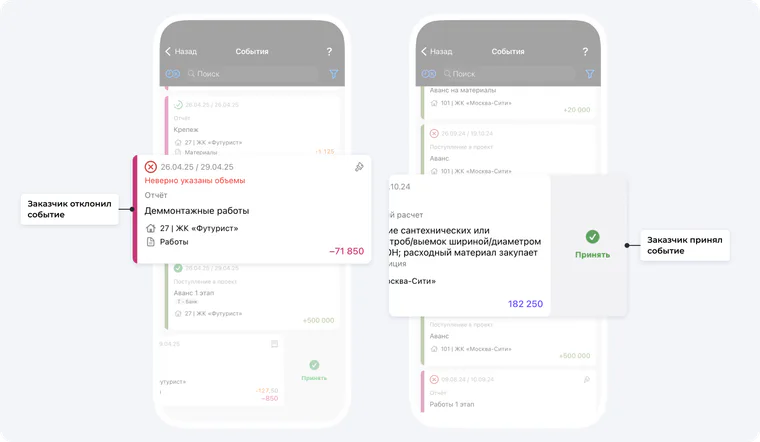
Remote reports help you follow progress between site visits. The need to visit depends on the nature of the work, the project’s condition, and the tasks involved in technical oversight. Agree with the team which issues can be handled remotely and which require an on-site inspection.