
The phrase ‘sellers are leaving WB’ comes up in conversations, chats and Telegram channels every season. Some close their seller accounts, others stop shipping, and others move their ranges to different platforms. From the outside, it looks like an exodus.
Inside the business, the picture is often different: the market is maturing, rules and fees keep changing, and product economics leave less room for mistakes. When margins are thin, a change in logistics, storage, penalties or advertising can turn selling into work that generates turnover alone.
Here we look at why sellers leave Wildberries, how to check your unit economics quickly and how to build a plan: stay, restructure or leave while limiting avoidable losses.
Contents:
- Why is sellers’ departure from Wildberries so noticeable?
- What undermines the economics of selling on WB?
- How can you tell whether to leave Wildberries or restructure?
- How can you leave Wildberries carefully: a 2–6-week plan?
- What can replace WB, and how can you avoid dependence again?
- How can you monitor profit regardless of the platform?
Why is sellers’ departure from Wildberries so noticeable?
When a platform is large, departures are always visible. One seller turns off advertising, another removes stock from the warehouse, and a third switches to seasonal products and disappears from search results. Viewed from outside, this can look like a mass departure.
Platform terms can change, and its fees and rules determine a substantial share of costs. The Russian seller portal separately explains fees, penalties and deductions, contract changes and promotion. This article discusses WB rules for the Russian seller account; they cannot automatically be applied to accounts in other countries. Before making a decision, check the current terms for your own account and contract. WB penalties and deductions (in Russian) and the procedure for changing the contract (in Russian) were checked on 2 October 2026; the update dates shown on those pages are 29 September and 1 October 2026 respectively.
When evaluating the channel, account for the costs of delivery speed and product visibility: logistics, storage, promotion and possible charges for packaging or labelling violations. A weak product listing and a small margin make the model sensitive to these costs.
What undermines the economics of selling on WB?
A typical scenario looks ordinary. A brand sells a product with a margin in rubles that seems reasonable. Sales come in during the first few weeks, and then volume needs to grow. Advertising starts, the advertising cost ratio rises, returns accumulate, and a couple of shipments are rejected because of labelling. Money keeps moving, but profit fades away.
To understand why sellers leave WB, it helps to view product economics as a collection of ‘small percentages’ that together create a substantial burden: commission, logistics, storage, reverse logistics, paid services, promotion and penalties. The seller portal explains where to find category commissions and how to calculate storage and logistics charges. WB rules (in Russian).
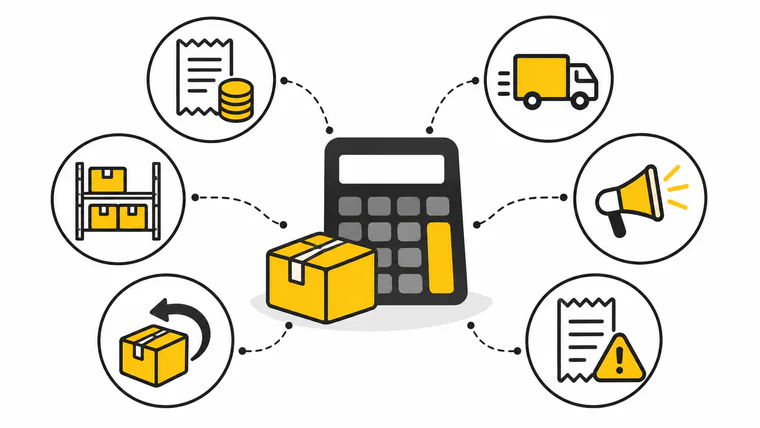
Penalties and deductions are another surprise for many sellers. WB rules list the grounds, from packaging and labelling violations to issues with shipments and product listings. They also describe arrangements that result in higher storage charges in certain situations. WB rules (in Russian).
Promotion is another cost category that is difficult to assess without figures. The advertising cost ratio, known as DRR in the Russian portal, is advertising expenditure divided by the corresponding revenue, expressed as a percentage. Include the monetary amount of advertising expenditure when calculating profit; the DRR percentage helps assess its relative weight. Check the definitions of advertising metrics and service terms in the current WB Promotion account.
How can you tell whether to leave Wildberries or restructure?
The decision ‘I am leaving Wildberries’ should rarely be emotional. It should be financial: the platform has stopped generating profit under your model, or profit remains but the risks and workload outweigh the channel’s value.
If the data has been exported and costs are collected in one place, an initial check can sometimes be completed in an evening. Discrepancies between reports or incomplete data will require more time. After that, discipline matters: calculate consistently each week and retain the same method. This is the logic of management accounting: record actual results, compare them with the plan and identify deviations. Keep the 101 blog articles on financial accounting for income and expenses and management accounting at hand.
A practical test for ‘is it time to leave WB?’ consists of three questions.
- Does every frequently sold SKU make a profit after all costs, including promotion and returns?
- Is there enough working capital to cover the interval between purchasing stock and receiving payouts? If cash-flow gaps occur regularly, the channel becomes risky. The article on working capital and the guide to avoiding cash-flow gaps can help: the underlying mechanism applies to any business that purchases goods and receives money later.
- Do you understand which rules and fees affect your model? WB’s contract rules separately describe how changes are made and when notices are published, including those concerning penalties and storage. WB rules (in Russian).
How can you leave Wildberries carefully: a 2–6-week plan?
An exit from Wildberries often runs into small operational problems: stranded stock, unclear deductions, goods ‘in transit’ and outstanding paperwork with contractors. Follow a plan and keep the objective simple: leave the channel while preserving money and goods.
The following is an example plan for when the decision has already been made. The 2–6-week interval is a planning guide, not a deadline or guarantee from WB. The actual exit depends on stock, goods in transit, returns, reconciliation of deductions and payout dates.
- Step 1. Stop expanding the product range. New SKUs add complexity to the figures and the warehouse.
- Step 2. Build a stock register: items in the warehouse, in transit, with a fulfilment provider and at home.
- Step 3. Calculate the ‘cost of exit’ separately: storage, reverse logistics, returns, advertising, penalties and packaging.
- Step 4. Reconcile the money figures: what has already been earned, what has been deducted and what will arrive as payouts. If accounting was kept in spreadsheets, organise receipts and payments using cash-flow accounting. The 101 blog has a detailed guide to fixed costs (in Russian) to help check the composition of costs.
- Step 5. Sell off stock that is not worth retrieving. Base this decision on money rather than a sense of fairness.
- Step 6. Complete the operational tasks: access permissions, roles and team procedures, so that an ‘accidental’ shipment does not restart the cycle.
If you use a model with stock held in WB’s warehouse, distinguish between two directions of returns. Under the Russian seller-account rules checked on 2 October 2026, the charge for transporting a customer return to a WB warehouse is fixed for 60 or 90 days for shipments dispatched from 15 May 2026 onwards; the period starts on the dispatch date. The categories ‘Clothing’, ‘Sportswear’, ‘Headwear’, ‘Footwear’, ‘Clothing and accessories for babies’ and ‘Underwear for newborns’ have a 90-day period; other categories have 60 days. The charge is not fixed for shipments dispatched before 15 May; after the fixed period ends, the current base rate by volume applies. Sending goods from the warehouse back to the seller is a different operation: it always uses the current rates in the ‘Cost of returning goods to the seller’ section. That separate rate is the one needed to calculate the cost of retrieving remaining stock after leaving. WB fee-fixation terms (in Russian).
What can replace WB, and how can you avoid dependence again?
When sellers leave Wildberries, they often ask ‘where next?’ There is rarely a single answer. A safer approach is to combine channels, each offering its own value: a marketplace for volume, social media for repeat sales, wholesale for stable batches and your own website for a customer base.
For a simple guide, classify channels by their role: attract, sell and retain. Plan how they will be managed from the outset: where contacts are stored, how repeat purchases are generated and how profit is calculated for each channel.
| Channel | When it fits | Main risk |
|---|---|---|
| Another marketplace | You have a product with clear economics and logistics | Dependence on platform rules repeats itself |
| Website + delivery | You need control over margins and the customer base | You need to invest in traffic and service |
| Social media and messengers | The product is bought repeatedly and communication matters | Orders and payments may become disorganised |
| Wholesale and corporate sales | You have stable production and a price list | Long sales cycles and deferred payments |
Telegram often becomes a basic tool for retention and repeat sales when the product lends itself to storytelling and content. The 101 article on using Telegram for business (in Russian) can help with channel presentation and communication.
How can you monitor profit regardless of the platform?
Leaving WB can have different causes: platform terms, the product range, logistics, risks or product economics. Irregular financial accounting makes any of them harder to assess. When fees, deductions and advertising reduce margins, sales figures and the cash balance alone are insufficient.
The system starts with three habits: record payments on the day they occur, calculate profit by SKU and channel consistently, and keep a working-capital reserve. Record receipts and payments in the cash-flow statement; calculate profit separately using revenue and the expenses attributable to it. Paying for stock or advancing money to a supplier does not by itself make that payment an expense of the corresponding period. You also need a short set of reports for the owner. The 101 blog supplements this topic with the owner’s three main reports (in Russian), setting up business analytics (in Russian) and keeping track of expenses (in Russian).
If you want an accounting setup that holds together as the business grows, attend a demonstration to see how the 101 App organises financial discipline across projects and business areas, with a transparent spending history and balance. The meeting is relaxed: we will review your cash-flow structure and show where percentages are being lost.
The Russian WB seller-account rules were checked on 2 October 2026: fees (in Russian), fee fixation (in Russian), contract changes (in Russian) and penalties and deductions (in Russian). They may change after the check: confirm the current terms for your own account before making a decision. The financial approaches are supplemented by published 101 blog articles.